Transforming Pharmaceutical Development: Combining Digital Platforms and QbD Principles


Summary
This insight explains how combining digital platforms with Quality by Design (QbD) can modernize pharmaceutical development, guided by ICH Q8–Q14. It contrasts science- and risk-based expectations with bottlenecks and data-integrity risks from paper-driven work.
Two case studies show digital workflows that standardize QTPP/CQA definition, criticality scoring, cause-effect linking, FMEA actions, and reporting, while connecting process knowledge to analytical lifecycle management (ICH Q14). The result is faster decisions, better knowledge reuse, and stronger support for compliant submissions.
Key Takeaways
-
Manual, paper-based development slows timelines, weakens knowledge reuse, and raises data-integrity and regulatory-alignment risks.
-
A single digital workflow can standardize QbD risk work: QTPP/CQA definition, criticality scoring, parameter-to-CQA mapping, FMEA, and auto-generated control strategy outputs.
-
Linking product/process knowledge to the analytical space supports ICH Q14 implementation with faster reporting, clearer collaboration, and more consistent method development decisions.
Who is this for
-
CMC (Chemistry, Manufacturing, and Controls) leaders and program managers
-
Formulation and pharmaceutical development scientists
-
Process development / MSAT engineers and scientists
-
Analytical method development and analytical lifecycle management teams
-
Quality assurance (QA), quality systems, and compliance professionals
-
Regulatory affairs and CMC submission authors/reviewers
-
CDMO development leads and technical project managers
-
Digital transformation / data governance leads in R&D and technical operations
Download your Industry Insight
Transforming Pharmaceutical Development: Combining Digital Platforms and QbD Principles
The pharmaceutical industry is undergoing a profound digital transformation, driven by the need for faster, more efficient, and compliant product development. This Industry Insight examines how integrating digital platforms with Quality by Design (QbD) principles can modernize pharmaceutical development, from early formulation through analytical lifecycle management. Drawing on ICH Q8–Q14 guidelines, it highlights the challenges of manual, paper-based processes and demonstrates how digital tools can streamline risk assessments, accelerate regulatory submissions, and improve knowledge management. By embedding digitalization throughout the development lifecycle, companies can strengthen compliance, increase agility, and accelerate innovation while fostering a culture of continuous improvement.
Introduction
The pharmaceutical industry is under increasing pressure to bring products to market faster while upholding high standards of quality, safety, and regulatory compliance. Evolving regulatory expectations — shaped by ICH Q8 through Q14 guidelines — encourage more systematic, science- and risk-based approaches to product development. However, traditional, paper-based methods often create bottlenecks that slow innovation and increase operational risks.
Digital transformation offers a powerful way to overcome these challenges. By integrating digital platforms with QbD principles, organizations can enhance process understanding, improve risk management, and accelerate regulatory submissions.
The following sections examine how digital tools can modernize pharmaceutical development by streamlining workflows and strengthening regulatory alignment. They explore current challenges and opportunities, present two case studies that demonstrate how digitalization can enhance both risk management and analytical lifecycle development, and highlight the broader benefits of digital transformation across the product lifecycle.
Pharmaceutical Development and Current Challenges
The International Council for Harmonisation (ICH) publishes quality guidelines designed to harmonize regulatory expectations for pharmaceutical products across regions. These guidelines define principles for pharmaceutical development, risk management, quality systems, and analytical procedures.
Together, they establish a systematic, science- and risk-based foundation for product development and lifecycle management.
In practice, however, many organizations continue to rely heavily on manual processes, paper-based documentation, and inefficient methods of communication and recordkeeping. These outdated practices lead to inefficiency, limited knowledge reuse, and workforce disengagement, as skilled employees spend significant time on low-value administrative tasks. As a result, development timelines lengthen, data integrity risks increase, and opportunities for proactive regulatory alignment are often missed.
The key question is: How can data and digital technologies further enhance pharmaceutical development and enable the continuous delivery of products in a faster, more efficient way?
Case Study 1: Streamlining Pharmaceutical Development through Digitalization
Quality by Design is a concept first developed by quality pioneer Dr. Joseph M. Juran, who believed that quality should be built into a product from the start and that most quality problems stem from how the product was designed in the first place. Over time, pharmaceutical QbD has evolved through the issuance of ICH Q8 (Pharmaceutical Development), ICH Q9 (Quality Risk Management), ICH Q10 (Pharmaceutical Quality System), and ICH Q11 (Development and Manufacture of Drug Substances).
Digital platforms can greatly enhance adherence to these guidelines, which emphasize a systematic approach to QbD and risk management throughout the product lifecycle.
Problem
In the biopharma division of a leading pharmaceutical company, disparate approaches were being used for risk assessments during product development. Risk assessments were lengthy, relied heavily on manual processes, and knowledge was not reused in a systematic way. These inefficiencies made it difficult to standardize practices, leverage prior assessments, and ensure consistent control strategies across development programs.
Solution
To address these challenges, the company implemented a standardized digital workflow (Figure 1) that integrated multiple risk management methods into a single, structured process.
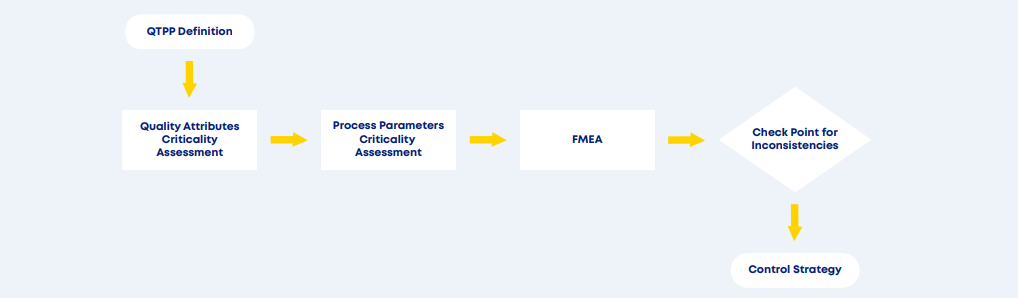
Figure 1 — QbD risk management workflow
Quality Target Product Profile (QTPP) and Critical Quality Attributes (CQAs) Definition
The process began by defining the QTPP and identifying CQAs. Attributes without predefined criticality were evaluated based on the following criteria:
- Each attribute was assigned values for its impact on product quality and the level of criticality uncertainty.
- A final score was calculated to determine the criticality of each quality attribute.
Process Parameters Criticality Assignment
The next step involved linking process parameters to the defined CQAs through a cause-effect matrix. This matrix assessed how each process parameter affected specific attributes, enabling structured and transparent criticality assessments for each parameter.
Product Risk Assessment
In later development stages, a product risk assessment was conducted using the tools applied in previous steps. This approach made it possible to evaluate risks and pinpoint specific areas that required additional attention during the Failure Mode and Effects Analysis (FMEA) process. Mitigation actions were then incorporated to reduce risks to acceptable levels.
Criticality Revision and Control Strategy Development
Digital tools can help identify inconsistencies by compiling a list of inputs along with their respective criticalities. This list became a focal point for revising assigned criticalities based on the risk assessment results. Finally, the control strategy was compiled automatically using the information entered during the risk assessment process.
Value
- Facilitated regulatory compliance: By demonstrating a thorough understanding of product and process risks, the company strengthened regulatory submissions, reduced the likelihood of regulatory hurdles, and expedited approval timelines.
- Accelerated development timelines: By streamlining risk assessment activities and optimizing experimental design, the team shortened development timelines and accelerated the creation of robust control strategies.
- Enhanced knowledge sharing: By storing quality risk management information for each product on a single platform, the company reduced knowledge loss and avoided unnecessary rework.
- Expedited reporting: Automated generation of key documents, such as CQA assessment reports and control strategy summaries, helped avoid delays in CMC regulatory submissions.
Case Study 2: Accelerating the Implementation of ICH Q14 with a Digital Platform
The ICH Q14 guideline delineates science- and risk-based approaches for the development and lifecycle management of analytical procedures. It aligns with the principles set out in ICH Q8 and Q9, promoting a systematic methodology and emphasizing the importance of risk management.
Problem
A contract development and manufacturing organization (CDMO) sought to implement a digital solution that effectively integrated QbD principles and risk management across all stages of the development process, from identifying CQAs to establishing an Analytical Target Profile (ATP).
Solution
The proposed workflow integrated information from both product and process knowledge and linked it with the analytical space (Figure 2).
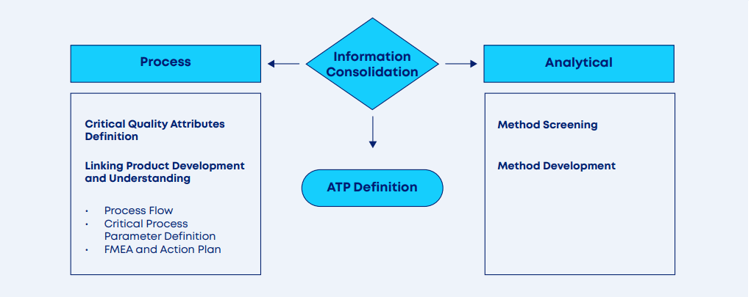
Figure 2 — Connection between process and analytical workflow.
Critical Quality Attributes Definition
The first step involved gathering a list of quality attributes, each evaluated for criticality using specific criteria. This assessment employed a scoring process that factored in impact and uncertainty, establishing the groundwork for subsequent phases of the strategic workflow.
Linking Product Development to Process Understanding
Next, the strategy focused on understanding the criticality associated with the process parameters and identifying potential failure modes. This stage also involved integrating the required mitigations to address identified risks.
Information Consolidation
The third phase consolidated all previously generated information to facilitate the definition of the ATP.
Analytical Workflow Establishment
Finally, the complete list of attributes was used to select the most appropriate analytical technologies for each quality attribute. Method parameters were then developed, and their criticality was determined, finalizing the analytical workflow.
Value
- Automated routine tasks: By automating routine activities, the company reduced manual effort and accelerated decision-making.
- Enhanced communication and collaboration: By providing a dynamic, cloud-based platform, diverse teams involved in product and analytical method development gained real-time access to risk assessments, increasing transparency and promoting a collective approach to issue resolution.
- Improved reporting: By using configurable templates, the organization generated reports more quickly and tailored them to specific requirements, enabling timely and efficient communication.
Conclusion
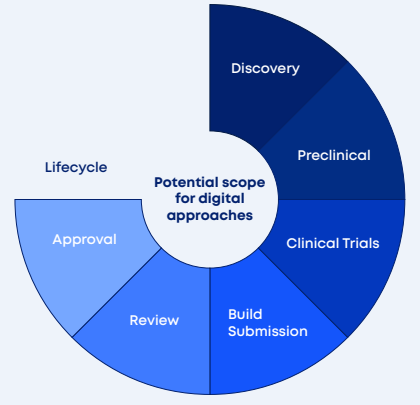
Innovative digital technologies have the potential to transform the pharmaceutical sector and can be applied across all stages of the product lifecycle (Figure 3).
Regulatory bodies are increasingly recognizing the importance of cloud-based approaches in their technology strategies. For example, recent FDA initiatives, although primarily focused on regulatory submissions and approvals, reflect a broader industry shift toward digitalization.
This transformation begins by questioning traditional approaches, practices, and business models. By embracing digital technologies, organizations can significantly improve the agility, efficiency, flexibility, and quality of production within the pharmaceutical industry.
Implementing digital platforms can deliver a wide range of benefits, including:
- Enhanced information accessibility and organization
- Improved decision-making
- A culture of continuous improvement
- Stronger data integrity
- Enhanced reporting
Integrating digital platforms enables proactive compliance management and continuous improvement. Digitalization centralizes and structures data, enables real-time reporting, and enhances product and process understanding. Embracing these strategies not only ensures regulatory adherence but also fosters a culture of innovation and operational excellence.
References
-
Singh, J. (2015). International Conference on harmonization of technical requirements for registration of pharmaceuticals for human use. Journal of Pharmacology and Pharmacotherapeutics, 6(3), 185–187. https://journals.sagepub.com/doi/10.4103/0976-500X.162004 (access required)
-
ICH. (2012). ICH guideline Q11: Development and manufacture of drug substances (chemical entities and biotechnological/biological entities). www.ich.org
-
ICH. (2023). ICH guideline Q14: Analytical produced development. www.ich.org
-
ICH. (2008). ICH guideline Q10: Pharmaceutical quality system. www.ich.org
-
ICH. (2009). ICH guideline Q8(R2): Pharmaceutical development. www.ich.org
-
ICH. (2023). ICH guideline Q9(R1): Quality risk management. www.ich.org
-
Finelli, L. A., & Narasimhan, V. (2020). Leading a digital transformation in the pharmaceutical industry: reimagining the way we work in global drug development. Clinical Pharmacology and Therapeutics, 108(4), 756–761. https://doi.org/10.1002/cpt.1850
-
Yu, L. X., Amidon, G., Khan, M. A., Hoag, S. W., Polli, J., Raju, G. K., & Woodcock, J. (2014). Understanding pharmaceutical quality by design. AAPS Journal, 16(4), 771–783. https://doi.org/10.1208/s12248-014-9598-3 (access required)
-
Khalil, R., Macdonald, J. C., Gustafson, A., Aljuburi, L., Bisordi, F., & Beakes-Read, G. (2023). Walking the talk in digital transformation of regulatory review. Frontiers in Medicine, 10. https://doi.org/10.3389/fmed.2023.1233142
-
Teguh, M. J., & Noermijati, N. (n.d.). The role of digital innovation in transforming pharma to the next normal during the COVID-19 pandemic: a systematic review. https://doi.org/10.5281/zenodo.7446169
Table of Contents


