Technology Transfer Readiness Signals: Why Transfer Problems Often Begin Long Before Transfer Starts


Part of: CMC Development
Summary
Technology transfer problems may surface during execution even when their causes began earlier in development, scale-up, risk assessment, or control strategy design.
Readiness depends on usable process knowledge, visible and owned risks, justified controls, and shared understanding across functions. Document completion alone does not show that a receiving unit can reproduce and sustain the process.
Key takeaways
-
Early readiness signals fall into four areas: process knowledge maturity, risk visibility and ownership, control strategy robustness, and cross-functional alignment.
-
Knowledge readiness goes beyond having approved transfer documents. The receiving unit also needs traceable rationale, current risks, justified controls, and usable development knowledge.
-
Connected digital approaches can make development evidence, risks, control strategies, validation evidence, and lifecycle decisions easier to trace and apply during transfer.
Who is this for
-
Director or Head of Manufacturing Science and Technology (MSAT) — process understanding, scale-up, and transfer readiness
-
Director of Manufacturing — receiving-site execution and process reproducibility
-
VP of Quality/QA — quality oversight, risk management, and control strategy
-
VP of Engineering / Facilities — equipment, utilities, facility fit, and scale-up assumptions
-
VP of Validation / CQV — process validation, PPQ preparation, and transfer execution
-
VP of Regulatory Affairs / Compliance — comparability, filing commitments, and change management
-
Program Manager / Program Lead — cross-functional milestones, risks, and readiness decisions
Download your Industry Insight
Technology Transfer
Readiness Signals:
Why Transfer Problems Often Begin
Long Before Transfer Starts
Abstract
Technology transfer is often treated as a discrete execution phase: a structured
handoff of process, analytical, manufacturing, quality, and regulatory information
from a sending unit to a receiving unit. Yet many problems that surface during
transfer may originate much earlier in the product lifecycle, including unexpected
process variability, analytical method issues, incomplete facility fit, unresolved scaleup
assumptions, unclear control strategy rationale, or late-stage validation concerns.
Traditional readiness assessments may confirm that required documents, protocols,
and milestones are complete without revealing whether process knowledge is
mature, risks are visible, and the receiving organization can reproduce the intended
process under real manufacturing conditions. Technology transfer success depends
not on document completeness alone, but also on the quality, continuity, and
usability of process knowledge across development, scale-up, validation, and
commercial manufacturing.
This Industry Insight examines technology transfer readiness through a broader
lifecycle lens, focusing on four signals that can indicate potential readiness gaps
earlier: process knowledge maturity, risk visibility and ownership, control strategy
robustness, and cross-functional alignment. It also explores the distinction between
document readiness and knowledge readiness and how connected digital
approaches can help make lifecycle
Introduction
Technology transfer is commonly defined as the movement of manufacturing
processes, analytical procedures, product knowledge, and related capabilities from
one organization, site, or lifecycle stage to another. Guidance from the World Health
Organization (WHO, 2022) addresses activities needed to conduct successful intra-site or
inter-site transfers, including active pharmaceutical ingredients (APIs), finished dosage
forms, and analytical transfer. PDA Technical Report No. 65 similarly positions technology
transfer as a standardized, cross-functional process supported by coordinated activities
and deliverables that help enable operational readiness and, where applicable,
regulatory approval (Parenteral Drug Association [PDA], 2022).
In practice, however, technology transfer is more than a handoff. It tests whether
accumulated process knowledge can be interpreted, applied, and controlled in a new
environment. What must be transferred is not only a process description, batch record,
analytical method, or validation package, but also the scientific rationale behind
how and why the process is expected to perform. When that rationale is incomplete,
fragmented, or poorly connected to risk and control strategy decisions, readiness gaps
may not become apparent until engineering runs, process performance qualification
(PPQ) preparation, method transfer, or routine manufacturing. The immediate problem
may surface during technology transfer, but its root cause may trace back to gaps in
process understanding, knowledge management, risk identification, or control strategy
development much earlier in the lifecycle.
This creates a fundamental challenge for transfer readiness: How can organizations
identify those weaknesses before formal transfer execution exposes them? A lifecycle
approach requires looking beyond whether the expected transfer package is complete
and evaluating whether the knowledge, risk understanding, controls, and organizational
alignment needed to reproduce the process are sufficiently mature.
Why Traditional Readiness Checks Can Miss Early Signals
Many organizations assess technology transfer readiness using milestone-based or document-centric
checklists. These tools are useful and necessary, but they can create a false sense of readiness when they
primarily verify whether documents exist rather than whether the underlying scientific and operational
knowledge is sufficient.
This limitation can be compounded when development knowledge is fragmented across reports, spreadsheets,
presentations, and individual subject matter experts. Although the required deliverables may exist, critical
relationships among critical quality attributes (CQAs), critical process parameters (CPPs), critical material
attributes (CMAs), risks, development rationale, and control strategy elements may remain difficult to trace and reuse
during technology transfer activities. As a result, process assumptions, unresolved uncertainties, or gaps in scientific
understanding may not become apparent until scale-up, process validation, or transfer execution (Figure 1).
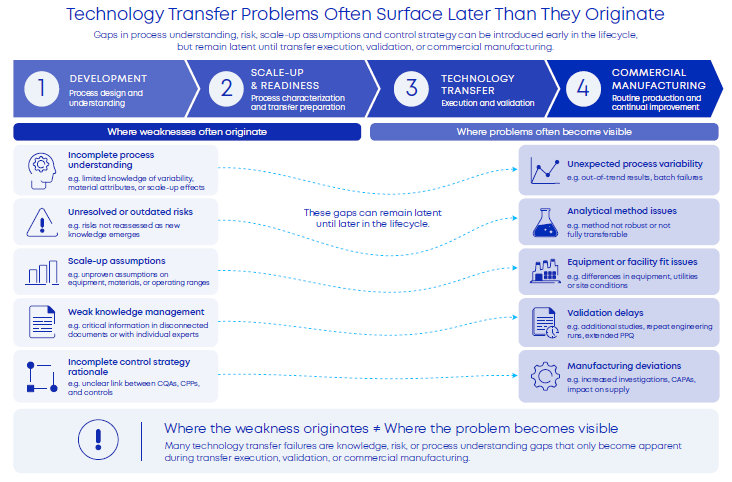
Figure 1. Where Technology Transfer Problems Begin — and Where They Surface
For example, a development report may document ranges evaluated during laboratory studies without clearly
distinguishing proven acceptable ranges from exploratory ranges. A process risk assessment may exist but may
not reflect later scale-up observations or site-specific equipment differences. A control strategy may list CPPs
and CQAs without explaining why certain parameters are tightly controlled while others are monitored only
periodically.
These examples also highlight the importance of knowledge management. When development
knowledge is treated primarily as information to be stored and retrieved rather than as connected process
understanding, critical context and decision rationale may be difficult to trace and apply during transfer.
These gaps can become more consequential when the receiving unit attempts to execute the process
under different equipment, materials, utilities, staffing, environmental conditions, or scheduling constraints.
The ICH Q8/Q9/Q10 framework provides a useful lens for this problem because it connects pharmaceutical
development, quality risk management, and the pharmaceutical quality system as interacting elements
that support science- and risk-based product and process development, successful technology transfer, and
continual improvement across the lifecycle (International Council for Harmonisation of Technical Requirements for
Pharmaceuticals for Human Use [ICH], 2008, 2009, 2023).
Readiness therefore should not be limited to whether predefined transfer documents are complete. It should also assess whether the knowledge captured in those documents is current, traceable, risk-informed, and actionable by the receiving site.
The Readiness Signals That Matter Earlier in the Lifecycle
A more mature approach to transfer readiness looks for signals that appear before formal transfer
execution begins. These signals extend beyond missing documents to indicators that process understanding,
risk management, control strategy, and cross-functional alignment may not yet be strong enough to support
robust transfer (Figure 2).
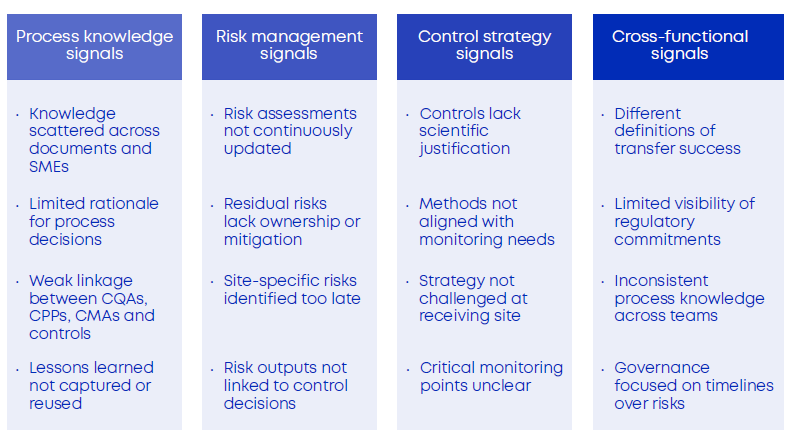
Figure 2. Four Early Readiness Signals
Process Knowledge Maturity
The first signal is the maturity of process knowledge. The U.S. Food and Drug Administration’s (FDA) process
validation guidance describes process validation as a lifecycle activity involving the collection and evaluation of
data from process design through commercial production to establish scientific evidence that a process can
consistently deliver quality product. This lifecycle view implies that knowledge generated during development and
scale-up must be sufficient to define, qualify, and monitor the commercial process (FDA, 2011).
For technology transfer, process knowledge maturity includes more than knowing the nominal operating
parameters. It includes understanding sources of variability, material attribute sensitivity, scale-dependent
effects, equipment constraints, process hold times, analytical method capability, and the relationship
between process parameters and CQAs. From a readiness perspective, it also includes the ability to trace
development decisions back to the experimental evidence, risk assessments, and process characterization work that
justified them.
When process knowledge exists primarily as tacit knowledge or is distributed across disconnected systems,
technology transfer teams often spend significant effort reconstructing the rationale behind key decisions rather
than focusing on process performance and operational readiness.
Risk Visibility and Risk Ownership
The second signal is risk visibility. Technology transfer often fails when risks are documented but not actively owned,
updated, or connected to execution decisions. WHO technology transfer guidance addresses due diligence
and gap analysis, organization and management, quality management and quality risk management (QRM),
documentation, qualification and validation, lifecycle approaches, and defined transfer phases (WHO, 2022).
PDA TR 65 also provides a matrixed reference guide to technology transfer activities and deliverables that can
help coordinate cross-functional work toward operational readiness (PDA, 2022).
A risk assessment that remains static after early development is unlikely to reflect the real transfer context.
Risks can change as the process moves from laboratory to pilot scale, from pilot to commercial scale, or from one
facility platform to another.
For biologics and advanced modalities, risks may also emerge from raw material variability, cell culture performance,
contamination control, single-use system configuration, analytical comparability, or cold-chain dependencies. For
small molecules, risks may relate to crystallization, impurity control, mixing, heat transfer, drying endpoint, cleaning,
containment, or equipment train differences.
ICH Q9(R1) reinforces the importance of quality risk management as part of science-based decision-making
(ICH, 2023), while ICH Q8/Q9/Q10 training materials show how risk-based decision-making should begin during
development and continue throughout the product lifecycle (ICH, 2024). A practical readiness signal is whether
risks are connected to owners, controls, acceptance criteria, transfer activities, and residual risk decisions.
A key readiness question is therefore: Can the receiving unit understand
not only what to do, but why the process is designed and controlled in
a particular way?
Control Strategy Robustness
The third signal is control strategy robustness. A control strategy is often transferred as part of the technical
package, but the key question is whether it is justified by process understanding and suitable for the receiving
context. The International Society for Pharmaceutical Engineering’s (ISPE, 2018) technology transfer guide
highlights alignment with QbD principles such as QTPP, CQAs, CPPs, material attributes, design space where
applicable, and especially control strategy.
A weak control strategy may pass document review but struggle during execution. Digital QbD frameworks
can support stronger control strategies by maintaining explicit traceability among product quality requirements,
process understanding, risk assessments, development studies, process characterization activities, and lifecycle
knowledge (Santos, 2025). This traceability can improve transfer effectiveness because receiving organizations
can better understand the scientific rationale underpinning each control mechanism.
For example, if upstream variability is not clearly linked to downstream impact, the receiving unit may not know
when to intervene. If analytical method variability is not fully characterized, apparent process variation
may be misinterpreted. If scale-up assumptions are not documented, site-specific differences may lead to
unplanned deviations or repeated engineering interventions.
The European Medicines Agency’s (EMA, 2016) guidance for biotechnology-derived active substances includes
process characterization, process evaluation, process verification, and ongoing process verification during
the lifecycle. These expectations reinforce the idea that control strategy is not a static list of tests and parameters;
it is a lifecycle mechanism for maintaining process performance and product quality.
Cross-Functional Alignment
The fourth signal is cross-functional alignment. Technology transfer spans development, manufacturing
science and technology (MSAT), manufacturing, quality, engineering, regulatory, supply chain, analytical,
validation, and sometimes external partners. PDA TR 65 emphasizes cross-functional roles, project management,
management oversight, transfer charters, success factors, and deliverables across initiation and execution stages.
WHO technology transfer guidance similarly includes organization and management as a core element of
successful transfer.
Misalignment can occur when functions interpret readiness differently. Development may consider
the process ready once characterization studies are complete. Manufacturing may define readiness as
equipment availability and trained operators. Quality may focus on validation, deviation prevention, and inspection
readiness. Regulatory may focus on comparability, filing commitments, and change management.
BioPhorum’s benchmarking and best-practice work also highlights the importance of common terminology
between transferring and receiving organizations, as well as the need to define robust business processes and
critical milestones for biopharmaceutical technology transfer (Abraham et al., 2015). Transfer readiness can
be weakened when development, MSAT, manufacturing, quality, analytical, and regulatory teams use different
language for the same technical concepts or interpret milestones differently. A shared vocabulary and milestone
model can help teams distinguish between document completion, knowledge maturity, operational readiness,
and residual risk acceptance.
Cross-functional alignment becomes significantly more effective when all stakeholders operate from a common
source of truth.
Moving from Document Readiness to Knowledge Readiness
A more effective readiness model should complement document readiness with knowledge readiness (Figure
3). Document readiness asks: Do we have the required deliverables? Knowledge readiness asks: Is the process
sufficiently understood, risk-assessed, controlled, and transferable?
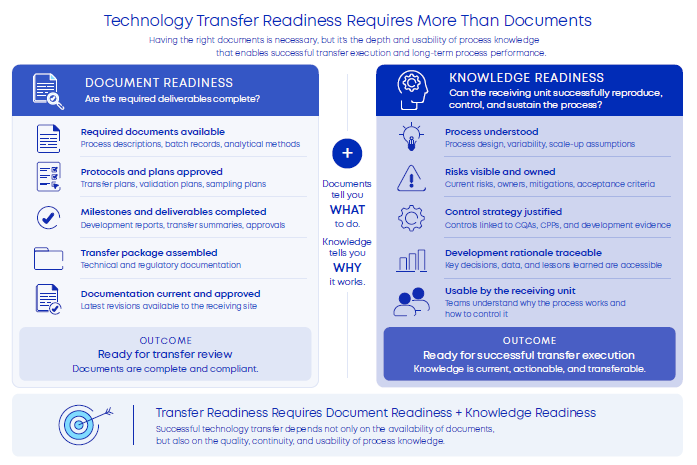
Figure 3. Document Readiness and Knowledge Readiness
This distinction aligns with industry guidance emphasizing knowledge management as an important component
of effective technology transfer. It also reinforces the need to preserve and transfer the process knowledge
and rationale required by both sending and receiving units. ISPE recognizes knowledge management as a
critical component of effective technology transfer and emphasizes the importance of quality culture in both
sending and receiving units, with specific tools that can be used for a structured technology transfer process
depending on the type and complexity (ISPE, 2018).
A knowledge-readiness assessment may include questions such as:
• Are CQAs, CPPs, CMAs, and process parameters
clearly linked to development evidence and risk
assessments?
• Are scale-up assumptions documented and tested
against receiving-site equipment and operating
ranges?
• Are unresolved risks visible, owned, and connected to
mitigation plans?
• Is the control strategy justified by process
understanding and suitable for the receiving site?
• Are analytical methods robust, transferable, and
aligned with manufacturing decision needs?
• Are prior deviations, lessons learned, and process
history available in a usable form?
• Is there a shared understanding of acceptance
criteria, comparability expectations, and escalation
triggers?
These questions shift readiness from a static checklist toward a dynamic evaluation of whether the organization
can reproduce, monitor, and improve the process across sites and lifecycle stages.
Implications for Small Molecules, Biologics, and Complex Modalities
The core principles of technology transfer readiness apply across small and large molecules, but the
risk profile differs by modality and process type. For biopharmaceutical products, this distinction can be
particularly important because process performance may depend heavily on accumulated operational experience
and tacit process knowledge.
Biopharmaceutical transfer is the movement of both knowledge and experience, not simply formal
documentation. This reinforces the need for readiness models that capture practical manufacturing insight,
analytical experience, facility-fit assumptions, process characterization outcomes, and lessons learned from
development and scale-up.
PDA TR 65 addresses technology transfer activities across small- and large-molecule drug substances, biologics,
sterile and nonsterile drug products, and biological products. Across these modalities, the specific risks
and controls may differ, but the fundamental readiness question remains whether the receiving unit can maintain
a state of control in its actual operating environment.
That requires more than technical package delivery; it requires structured knowledge transfer, active risk
management, and control strategy continuity.
Digital Knowledge, AI, and Pharma 4.0 as Enablers of Technology Transfer Readiness
As product portfolios, supply networks, and manufacturing technologies become more complex,
organizations increasingly need structured approaches to preserve and use process knowledge. Fragmented
spreadsheets, disconnected systems, and inconsistent knowledge management practices can limit visibility into
readiness risks and make transfer execution more difficult.
The challenge is not simply the volume of information generated during development, but the ability to preserve
relationships among process knowledge, development history, risk assessments, control strategy elements,
validation evidence, lifecycle changes, and site-specific decisions.
Digital QbD frameworks can help address this challenge by connecting information that might otherwise remain
distributed across risk assessments, control strategies, development reports, and process characterization
studies. A connected knowledge environment can make information more searchable, traceable, and reusable
throughout the product lifecycle.
Artificial intelligence can further support knowledge readiness by helping organizations surface relevant
information, identify relationships within large volumes of development and manufacturing data, and detect
potential gaps or emerging risks. These capabilities may help transfer teams access development rationale,
process history, study outcomes, and lifecycle decisions when evaluating readiness or planning transfer activities.
When process knowledge, risk, and control strategy information are connected, readiness assessments can
move beyond verifying whether documentation exists toward evaluating whether decisions remain supported by current process understanding and lifecycle evidence.
Modern Pharma 4.0 approaches also provide opportunities to strengthen risk visibility through
structured data management, AI-enabled analytics, and continuous monitoring (Santos, 2024). Rather than
being treated as static development deliverables, risk assessments can become living elements of the product
lifecycle that evolve as additional manufacturing and process knowledge becomes available. Advanced digital
tools may further strengthen control strategies through real-time monitoring, predictive analytics, and datadriven
decision-making capabilities, helping organizations maintain process performance across sites and
throughout commercial operations.
Conclusion
Technology transfer problems often surface during execution, but the conditions that create
them may develop much earlier. Gaps in process understanding, risk visibility, control strategy,
or cross-functional alignment can remain hidden until the receiving organization attempts to
reproduce the process under different operating conditions.
A lifecycle approach to readiness looks beyond whether the expected transfer package is
complete. It considers whether process knowledge is sufficiently mature, risks are visible and
actively managed, control strategies are understood and justified, and teams share a common
understanding of what readiness requires. In this sense, transfer readiness depends not only
on document readiness, but also on knowledge readiness.
As products, processes, and manufacturing networks become more complex, preserving
that knowledge across lifecycle stages becomes increasingly important. Connected digital
approaches can help organizations maintain relationships among development evidence, risk
assessments, control strategies, validation evidence, and lifecycle decisions, making critical
knowledge easier to trace and apply when transfer decisions are made.
Ultimately, earlier visibility into readiness signals can help organizations identify potential
weaknesses before formal transfer execution exposes them. The goal is not simply to transfer
information, but to ensure that the receiving organization has the knowledge, context, and
controls needed to reproduce and sustain the process.
References
Abraham, S., Bain, D., Bowers, J., Kenty, H., Larivee, V., Leira, F., Xie, J., & Tsang, J. (2015). Overview of best practices for
biopharmaceutical technology transfers. PDA Journal of Pharmaceutical Science and Technology, 69(5), 645–649.
https://doi.org/10.5731/pdajpst.2015.01086
European Medicines Agency. (2016). Guideline on process validation for the manufacture of biotechnology-derived active
substances and data to be provided in the regulatory submission.
https://www.ema.europa.eu/en/scientific-guidelines/process-validation-manufacture-biotechnology-derived-activesubstances-
data-be-provided-regulatory-submission
International Council for Harmonisation of Technical Requirements for Pharmaceuticals for Human Use. (2008).
ICH Q10: Pharmaceutical quality system. https://database.ich.org/sites/default/files/Q10%20Guideline.pdf
International Council for Harmonisation of Technical Requirements for Pharmaceuticals for Human Use. (2009).
ICH Q8(R2): Pharmaceutical development. https://database.ich.org/sites/default/files/Q8%28R2%29%20Guideline.pdf
International Council for Harmonisation of Technical Requirements for Pharmaceuticals for Human Use. (2023).
ICH Q9(R1): Quality risk management. https://database.ich.org/sites/default/files/ICH_Q9%28R1%29_Guideline_Step4_2025_0115_0.pdf
International Council for Harmonisation of Technical Requirements for Pharmaceuticals for Human Use. (2024).
ICH Q8/Q9/Q10 training material [Training materials]. https://www.ich.org/page/quality-guidelines
International Society for Pharmaceutical Engineering. (2018). ISPE good practice guide: Technology transfer (3rd ed.).
https://ispe.org/publications/guidance-documents/good-practice-guide-technology-transfer-3rd-edition
Parenteral Drug Association. (2022). Technical report No. 65 (revised 2022): Technology transfer.
https://www.pda.org/bookstore/product-detail/6680-tr-65-revised-technology-transfer
Santos, S. (2024, August 22). A digital toolbox for effective tech transfer in pharma. ValGenesis.
https://www.valgenesis.com/blog/a-toolbox-for-effective-tech-transfer
Santos, S. (2025, December 4). Digitalizing QbD frameworks: Setting tech transfers up for success. ValGenesis.
https://www.valgenesis.com/blog/digitalizing-qbd-frameworks-setting-tech-transfers-up-for-success
U.S. Food and Drug Administration. (2011). Process validation: General principles and practices [Guidance for industry].
https://www.fda.gov/regulatory-information/search-fda-guidance-documents/process-validation-general-principles-andpractices
World Health Organization. (2022). WHO guidelines on technology transfer in pharmaceutical manufacturing (WHO Technical
Report Series No. 1044, Annex 4). https://www.who.int/publications/m/item/trs1044-annex4
Table of Contents


