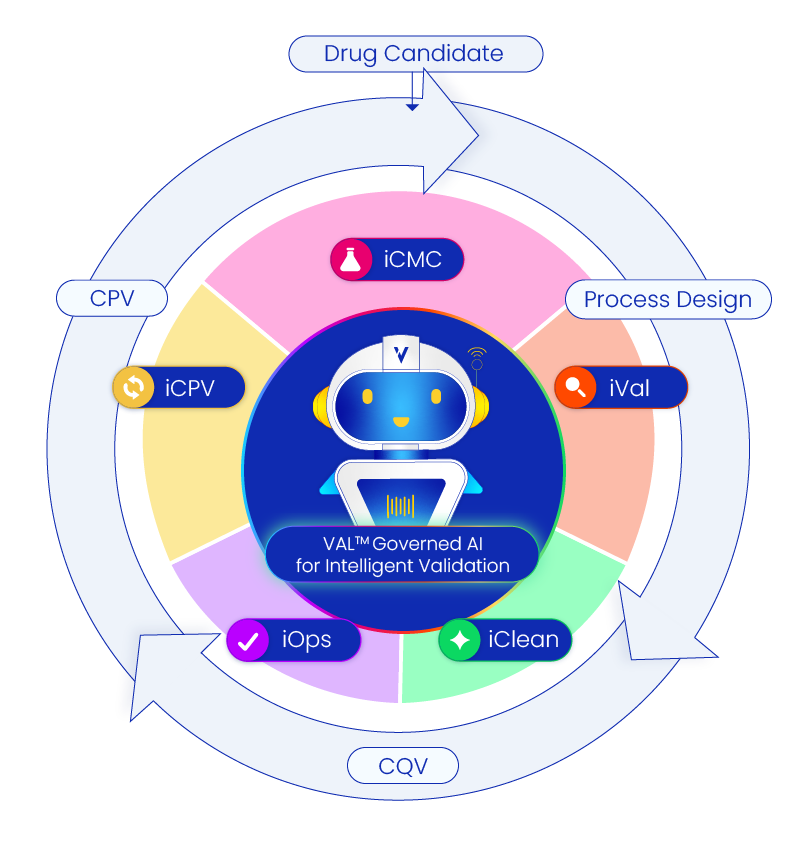
AI-Native GxP Validation for Faster Product Readiness
VALTM is the ValGenesis AI agent for life sciences organizations, putting connected GxP data and knowledge to work through governed AI to support right-first-time validation, uncover issues earlier, and accelerate product readiness.
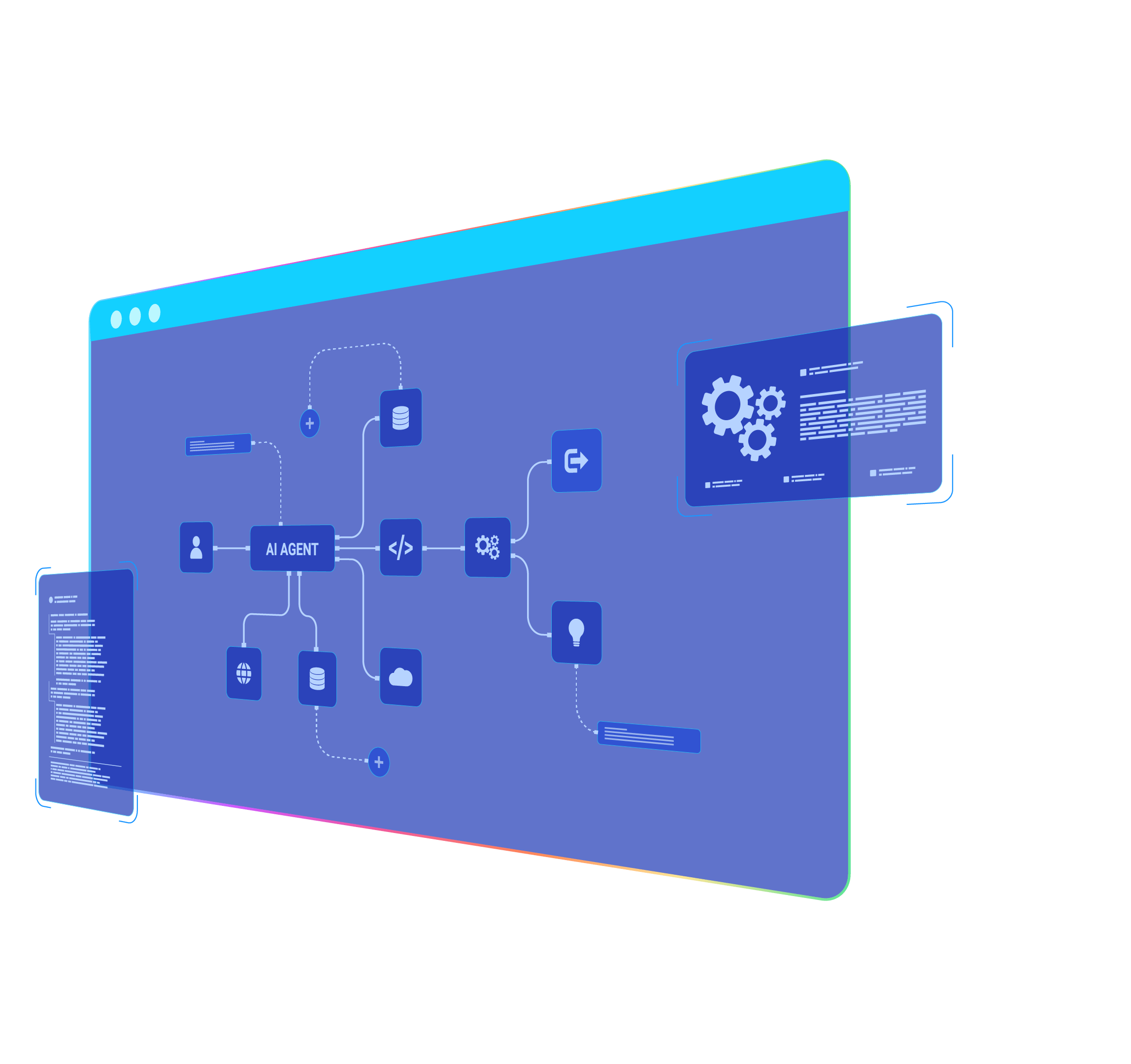
Get Validation Right the First Time—with AI Built for GxP
VAL, the AI That Is Purpose-Built for GxP Validation
VAL is the ValGenesis AI agent built into the Validation Lifecycle Suite (VLS), bringing governed AI directly into GxP validation work.
Powered by connected lifecycle data and governed validation knowledge within the ValGenesis Smart GxP™ platform, VAL transforms data, relationships, and context into intelligent action while maintaining human oversight, source traceability, and auditability.
Six Core Capabilities to Turn Validation Work Into Value
VAL brings six purpose-built AI capabilities into GxP validation, turning connected data and knowledge into practical actions across critical validation activities.
Author
Create validation content with greater speed and consistency.
- Accelerate authoring and reduce manual effort
- Improve Right-First-Time quality and reduce rework

Examine
Surface potential issues before they become validation problems.
- Catch anomalies and mismatches earlier
- Reduce downstream failures and rework

Analyze
Turn validation evidence into confident decisions.
- Accelerate evidence review and result verification
- Improve test completion accuracy and consistency

Trace
Keep requirements, tests, and evidence connected.
- Build and maintain end-to-end requirements traceability
- Reduce manual mapping and coverage gaps

Compare
Understand what changed and what matters.
- Accelerate change impact assessment
- Reduce manual line-by-line comparison

Summarize
Turn complex validation information into decision-ready insights.
- Accelerate review and decision-making
- Improve reporting consistency and audit readiness

10 Questions Every Life Sciences Executive Should Be Asking About AI and the Future of Validation
We have assembled what we believe are the 10 critical questions life sciences executives should ask to assess whether their validation strategy is ready for governed AI, intelligent automation, reusable knowledge, and enterprise scale.
Explore these questions and consider what the future of validation could mean for your organization.
Measured Impact on Validation Work
The AI You Can Trust for GxP Validation
Information Security
ValGenesis software product development operates within an ISO/IEC 27001:2022-certified ISMS, supporting independently verified information security practices.
- Gain confidence through independent certification
- Reduce information security risks
- Benefit from ongoing security oversight
Grounded in the Knowledge That Matters
Federated knowledge management connects regulatory sources, approved validation content, and organizational knowledge to ground VAL in relevant GxP context.
- Improve AI output relevance and consistency
- Reduce hallucination risk
- Strengthen transparency through source provenance
Built for Controlled, Enterprise-Scale Validation
VAL leverages enterprise controls within the ValGenesis Validation Lifecycle Suite to support governed AI across global validation programs.
- Retain control over critical GxP decisions
- Protect validation data and access
- Scale AI across global validation programs
How Much Time and Cost Could Your CQV Team Save?
This calculator estimates the potential annual time and cost savings from modernizing commissioning, qualification, and validation (CQV) workflows with a digital and AI-enabled approach.
It compares your current CQV process against a future-state model to show how changes in document creation, review, execution, and administrative effort could affect overall performance.
How Does It Work?
This calculator estimates annual CQV effort, cost, and potential cycle-time savings across your qualification portfolio.
It uses four current-state inputs:
-
Number of systems or projects qualified per year: The annual volume of CQV systems, assets, facilities, utilities, or project packages that require qualification.
-
Average pages per protocol: The typical size of a CQV protocol package, including test steps, evidence capture requirements, attachments, and related documentation.
-
Average review cycles per protocol: The typical number of review and approval iterations required before a protocol package is finalized.
-
Fully loaded hourly rate: The average blended hourly cost for the people involved in CQV authoring, review, execution, QA approval, and document-control activities.
The calculator then uses conservative assumptions to calculate current-state CQV effort and cost using this logic:
-
Annual CQV effort = authoring hours + review hours + execution hours + administrative hours
-
Annual CQV cost = annual CQV effort × fully loaded hourly rate
Lastly, it estimates how that effort could be reduced using digital and AI-enabled CQV by applying modeled reduction factors to the major effort areas (authoring, review, execution, and admin).
The result is a directional estimate of CQV cycle-time improvement and labor-cost savings designed to help teams understand where manual CQV processes create avoidable effort and where digital and AI-enabled CQV can reduce documentation, review, execution, and administrative burden.
Disclaimer: Results generated by this calculator are based on ValGenesis internal testing and are intended as directional estimates only. They represent a suggestion of what might happen, not a guarantee of actual performance or savings.
CQV Effort & Cost Drivers
Before you use our calculator,
we need to know a little more about you!
ValGenesis is committed to protecting and respecting your privacy, and we’ll only use your information to provide you the content you requested from us. If you consent to us contacting you for this purpose, please tick below to say how you would like us to contact you:
In order to provide you the content requested, we need to store and process your data. If you consent to us storing your data for this purpose, please tick the checkbox below.
CQV Savings Overview
Annual CQV effort:
0 hrs
0 hrs
Hours per Year
Costs per Year
Watch AI-Powered Validation in Action

Advancing CQV: The Role of AI in Modern Validation Processes
Recover lost validation time, reduce protocol deviations, and speed CQV cycles with AI-driven digital execution. Watch the video to see how.
WatchAI-Powered CQV That’s Still Audit-Ready: What "Good" Looks Like

Learn how to keep AI-powered CQV audit-ready with governed workflows and full traceability—watch now to avoid compliance risks.
WatchSmart Anomaly Detector - Catching mismatches early
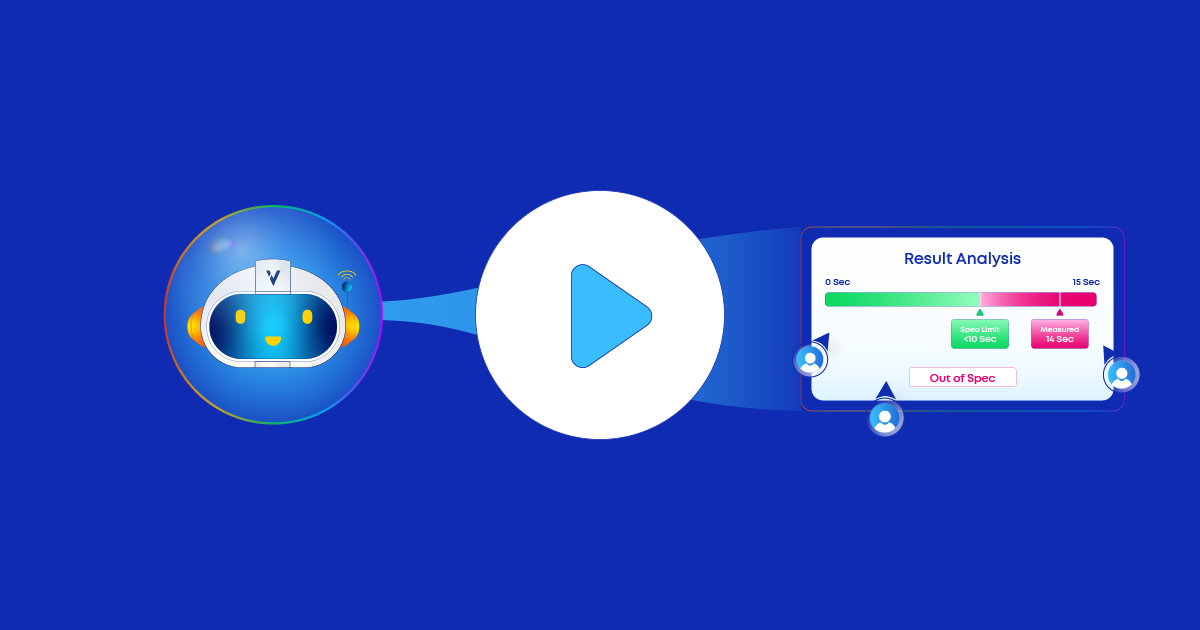
See how smart anomaly detection can flag validation mismatches during execution, helping reduce downstream rework. Watch the video.
WatchFrequently Asked Questions
VAL is the ValGenesis AI agent built natively into Smart GxP. It puts connected validation data, relationships, and knowledge into action to accelerate validation, reduce manual effort, and improve right-first-time quality—with people in control.
VAL applies six AI capabilities—Author, Examine, Analyze, Trace, Compare, and Summarize—to support content creation, evidence review, issue identification, traceability, change assessment, and reporting. Together, they help identify gaps and inconsistencies earlier, support Right-First-Time validation, and reduce downstream rework.
VAL is designed around GxP principles for data integrity, traceability, controlled access, auditability, human accountability, and validated use. Its design supports organizations operating under FDA 21 CFR Part 11, EU Annex 11, GAMP 5, and applicable ICH guidelines, while providing a foundation for evolving regulatory expectations for AI.
VAL combines governed knowledge with controlled AI execution, source provenance, performance monitoring, and human oversight. Non-deterministic AI outputs require appropriate human review and approval, while AI-generated content and human actions remain traceable and auditable.
VAL protects customer data with role-based access, encryption, controlled data boundaries, and data separation. Customer data, prompts, and AI outputs are not used to train generalized AI models unless explicitly authorized or agreed with the customer.
Yes. VAL operates within VLS/VLMS, leveraging the platform’s enterprise controls and infrastructure—including role-based access, data encryption, backup and disaster recovery, and multisite cloud scalability—to support governed AI across enterprise validation programs.
Paperless validation digitizes documents and workflows. VAL goes further by applying AI to connected validation data and knowledge to author content, identify issues, analyze evidence, maintain traceability, assess change, and summarize information—while keeping people responsible for GxP decisions.
See VALTM in Action
See how governed AI puts connected validation context to work—accelerating validation, reducing manual effort, and keeping people in control.