A Roadmap for Implementing Analytical QbD


Summary
Analytical QbD (AQbD) applies Quality by Design to analytical method development, starting from predefined performance goals (ATP). It uses risk management, DoE, and multivariate analysis to define a Method Operable Design Region (MODR).
It links AQbD to ICH Q14 and proposes a roadmap: set ATP, evaluate method options, run initial risk assessment to identify CMAs/CMPs, test to define MODR, revisit risk, build an Analytical Control Strategy, validate, then monitor and manage changes across the method lifecycle, including PAT/RTRT use.
Key takeaways
-
AQbD centers on defining ATP and establishing MODR (using QRM, DoE, and MVDA) so the method consistently meets performance requirements and is more robust.
-
ICH Q14 is positioned to address gaps in harmonized guidance for analytical procedure development and modern analytical techniques, including approaches relying on MVDA and spectroscopic methods.
-
A practical implementation path is laid out from ATP definition through control strategy, validation, and ongoing lifecycle monitoring with change management.
Who is this for
-
Analytical development scientists and method development leads
-
Quality control (QC) laboratory managers and analysts
-
CMC scientists and technical development teams
-
Quality assurance (QA) and quality risk management practitioners
-
Regulatory affairs and CMC regulatory submission teams
-
PAT and real-time release testing (RTRT) program leads
-
DoE/MVDA specialists supporting analytical and process development
Download your Industry Insight
A roadmap for implementing analytical QbD
“Quality by Design (QbD) is a systematic approach to development that begins with predefined objectives and emphasizes product and process understanding and process control, based on sound science and Quality Risk Management”.
Analytical QbD (AQbD) is the application of the QbD concepts to analytical method development.
It is a systematic and scientific-based approach to develop analytical methods, based on the a priori definition of the expected analytical performance.
AQbD heavily depends on QbD approaches and tools, such as Quality Risk Management (QRM), Design of Experiments (DoE) and Multivariate Data Analysis (MVDA) to define the Method Operable Design Region (MODR).
What are the benefits of AQbD implementation?
Analogous to QbD, a successful AQbD implementation will focus on the definition of the operating ranges for the analytical method to meet the desired Analytical Target Profile, improving its robustness, and resulting in resource-efficient drug development.
This approach will potentially minimize the out of specification results and consequently contribute to cost reduction.
Moreover, the knowledge of the MODR increases regulatory flexibility and enables easier post-approval changes.
The existence of clear guidelines is expected to encourage the use of more advanced analytical methods such as spectroscopy techniques, and to enable a robust quality oversight by drug manufacturers.
AQbD and ICH Q14
AQbD development has been hindered by a lack of harmonized guidelines and regulations on how to apply the QbD concepts to analytical procedure development.
This is being addressed in ICH Q14, which is currently a concept paper2 and it is expected to be published, in its final version, in November 2022.
ICH Q14, on “Analytical Procedure Development”, stems from the original ICH Q2, referring to analytical procedure validation.
However, this initial document recently completed its 27th birthday, and consequently it did not incorporate the regulatory developments and guidelines for the recent Cell and Gene Therapies (viral vector-based therapies, CAR-T cells, etc.) neither for the most recent analytical techniques, such as Near-infrared (NIR), Raman, Nuclear Magnetic Resonance (NMR) and Mass (MS) spectroscopies.
Therefore, ICH Q14 publication is expected to build upon ICH Q2 and be aligned with the existing ICH Q8 to Q12, addressing not only the validation of analytical procedures, but also providing guidelines on how to incorporate a QbD mindset from the initial stages of analytical procedure development to the full lifecycle management and post-approval change management, aiming to a harmonization of AQbD adoption by the pharma industry and facilitating communication between pharma and regulators.
Regarding ICH Q2 revision, ICH Q14 will provide guidelines for statistical analysis, validation and regulatory submission of data obtained with modern analytical procedures, such as Near-infrared spectroscopy, Raman, NMR and hyphenated techniques (CE-MS, LC-MS, etc.), in particular when MVDA is used, which was not addressed in ICH Q2.
Implementation of these guidelines is expected to speed up the time needed for regulatory approval of submissions relying on these techniques.
The final ICH Q14 guideline will be a cornerstone for analytical method development using the QbD principles, changing the focus from the method to the result.
Moreover, it will play an important role on the lifecycle management of Process Analytical Technology (PAT) and in real-time release testing (RTRT).
A strategy for AQbD implementation should therefore, include formal risk, lifecycle, and knowledge management programs.
The highlights of an AQbD method development are the definition of the Analytical Target Profile (ATP) and the Method Operable Design Region (MODR), the design of the Analytical Control Strategy (ACS) and the concept of continuous method lifecycle management.
Roadmap to AQbD implementation
This section describes the major steps required for a successful AQbD implementation.
AQbD method development should start with the end in mind, meaning that the regulatory requirements should be incorporated in the design stage early on.
This will assure that the method focus on its key points.
As such, a close communication with all the parties involved in analytical method development is recommended at all stages, including quality control labs.
The correct identification of the CQAs is of outmost importance as well as the analytical methods to measure them, to ensure the ATP has a clear focus, in line with the regulatory agencies.
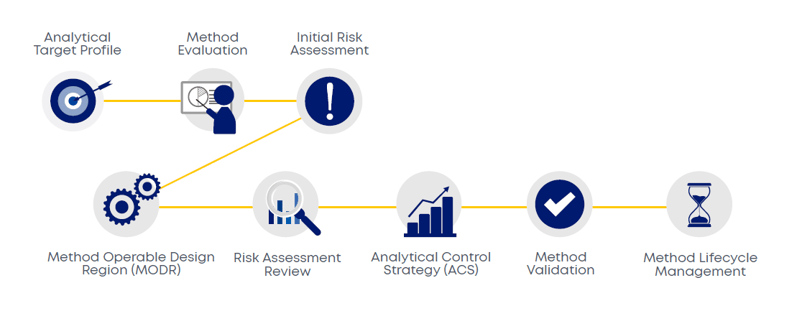
Fig. 1 - Lifecycle management
Analytical Target Profile (ATP) definition
The ATP establishes the analytical method goals (what, where, when) and its performance requirements (precision, specificity, linearity, limit of detection, limit of quantification, range, robustness, statistical intervals, confidence intervals, etc.).
The ATP is a key requirement in the choice of the analytical method, facilitating technology selection and guidance for method development, ensuring the method is fit for the purpose.
Finally, it provides objective-driven criteria for method validation.
The ATP supports the risk assessment and evaluation of the method, facilitates the understanding of the analytical procedure by the regulatory authorities and it is critical for continuous improvement and post-approval changes management, allowing faster implementation of changes at a lower level.
Method evaluation
Criteria such as availability, suitability, cycle times and/or measurement frequencies should be explored to find the analytical method most likely to meet the desired ATP for the chosen process.
In this stage, both knowledge management techniques6 and quality risk management platform should be used.
Initial risk assessment
This stage consists in an overall risk assessment to identify the critical method attributes (CMAs) and the critical method parameters (CMPs), parameters with a significant impact on the CMAs.
The need of an appropriate knowledge management system is undoubted at this stage, in order to take full advantage of existing previous and scientific knowledge and document our approach during the AQbD development journey.
Method operable design region (MODR) definition
The MODR can be defined based on the initial risk assessment and after adequate experimental testing.
MODR is the operating range for the CMPs where the analytical method yields consistent results that fulfill the ATP criteria.
Tools such as DoE and MVDA can be used in this stage.
Risk assessment review
Following the MODR definition and the new acquired knowledge on the analytical method, the risk analysis should be reviewed.
If necessary, CMPs and CMAs classification can be updated, as well as their ranges and the MODR itself.
Analytical control strategy (ACS) design
The ACS is the control plan to mitigate the risks found during the previous stages, ensuring the method performs as expected during the whole lifecycle.
Ideally, it should anticipate the sources of variability and establish the necessary tools and strategies to minimize, detect and control them, assuring the method robustness and its compliance with the ATP criteria.
It should be detailed and comprehensive, requiring continual review as new risks emerge.
Analytical validation
Formal demonstration of the analytical method fitness for its defined purposes, and that the ACS is appropriate and robust.
Lifecycle management
When it comes to AQbD implementation, in order to assure method performance and its suitability during its lifecycle, it’s necessary to have a continuous performance monitoring stage.
A change management system should be in place to update the method if it no longer meets the ATP requirements, as well as to cover any other applicable method changes.
Current hurdles and future directions
Current hurdles
Application of AQbD requires a certain degree of knowledge on this topic, and an extended degree of expertise about the concepts involved (QRM, DoE, PAT, etc).
It is certainly a daunting task that requires considerable investment of time and specialized resources to ensure familiarization with these concepts and for the development and implementation of these methods.
Still, it should be noted that the current submission processes, especially the ones relying on multivariate models and spectroscopic techniques, are lengthy, requiring multiple rounds of information requests to regulatory agencies.
This delays patient access to therapies, while also increases its cost.
So, the real major cost can be the cost of non-action.
Future directions
- Real-time release testing (RTRT): Demonstration of method suitability for RTRT is one issue to be harmonized by ICH Q14. A clear ATP definition is critical to shift for faster methods allowing assessment of product quality, and to implement adequate in-process controls, which can be trusted for early release7. Adequate, bi-directional regulatory communication is essential. RTRT is often associated with multivariate models, again stating the need of guidelines for validation of analytical methods relying on these models.
- Standardization of data quality assessment and data analysis. Automatic data analysis, independent of the operator, and matching the necessary GMP and quality control requirements.
- Bridge with industry 4.0 - industry digitalization, other innovative technologies.
- Use of artificial intelligence for continual verification of the process controls and automatic decision making. Artificial intelligence can contribute to analyze the complex CQAs of cell and gene therapies in real-time and provide guidance on the necessary action steps.
- Blockchain for documenting every change performed in the analytical method (although it always relies on the operator reporting that change).
Table of Contents


