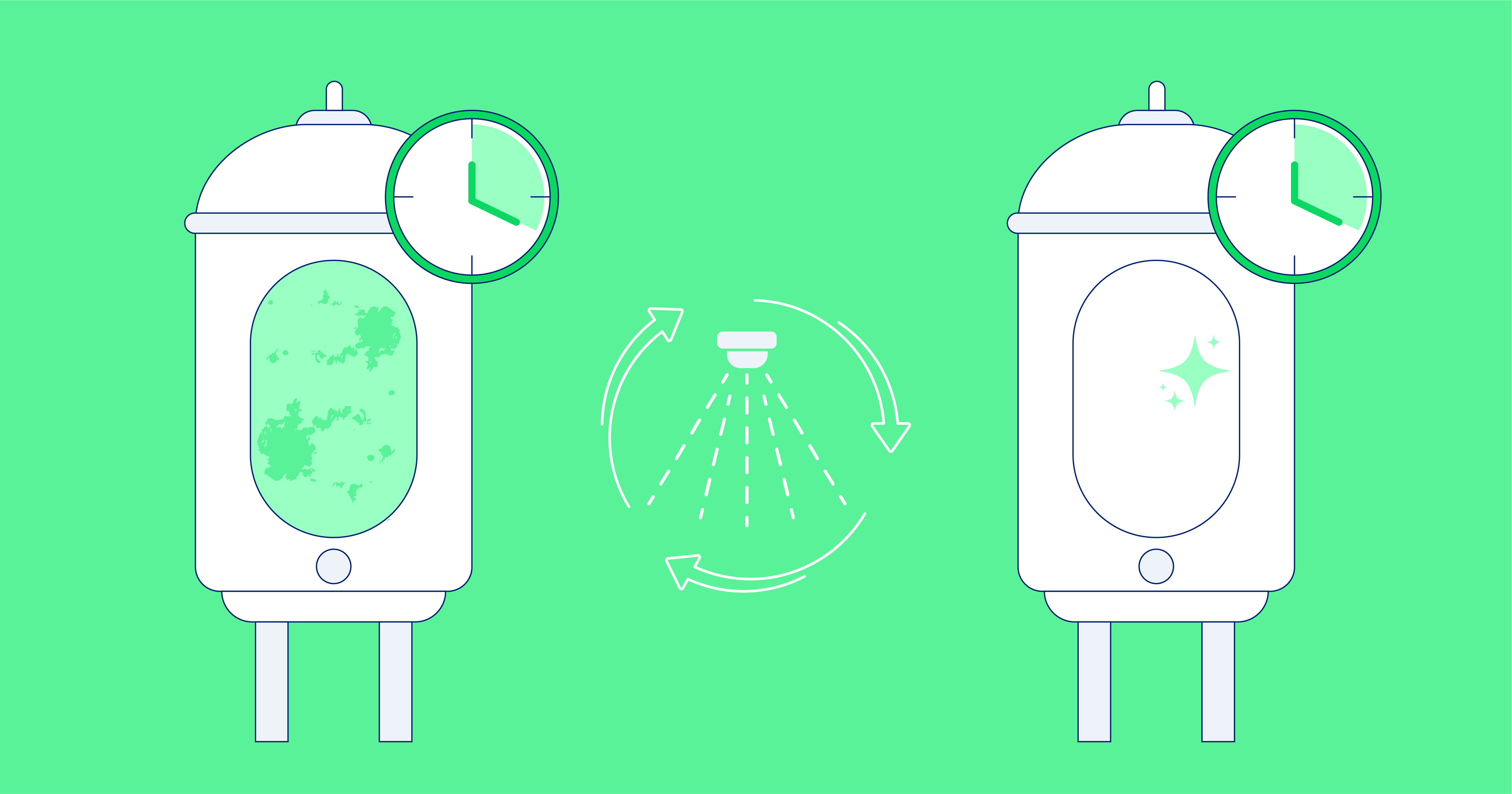

Cleaning validation provides documented evidence that approved cleaning procedures can consistently reduce product residues, cleaning agents, and microbial contaminants to predefined acceptable levels. In shared facilities and multiproduct operations, effective cleaning controls help reduce cross-contamination risk, protect product quality, support patient safety, and maintain inspection readiness.
But cleaning validation involves more than demonstrating that equipment looks clean. Manufacturers must establish appropriate acceptance criteria, define defensible sampling strategies, maintain traceable documentation, assess changes, and confirm that validated cleaning processes remain in control over time. The following FAQs address common questions about cleaning validation requirements, limits, lifecycle management, and risk-based execution.
Cleaning Validation Fundamentals
What is cleaning validation in pharma?
Cleaning validation is the documented confirmation that equipment, utilities, and facilities that may come into contact with the drug manufacturing process are cleaned effectively. It verifies that residues from previous products, cleaning agents, and microbial contaminants are reduced to predefined acceptable levels.
The goal is to show that the cleaning process can be performed consistently under defined conditions.
Why is cleaning validation required?
Cleaning validation helps demonstrate that cleaning procedures effectively control the risk of residues carrying over from one product or batch to another. That risk is particularly relevant in facilities that use shared equipment for different products.
A controlled program helps prevent cross-contamination, protect product quality, and support patient safety.
Is cleaning validation only about visible cleanliness?
No. Visual inspection is useful for detecting obvious residue, films, or particles, but it is not designed to prove low-level chemical carryover control by itself.
Residues can be invisible and still exceed quantitative acceptance criteria. Visual inspection works best as a complementary check alongside measurable residue limits, sampling, analytical method capability, and clearly defined inspection conditions.
Which residues should my cleaning validation program consider?
A cleaning validation program should consider residues from previously manufactured products, cleaning agents, and microbial contaminants. It should also account for product characteristics, equipment design, process flow, and areas that are difficult to clean.
The program should define how each risk is evaluated, sampled, tested, documented, and maintained over time.
How does cleaning validation support product changeovers?
Cleaning validation supports product changeovers by confirming that shared equipment can be cleaned before the next product is manufactured. This helps control carryover risk between products and supports safe, repeatable changeover decisions.
For multiproduct facilities, the cleaning strategy should connect product data, equipment data, residue limits, sampling plans, and execution records so teams can make decisions using traceable evidence.
Regulatory Expectations, Documentation, and Data Integrity
What do regulators expect from a cleaning validation program?
Regulatory expectations for cleaning validation focus on effective control of contamination and carryover risk, scientifically justified acceptance criteria, documented procedures, and records that demonstrate the cleaning process performs as intended.
A strong program includes written procedures, defined responsibilities, justified acceptance criteria, approved protocols, executed records, analytical methods, reports, and change control.
Do FDA regulations address equipment cleaning and records?
Yes. FDA 21 CFR 211.67 requires equipment to be cleaned, maintained, and, as appropriate for the nature of the drug, sanitized and/or sterilized at appropriate intervals to prevent malfunctions or contamination. It also requires written procedures assigning responsibility and describing cleaning and maintenance requirements (21 CFR § 211.67).
FDA 21 CFR 211.182 requires written records of major equipment cleaning, maintenance, and use. Equipment logs must include information such as the date, time, product, and lot number of each batch processed, as well as required signatures or initials for cleaning and maintenance activities (21 CFR § 211.182).
What documents are usually part of a cleaning validation package?
A typical cleaning validation package includes a cleaning validation master plan, cleaning validation protocols, cleaning validation reports, records and logs, SOPs, and analytical methods.
The package should show how the cleaning strategy was planned, executed, reviewed, and maintained. It should also make the rationale for limits, grouping, sampling, and acceptance criteria easy to trace.
Why do cleaning validation programs receive inspection findings?
Cleaning validation findings often trace back to weak procedures, insufficient studies, poorly justified residue limits, poor documentation, or gaps in monitoring. Equipment cleaning, sanitizing, and maintenance can also become inspection focus areas when records do not demonstrate consistent control.
Programs become more defensible when procedures are followed, limits are justified, records are complete, and changes are assessed before they affect validated cleaning processes.
How can data integrity problems appear in manual cleaning validation?
Manual cleaning validation can create data integrity exposure when records have missing initials or timestamps, unexplained corrections, mismatched values across forms and spreadsheets, or unclear version histories.
Each handoff between paper forms, spreadsheets, email attachments, and reports can add delays and increase the chance of transcription errors or incomplete records.
Cleaning Validation Limits, Sampling, and Ongoing Control
What is a cleaning validation limit?
A cleaning validation limit translates a risk question into a measurable acceptance criterion. The risk may relate to patient exposure, product purity, visible cleanliness, or analytical method capability.
One number rarely addresses every risk. Many programs use more than one criterion so that each limit has a clear purpose.
What is HBEL or PDE used for in cleaning validation?
A health-based exposure limit (HBEL), often expressed as a permitted daily exposure (PDE) or acceptable daily exposure (ADE), provides a health-based threshold that can be used to support patient-safety carryover limits in shared equipment.
HBEL or PDE can provide the basis for maximum allowable carryover when the underlying assumptions and source inputs are current and traceable (World Health Organization, 2021).
What is MACO in cleaning validation?
Maximum allowable carryover (MACO) converts an exposure threshold into an allowable carryover limit using defined assumptions such as route, batch size, maximum daily dose, shared surface area, and related inputs.
The calculation is only useful when the inputs and assumptions are controlled. If those details are hidden in static spreadsheets, teams may have to reconstruct the rationale during review or inspection.
Can I rely on the 10 ppm criterion alone?
No. The 10 ppm criterion is not a toxicology-based patient exposure limit and should not be treated as a universal acceptance criterion. Acceptance limits should be scientifically justified based on the products, risks, and manufacturing circumstances involved (U.S. Food and Drug Administration, 1993; World Health Organization, 2021).
How should visual inspection fit into acceptance criteria?
Visual inspection can provide an important check for visible contamination, but it should not be treated as a substitute for quantitative residue control where quantitative testing is warranted.
To make visual inspection repeatable, define lighting, distance, angle, inspection time, training expectations, and how to distinguish residue from acceptable surface conditions, such as staining or spotting.
What makes a sampling strategy defensible?
A defensible sampling strategy should consider locations that are hardest to clean or most likely to retain residue, such as valves, gaskets, shadowed areas, crevices, and complex equipment surfaces.
Swab sampling and rinse sampling are commonly used to verify cleaning effectiveness. The selected method should be able to support the applicable limit through recovery, limit of quantitation, and representative sampling capability.
When should I reassess or revalidate a cleaning process?
Changes to products, equipment trains, cleaning agents, or manufacturing processes, as well as significant deviations or failures, should be evaluated to determine whether they affect the validated cleaning process and whether additional verification or revalidation is warranted.
The assessment should include document review, impact assessment, and verification of relevant data, such as MACO limits, equipment surface areas, and product batch sizes.
Risk Management, Change Control, and Digital Execution
How does risk-based cleaning validation work?
Risk-based cleaning validation uses product, process, equipment, and contamination risk information to determine where controls are needed most. It can include worst-case assessments, health-based limits, sampling plans focused on hard-to-clean locations, and ongoing monitoring.
The goal is to apply controls commensurate with risk rather than treating every product, surface, or changeover as identical (International Council for Harmonisation of Technical Requirements for Pharmaceuticals for Human Use, 2023).
What is a worst-case assessment in cleaning validation?
A worst-case assessment selects a challenging product, equipment configuration, or cleaning situation to represent a broader group. Factors may include toxicity, cleaning difficulty, or equipment complexity.
A scientifically justified worst-case assessment can support a broader validation strategy when the selected case appropriately represents the products, equipment, and cleaning conditions within the defined group.
Why is change impact assessment important in cleaning validation?
Change impact assessment helps determine whether a change affects the validated cleaning process. Product changes, equipment changes, cleaning agent changes, process changes, and deviations can all affect the assumptions behind limits, sampling, grouping, and procedures.
Without a structured assessment, teams may miss downstream effects or continue using outdated rationales.
What problems can digital cleaning validation help solve?
Digital cleaning validation can reduce reliance on paper forms, disconnected spreadsheets, and email-based handoffs. It can help teams centralize product, equipment, limit, protocol, sampling, execution, review, and reporting data.
This makes it easier to track status, reduce manual transcription, improve traceability, and respond faster during reviews, investigations, and inspections.
How do I know when a manual cleaning validation process is no longer enough?
A manual process may no longer be enough when protocols take too long to draft, reviewers cannot see status at a glance, teams spend time reconciling documents, limits are difficult to trace, or investigations require days of document reconstruction.
Those signals can indicate avoidable delays and data integrity risk. They may also indicate that a more structured, digital approach could help the program remain controlled as products, equipment, and sites become more complex.
Effective cleaning validation depends on maintaining the connection between risk, acceptance criteria, execution, documentation, and ongoing control. This FAQ series will continue to address practical questions life sciences teams face as they manage cleaning validation programs over time.


Table of Contents


Related Blog Posts
.webp)