Digital CPV
Explore how digital CPV, digital twins, and process analytical technology enable real-time monitoring, earlier signal detection, and proactive process control.Last Updated: August 04, 2026
Digital CPV in Life Sciences
Digital continued process verification (digital CPV) uses connected manufacturing data, automated analysis, and controlled workflows to confirm that a commercial process remains in a state of control. It replaces much of the manual extraction, spreadsheet analysis, and retrospective reporting associated with traditional CPV. By monitoring critical process parameters and critical quality attributes more consistently, digital CPV helps teams identify signals earlier and connect them to investigation and improvement. This page explains the digital CPV model and how digital twins and process analytical technology extend real-time process understanding.
How Digital CPV Transforms Process Monitoring
Continued process verification begins after process design and process qualification. In this third lifecycle stage, manufacturing data, material attributes, in-process controls, process parameters, and product-quality results are evaluated to determine whether the process continues to perform as intended. The process validation lifecycle depends on this feedback because every batch or production period adds new evidence about process performance.
Traditional CPV often requires teams to extract data from multiple systems, reconcile formats, update spreadsheets, rebuild plots, and prepare periodic reports. Analysis is delayed while skilled resources complete repetitive data-handling tasks. Spreadsheet-based workflows can also make formulas, versions, access, and changes difficult to govern. The discussion of spreadsheet compliance risks shows why data integrity and system control must be built into the monitoring process.
Digital CPV changes this operating model. Connected data, standardized calculations, automated trending, alerts, guided review, and controlled reporting reduce the need to reconstruct process performance manually. A digital system can update approved analyses as source data becomes available, giving process, manufacturing, and quality teams a shared view of current performance. The shift to digital continued process verification allows teams to spend more time interpreting signals, investigating causes, assessing risk, and improving the process.
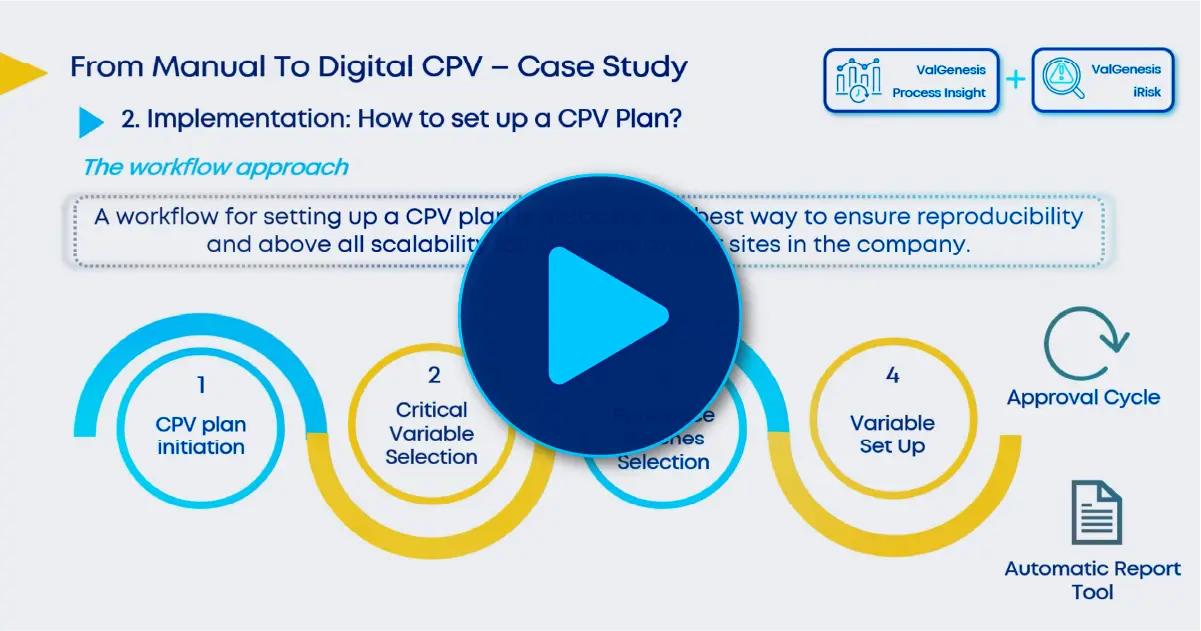
A structured CPV plan remains the foundation. Teams define products, processes, CPPs, CQAs, data sources, sampling frequency, statistical methods, control limits, alert rules, responsibilities, and escalation paths. The plan should connect directly to the control strategy so monitoring remains focused on variables that matter to product quality and process performance. Controlled methods also reduce variation between products and sites.
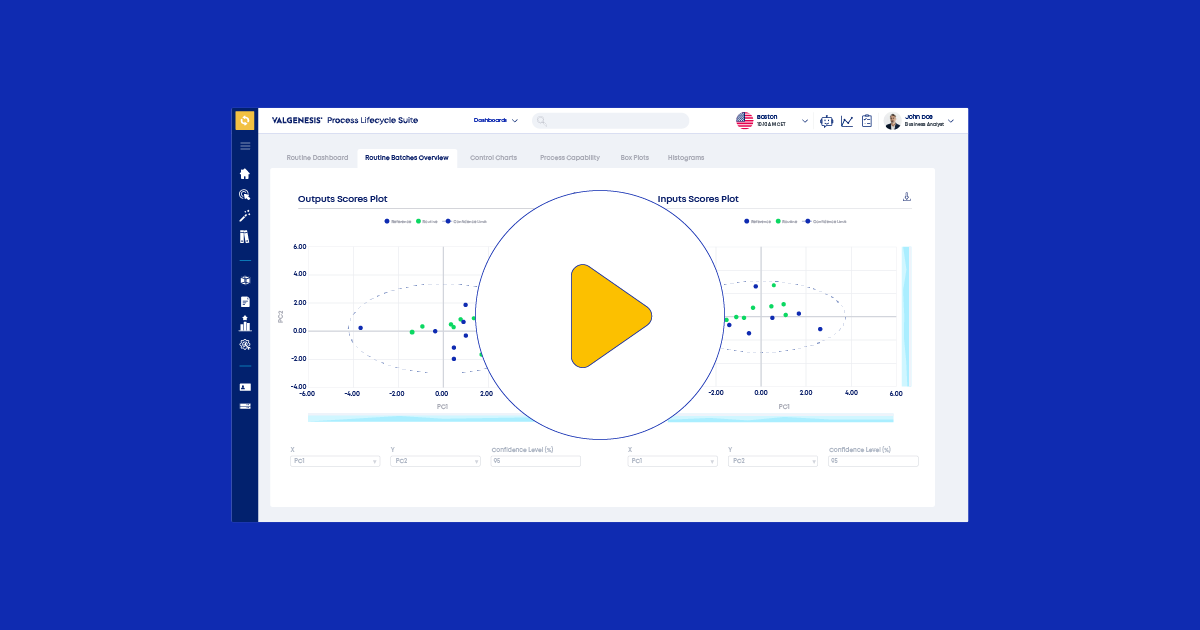
The value comes from learning over time. Stable results provide evidence that the process and control strategy remain capable. Emerging patterns may reveal variability or a need for investigation before a quality failure occurs. Real-time process monitoring shortens the distance between a process signal and a decision, while multivariate approaches help teams evaluate relationships that are difficult to see in isolated charts.
Automation does not remove the need for scientific assessment. Alerts must flow into approved review, investigation, root-cause analysis, risk management, and change control. The webinar on closing the loop from CPV trends to defensible change shows why monitoring has limited value when findings do not lead to timely action.
Implementation should start with data and process governance. Organizations need authoritative sources, aligned parameter names and units, approved statistical methods, defined access and review controls, and clear exception handling. Reliable conclusions also require complete, attributable, consistent, and reviewable records. Applying ALCOA data-integrity practices helps ensure that automation strengthens the evidence behind each decision.

Digital Twin
A digital twin is a digital representation of a physical process that combines process knowledge, real-time or current data, and predictive models to support process understanding and control. Within a CPV context, the model can help teams compare observed performance with expected behavior, evaluate complex relationships, and investigate emerging changes before they become larger operational or quality problems.
The useful starting point is not the label “digital twin,” but the data and model foundation. Teams need trusted data acquisition, defined process boundaries, meaningful inputs and outputs, an appropriate modeling approach, and a controlled method for maintaining the model as the process evolves. The underlying model may be data-driven, mechanistic, or hybrid, depending on the process, available knowledge, and intended use.
Real-time acquisition allows the digital representation to reflect current operating conditions. Predictive analysis can then help identify departures from expected behavior or support troubleshooting. A practical digital-twin implementation within an Industry 4.0 framework connects real-time data, predictive modeling, process control, and troubleshooting. This makes the digital twin relevant to CPV where large, interconnected datasets make purely retrospective review too slow.
Governance remains essential. A digital twin used to support quality decisions needs defined ownership, appropriate validation, controlled changes, documented assumptions, and ongoing assessment of model performance. It should complement the approved control strategy and subject-matter expertise rather than become an unexplained decision engine. Organizations can begin with a bounded use case, such as monitoring a well-understood unit operation or comparing performance with a defined reference state, before expanding the model across a larger process.
Process Analytical Technology
Process Analytical Technology (PAT) supports the design, analysis, and control of manufacturing through timely measurement of critical quality and performance attributes. In CPV, PAT can provide high-frequency data that helps teams understand process behavior during operation rather than relying only on delayed end-product testing.
PAT is particularly relevant to continuous manufacturing, where process conditions and material flow must be monitored without conventional batch boundaries. The overview of PAT in continuous manufacturing explains how modern monitoring and advanced analytics enable reliable real-time control. Measurements can feed statistical and multivariate models, support early detection of abnormal behavior, and strengthen the connection between the process and its control strategy.
Successful PAT implementation requires more than installing an analyzer. Teams need a clear measurement objective, suitable technology, representative sampling, data integration, analytical-model development, lifecycle management, and an operating response when results cross an approved threshold. A roadmap for PAT implementation helps frame PAT as a coordinated process, analytical, data, and control initiative.
Multivariate Statistical Process Control (MSPC) can add context when many correlated variables are collected. Instead of reviewing hundreds of individual plots in isolation, teams can evaluate relationships and identify patterns across a multidimensional dataset. The editorial on MSPC and complex process-data visualization describes how multivariate monitoring can work with PAT to support continuous process oversight and real-time release activities.
For CPV teams, the priority is to connect PAT signals to approved monitoring and response workflows. Data should flow into governed analysis, alerting, investigation, and reporting. Without that connection, faster measurement can produce more data without producing faster or better decisions.