When Cleaning Limits Stop Being Calculations: The Shift to Controlled Outputs in Digital Cleaning Validation


Part of: Cleaning Validation
Summary
Cleaning limits depend on connected product, toxicology, equipment, analytical, sampling, and process data. When those inputs are managed across documents and systems, even one change can create extensive review and update work.
The paper describes a digital model in which approved data, calculation rules, workflows, ownership, version history, and impact assessment maintain cleaning limits as controlled outputs throughout the validation lifecycle.
Key takeaways
- Cleaning-limit management becomes difficult when the data behind acceptance criteria is fragmented across functions, systems, documents, spreadsheets, and local knowledge holders.
- A governed digital model can connect approved inputs, calculation logic, workflows, version history, and change impact assessment so limits remain controlled as underlying data changes.
- Equipment, toxicology, analytical methods, and sampling changes can affect multiple cleaning validation records and activities, making downstream impact assessment part of limit management.
Who is this for
- Director of QAV
- VP of Quality/QA
- Project Manager
- VP of Engineering / Facilities
- Director of Manufacturing
- Director of Engineering
- VP of Manufacturing / Operations
- Director of IT
Download your White Paper
When Cleaning Limits Stop Being Calculations: The Shift to Controlled Outputs in Digital Cleaning Validation
Executive Summary
Cleaning validation has always carried a heavy compliance burden. Determining, justifying, maintaining, and applying cleaning acceptance criteria, including maximum allowable carryover limits, is a critical part of cleaning validation compliance.
For many organizations, these limits are still treated as discrete calculation exercises. Changes to a product, toxicological consideration, piece of equipment, analytical method, or sampling point can trigger a familiar cycle of gathering data, locating procedures, confirming assumptions, updating spreadsheets, rechecking calculations, revising documents, routing approvals, and verifying that downstream systems reflect the same controlled limit. Furthermore, ensuring the change is reflected downstream in protocols, monitoring, reporting, and annual quality reports is a fractured and failure-point-riddled journey.
A better operating model treats cleaning limits as approved outputs from controlled data, rules, and workflows rather than standalone calculations with flexible processes recreated every time source data changes, or a new process opinion surfaces. The problem is not the calculation, the formula or the output-ranking mechanism, but the process itself. In a typical manufacturing environment, there are dozens of pieces of primary equipment, multiple manufacturing trains, multiple product and equipment groups, essential shared equipment, and multiple sets of interchangeable and/or dedicated parts. As a result, there is no such thing as a simple process improvement. A single change in this complex, interconnected matrix can produce an overwhelming effort to determine whether the final output value has changed and why.
In a mature, digitalized cleaning validation program, rules and calculation logic produce a controlled output from approved data, validated rules, and governed workflows. Here, a single change is just that. Input the new or updated piece of data to see and understand where the impact is, what has changed, what has not, and what actions, if any, need to be taken. Approved impact frameworks, controlled system updates, and confirmation of changed values ensure consistency, ease of update, streamlined actions, and constant program readiness.
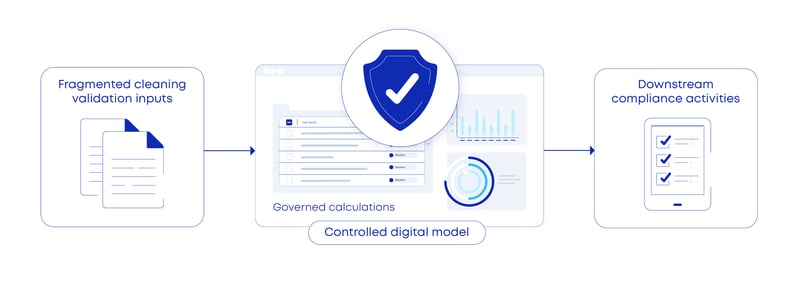
Figure 1. A controlled digital model connects fragmented cleaning validation inputs, governed calculations, and downstream compliance activities.
The Problem Is Not the Formula
Cleaning validation teams are not struggling because they lack formulas. Most organizations have established methods for determining residual limits, carryover limits, visual inspection limits, cleaning agent limits, microbiological criteria, and related acceptance criteria.
The deeper problem is that the data feeding those calculations is often fragmented across functions, systems, documents, spreadsheets, and local knowledge holders.
A cleaning limit may depend on:
- Product or material data
- Toxicological values such as acceptable daily exposure (ADE), permitted daily exposure (PDE), and supporting data such as the no-observed-adverse-effect level (NOAEL) or related health-based exposure limits (European Medicines Agency [EMA], 2014).
- Batch sizes and dose information
- Equipment train configuration
- Product-contact surface areas
- Materials of construction
- Cleaning process parameters
- Sampling locations
- Swab or rinse recovery factors
- Analytical method capability, range, limit of detection/quantification (LOD/LOQ)
- Site-specific procedures and business rules
- Worst-case product and equipment grouping logic
When these data sources are contained in different source documents (sometimes multiple versions of these documents for different areas, equipment, and products) and are manually assembled, the calculation becomes only one part of the burden. The greater challenge is ensuring and assuring that every input and step of the update is current, approved, justified, traceable, and consistently applied. That challenge continues throughout the cleaning validation lifecycle. Changes to equipment, toxicological data, analytical methods, sampling approaches, products, or cleaning processes can affect the basis for an established limit. Each change must be assessed to determine whether the limit remains valid and what follow-up actions are required to keep the program in a compliant state (European Commission, 2015; International Council for Harmonisation [ICH], 2008).
This is why limit management often creates more compliance burden than the calculation itself. The opportunity for variability is ever present and difficult to avoid, immediately presenting a risk to compliance with internal standards and external expectations.
The Digital Shift: From Manual Calculation to Controlled Output
Instead of treating each acceptance criterion as a manually maintained number, the organization establishes a governed data model. Product information, equipment data, analytical method capability, cleaning processes, sampling logic, and calculation rules are structured in the system. Once the rules, procedures, and approved settings are established, the system produces the calculation as a controlled output, preserving the approved inputs, calculation logic, relationships, and change history that support the limit throughout its lifecycle (ICH, 2008; Pharmaceutical Inspection Co-operation Scheme [PIC/S], 2021).
A controlled output comes from approved data, approved logic, approved workflows, controlled access, audit trails, version history, and change impact assessment (European Commission, 2011; PIC/S, 2021; U.S. Food and Drug Administration [FDA], 2018). In this model, users do not repeatedly ask, “How do I calculate this again?” and quality teams do not ask, “Did they do this calculation correctly?” Instead, your highly valuable resources are using their expertise to focus on the true value-added questions:
- What data changed?
- Who owns that data?
- Which products, equipment, processes, sites, and sampling points are affected?
- Does the change alter any cleaning limits?
- Does it change worst-case selection?
- Does it require revalidation, verification, additional monitoring, or process improvement?
- Which protocols, reports, matrices, and execution activities now need to be updated or generated?
In most cases, the answers to the first few questions are likely made immediately obvious by the digitalization process and knowledge flow. This allows teams to shift their focus to the later questions, and even more complex downstream questions:
- Will this affect my process performance range over time?
- Should I establish a periodic monitoring or re-baselining window related to this change?
- Are my product or equipment grouping strategies still appropriate?
- Is there an opportunity to consider an optimization project?
The value of digitalization is that the calculation, its inputs, and its downstream impact remain under control throughout the lifecycle. The sections that follow show how this governed operating model applies when key inputs change, including equipment, toxicology data, analytical methods, and sampling requirements, and how those changes can affect established cleaning limits and downstream validation activities.
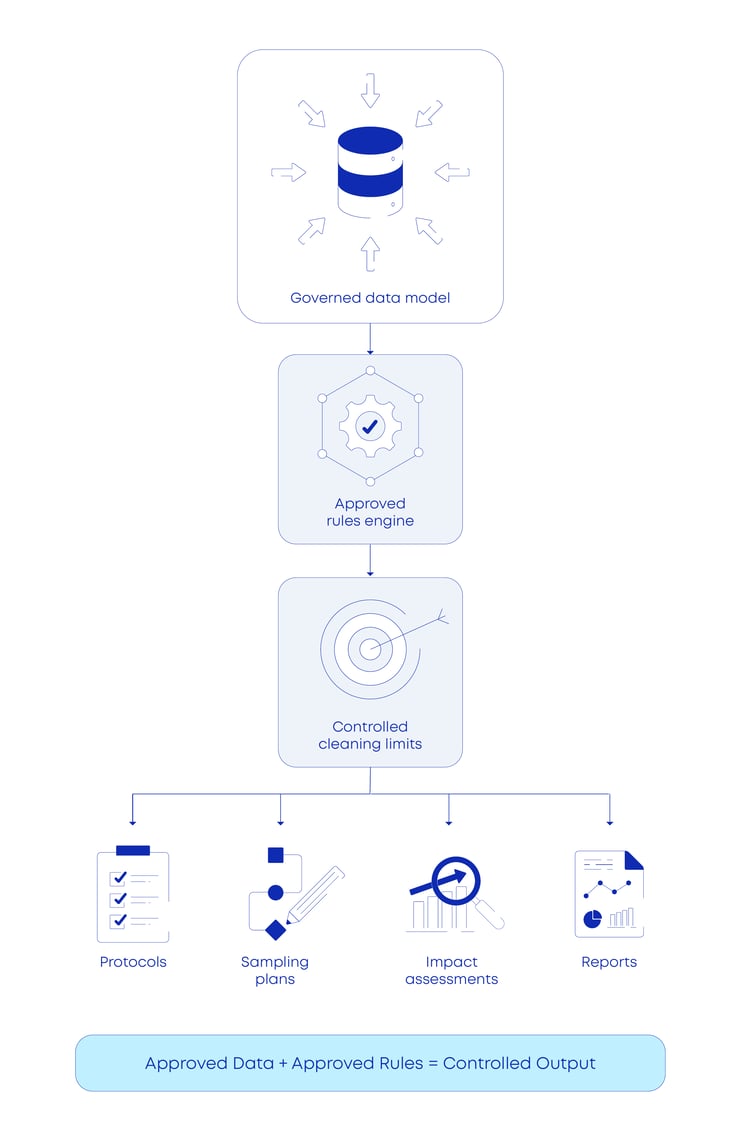
Figure 2. From governed data and approved rules to controlled cleaning limits and downstream actions.
Equipment Changes Should Trigger Impact Assessments
Equipment changes can affect several of the inputs and dependencies used to establish and maintain cleaning limits. Replacing a spool piece, installing a new agitator, adding a monitoring device, changing a material of construction, or modifying product-contact surface area may affect calculated surface area, sampling locations, recovery requirements, equipment groupings, worst-case designation, and the resulting acceptance criteria (European Commission, 2015). In a manual environment, assessing these dependencies can require teams to identify where the equipment is used, determine which approved inputs have changed, recalculate affected limits, reassess sampling and recovery requirements, review grouping and worst-case logic, and update the related validation documentation and activities. The challenge is therefore broader than recalculating a value; teams must determine the full downstream impact of the equipment change and ensure that each affected element remains scientifically justified and controlled (European Commission, 2015; ICH, 2023b).
In a digitalized program, these relationships can be maintained within a governed data model linking equipment, products, cleaning processes, sampling locations, surface areas, and acceptance criteria. When equipment data changes, the impact assessment can use those existing relationships to identify potentially affected limits, sampling plans, equipment groups, worst-case assessments, and downstream validation deliverables (European Commission, 2011; ICH, 2023b).
After the change is approved and applied, the system can identify the actions required to maintain the validated state. That means the cleaning validation team can focus their review on the required actions rather than rebuilding the rationale behind the limit. The figure below illustrates how a single equipment change can affect multiple interconnected elements of the cleaning validation program.
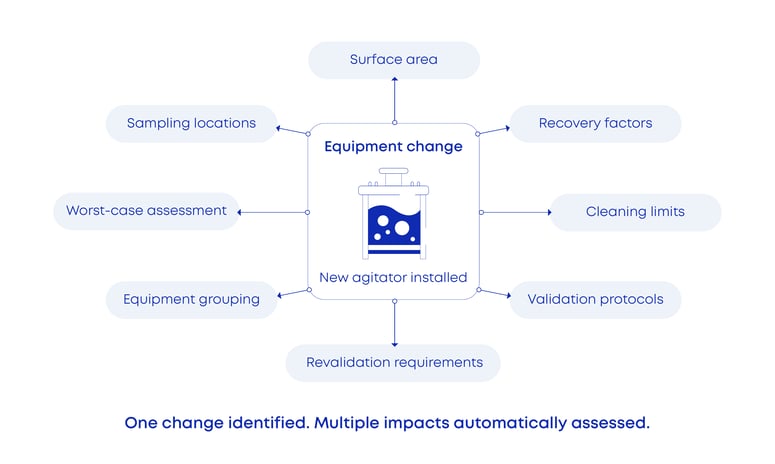
Figure 3. Example of how an equipment change can affect interconnected cleaning validation inputs, assessments, and downstream activities.
The Right SME Owns the Controlled Data
Cleaning validation teams need reliable toxicological inputs, but they do not need to own every toxicology justification, testing history, and product-specific scientific rationale. In many organizations, that information is better owned by a specialist in toxicology, product stewardship, or the global product data team.
A central SME group can maintain the approved product or material data in the system. They can update ADE, PDE, NOAEL, or related health-based exposure information through controlled workflows. Access can be limited to the data they own. Their role is to keep the data domain current, approved, and traceable while cleaning validation teams manage how that data affects limits and downstream activities (EMA, 2014).
When that data changes, the system can show the affected sites and product-equipment-cleaning process combinations. Sites can assess the operational impact before implementation. They can prepare for any required action. But they do not need to manually rediscover where the data is used or recalculate every downstream limit.
Analytical Method Data Drives Cleaning Limit Decisions
Cleaning validation depends on analytical methods that are suitable for their intended purpose and capable of reliably measuring residues at the levels required by the cleaning acceptance criteria. ICH Q2(R2) provides the framework for demonstrating analytical procedure performance, including characteristics such as accuracy, precision, specificity, reportable range, detection limit, and quantitation limit (ICH, 2023a).
Changes to an analytical method can affect several elements of the cleaning validation strategy. A new or revised method with improved sensitivity or a broader validated range may support lower quantitation levels, different sampling areas or sample volumes, or revised site-specific limits where analytical capability had previously constrained the calculated safety-based limit. Changes in recovery performance for a particular material of construction may also require reassessment of recovery factors, sampling locations, and the limits applied to those locations. In other cases, a simpler analytical method may become scientifically suitable for an application that previously required a more complex approach, reducing execution complexity while still requiring controlled evaluation, communication, and implementation.
In a digitalized model, analytical method owners can maintain method performance data directly in the controlled system. Range, accuracy, LOD, LOQ, recovery factors, sample-type suitability, and method applicability can be governed as structured data. When that information changes, the system can evaluate where cleaning validation limits, sampling plans, or pass/fail decisions may be affected. A digitalized validation program ensures that whatever the change and impact may be, the information is reliably transmitted downstream to the next SME or operator in the chain, and subsequent actions will increasingly be right-first-time and appropriately scaled.
Sampling Plans Should Be Intelligent and Dynamic, Not Static Attachments
Acceptance criteria do not exist in isolation. They are applied at sampling locations, using approved sampling methods, against specific residues, on specific equipment surfaces, and under defined procedures.
When equipment changes, sampling requirements must be reassessed. Changes to components, materials of construction, or surface areas can affect limit distribution, recovery considerations, or the suitability of existing sampling locations. New hard-to-clean locations may require sampling, while existing locations may no longer be representative (European Commission, 2015).
In a document-heavy environment, these updates are vulnerable to delay and inconsistency. Sampling plans may be delayed during the update process rather than pulled down automatically when the previously approved template and document refresh the specifics of the required sampling locations. Protocols and LIMS may diverge, with LIMS holding an old limit while the validation protocol contains an updated value, rather than a single system of record controlling the required value, ensuring this is populated in documentation, and ensuring results in LIMS are measured against the correct criteria (FDA, 2018; PIC/S, 2021). A digitalized cleaning validation program will help prevent this fragmentation. Sampling locations, equipment surfaces, materials of construction, recovery data, analytical methods, and limits should be continuously connected. When one changes, the system should identify the affected records and required actions. This should require minimal direct intervention, with a validated system ensuring that most tasks are completed without manual action (European Commission, 2011; ICH, 2023b).
Protocols Should Reference Current Approved Limits
Protocols, or digital execution objects, should pull the current approved limits from the controlled source at the point and time of use rather than store copied values that can become outdated. The approved execution object should exist in a format that has live links, tags, or references to the current, controlled, applicable data (European Commission, 2011; FDA, 2018; PIC/S, 2021). This connection to the approved source drives efficiency and accuracy rather than creating another sequence of items that must be reviewed, maintained, and synchronized. When a digital execution object is retrieved, it uses the latest approved acceptance criteria, sampling requirements, and related program rules.
This can reduce redundant document maintenance, improve confidence that execution is aligned with the current validated state, and ensure valuable resource time is adding true value to your operations.
Rethinking the Role of LIMS
A laboratory information management system (LIMS) can remain the system responsible for laboratory execution and result management, while the digital cleaning validation system serves as the system of record for the controlled limit. This can be a preferable setup because the cleaning validation system is the single source of truth for the broader context that produces the limit. With product data, equipment data, surface area, sampling point, analytical method suitability, calculation rules, version history, and validation status live and continuously up to date, it can perform all required operations on the incoming data and reduce the “multiple-system” maintenance burden, with LIMS focused on laboratory equipment, method, and testing control (FDA, 2018; PIC/S, 2021). Under this model, LIMS can pass the analytical result to the cleaning validation system. The cleaning validation system can determine pass/fail based on the current approved limit and trigger any required investigation, exception, or downstream workflow.
This can reduce duplicate limit maintenance across systems and support data integrity by clarifying system ownership.
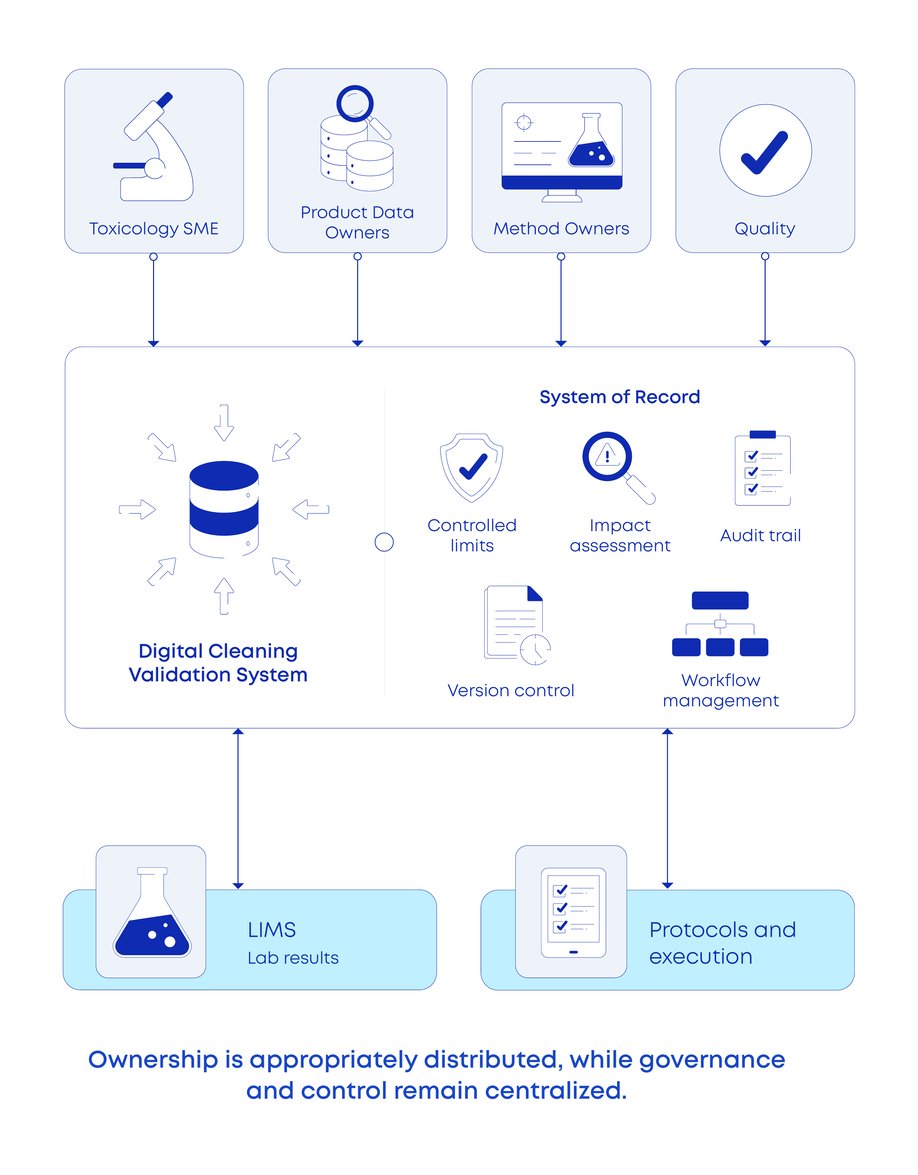
Figure 4. Centralized cleaning-limit governance with LIMS supporting laboratory results and the cleaning validation system controlling limits, impact assessment, and downstream workflows.
The Strategic Outcome: Cleaning Validation Teams Focus on Control
Digitalized limit management reduces the need to reconstruct calculations, data relationships, and supporting rationale so teams can spend more time on technical review, impact assessment, and control decisions. The cleaning validation team can spend less time on activities such as:
- Searching for the latest data source
- Rebuilding calculation logic
- Checking and rechecking spreadsheets
- Manually updating copied values across documents
- Reconciling inconsistent versions across systems
- Determining from scratch where a changed input is used
Instead, they can focus more attention on questions related to process performance and maintaining the validated state:
- Is the cleaning process still effective?
- Is the validated state still maintained?
- Has the worst-case scenario changed?
- Is revalidation required?
- Is additional verification sufficient?
- Should monitoring be increased?
- Is the analytical method still appropriate?
- Are the sampling locations still scientifically justified?
- Can the facility continue operating without unacceptable risk?
This shifts the focus of cleaning validation from manual calculation management to lifecycle control.
Digitalization Makes Governance Executable
Automation is sometimes viewed as reducing control. In a regulated environment, poorly governed automation can do exactly that. Properly implemented digitalization, however, should have the opposite effect by making governance easier to define, apply consistently, and inspect.
A well-governed digital cleaning validation program should include:
- Defined data ownership
- Controlled configuration of calculation rules
- Version-controlled data and outputs
- Audit trails for changes
- Role-based access
- Approved workflows
- Change impact assessment
- Traceability from input data to calculated output
- Visibility of downstream affected records
- Controlled generation of protocols and reports
- Integration with laboratory and quality systems where appropriate
The purpose is not convenience alone; it is to ensure that automation operates within defined governance and compliance controls (European Commission, 2011; FDA, 2018; PIC/S, 2021).
Building the Controlled-Output Operating Model
To advance into this digitalized world of cleaning validation, organizations will need to consider and determine several key foundational elements.
- What are the key pieces of data, procedures, and organizational rules contributing to the cleaning validation program, and who will be the designated owner of that data for the entire validation lifecycle?
- What are the standard variants of the business rules across technologies, divisions, and manufacturing stages, and who will determine how these evolve over time?
- What are the systems of record for each data source, and what are the defined flows between business-critical systems (European Commission, 2011; ICH, 2008)?
With a clear understanding of these needs, before embarking on a digitalization journey, an organization can more rapidly achieve the necessary harmonization (and localization) required to set up and go live in a digital system. This understanding will also support the evaluation of potential systems and help ensure that adoption thereafter is rapid and widespread, so that the potential value is realized.
Conclusion
Cleaning validation becomes difficult to maintain when acceptance criteria are treated as individual calculations rather than controlled outputs supported by an interconnected set of data, rules, and relationships. As products, equipment, toxicological values, analytical methods, sampling requirements, and cleaning processes change, the challenge is not simply recalculating a limit. It is understanding what the change affects and ensuring that every downstream action remains aligned with the current validated state.
A more mature digitalized operating model brings those dependencies under control. Approved source data, calculation logic, workflows, ownership, version history, and impact assessment work together to produce and maintain cleaning limits as governed outputs. Those limits can then be applied consistently at the point of use and connected to the sampling plans, protocols, monitoring activities, and other records that depend on them.
This changes the role of cleaning validation teams. Instead of repeatedly reconstructing calculations, reconciling versions, and tracing where changed information is used, teams can focus more attention on technical review, impact assessment, process performance, and the decisions required to maintain the validated state.
The broader shift, therefore, is from managing individual calculations to controlling the information lifecycle that makes cleaning limits reliable. By establishing clear data ownership, governed rules, traceability, system-of-record relationships, and controlled change, organizations can manage cleaning limits as controlled outputs throughout the validation lifecycle.
Take the Next Step Toward Controlled Cleaning Validation
See how ValGenesis iClean™ helps digitalize cleaning validation with governed data, controlled change, and lifecycle traceability.
References
European Commission. (2011). EudraLex volume 4, Annex 11: Computerised systems.
https://health.ec.europa.eu/medicinal-products/eudralex/eudralex-volume-4_en
European Commission. (2015). EudraLex volume 4, Annex 15: Qualification and validation.
https://health.ec.europa.eu/document/download/52a61141-cecd-4c9c-9ec6-7ab87be5d8ff_en?filename=annexe15_en.pdf
European Medicines Agency. (2014). Guideline on setting health-based exposure limits for use in risk identification in the manufacture of different medicinal products in shared facilities (EMA/CHMP/CVMP/SWP/169430/2012).
https://www.ema.europa.eu/en/scientific-guidelines/setting-health-based-exposure-limits-use-risk-identification-manufacture-different-medicinal-products-shared-facilities
International Council for Harmonisation of Technical Requirements for Pharmaceuticals for Human Use. (2008). ICH Q10: Pharmaceutical quality system.
https://database.ich.org/sites/default/files/Q10%20Guideline.pdf
International Council for Harmonisation of Technical Requirements for Pharmaceuticals for Human Use. (2023a). ICH Q2(R2): Validation of analytical procedures.
https://www.ema.europa.eu/en/scientific-guidelines/ich-q2r2-validation-analytical-procedures
International Council for Harmonisation of Technical Requirements for Pharmaceuticals for Human Use. (2023b). ICH Q9(R1): Quality risk management.
https://database.ich.org/sites/default/files/ICH_Q9%28R1%29_Guideline_Step4_2025_0115.pdf
Pharmaceutical Inspection Co-operation Scheme. (2021). PI 041-1: Good practices for data management and integrity in regulated GMP/GDP environments.
https://picscheme.org/docview/4234
U.S. Food and Drug Administration. (2018). Data integrity and compliance with drug CGMP: Questions and answers — Guidance for industry.
https://www.fda.gov/regulatory-information/search-fda-guidance-documents/data-integrity-and-compliance-drug-cgmp-questions-and-answers
Table of Contents


