The Toolbox for an effective Tech Transfer


Summary
Tech transfer can stall when knowledge and data are scattered across paper records and disconnected systems. This paper explains how digital-first methods can speed transfers while meeting compliance needs.
It connects Pharma 4.0 pillars to a practical toolbox for process design, data migration, risk assessment, control strategy, monitoring, and trend detection, plus steps to start adoption.
Key takeaways
- Pharma 4.0 links technology, digitalization, and skills to improve tech transfer through better data access, analytics, and integrated workflows.
- A “digital toolbox” can support scale-up, structured knowledge management, AI-enabled risk assessment, advanced control strategies, blockchain use cases, and trend detection.
- Successful use requires defined and validated use cases, investment in infrastructure and skills, integration with legacy systems, and a user-centered rollout.
Who is this for
- Tech transfer leaders and MSAT leads
- Process development scientists and scale-up engineers
- CDMO program and operations managers
- Quality assurance, validation, and CSV/CSA teams
- Quality risk management (ICH Q9/Q10) practitioners
- Manufacturing digitalization/automation (OT/IT) leaders
- Data integrity and compliance specialists
- Supply chain and cold chain quality teams
Download your Industry Insight
A Toolbox for an Effective Tech Transfer
As drug development costs continue to rise and reliance on contract development and manufacturing organizations (CDMOs) grows, the pharmaceutical industry is increasingly turning to digital-first strategies to streamline operations and accelerate time-to-market. Embracing advanced technologies enables organizations to address long-standing challenges in tech transfer, including fragmented knowledge sharing, inefficient paper-based workflows, and inconsistent process standardization.
In this Industry Insight, we explore how these advancements align with the principles of Pharma 4.0-a strategic transformation framework guiding the pharmaceutical industry toward scalable digital maturity, with adoption evolving at different levels across organizations. By integrating advanced digital tools and methodologies, CDMOs are not only improving efficiency and competitiveness, but also embracing a holistic and data-driven approach that is at the core of Pharma 4.0. This synergy underscores the transformative potential of digital innovation in driving the future of pharmaceutical manufacturing.
Introduction
The pharmaceutical industry is undergoing a transformative shift driven by the integration of advanced digital technologies into manufacturing environments. Known as Pharma 4.0, this evolution builds upon the foundation of Industry 4.0 and represents a strategic response to increasing complexity, rising development costs, growing regulatory demands, and the push for greater efficiency across the product lifecycle.
This digital transformation is particularly critical in areas like tech transfer, where a seamless exchange of knowledge, data, and processes is essential to ensuring quality, speed, and compliance.
The following sections provide a comprehensive exploration of the pillars of the Pharma 4.0 landscape, grouped into three core domains: technology, digitalization, and skills. The document then examines how these pillars contribute to enhancing and accelerating tech transfer processes, presenting a roadmap for leveraging digital toolboxes to optimize process design, knowledge management, risk assessments, and control strategy development. As the pharmaceutical sector adapts to ever-evolving demands, the Pharma 4.0 model is not just a technological upgrade, but a foundational shift in how pharmaceutical manufacturing is projected and executed.
The Pillars of the Pharma 4.0 Landscape
Pharma 4.0 is a comprehensive manufacturing approach derived from Industry 4.0, introduced in 2017 by the International Society for Pharmaceutical Engineering (ISPE). It describes the integration of advanced digital technologies in the pharmaceutical industry, including artificial intelligence (AI), machine learning (ML), the Internet of Things (IoT), and big data analytics. This approach epitomizes the application of technology to optimize manufacturing processes through digitalization, leading to new levels of connectivity, transparency, flexibility, efficiency, responsiveness, and productivity. Pharma 4.0 simplifies compliance, achieves cost savings, reduces downtime and waste, and fosters innovation.
Pharma 4.0 consists of nine key pillars, encompassing three main areas: Technology, Digitalization, and Skills (see Figure 1).
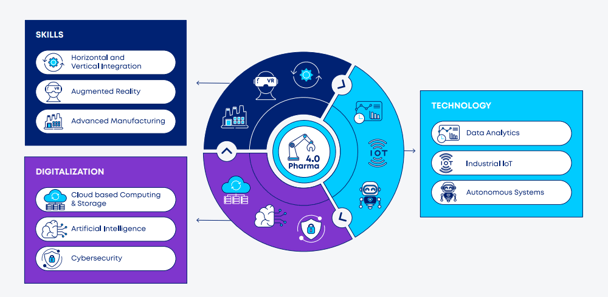
Figure 1 – Representation of the 9 pillars of Pharma 4.0 action plan into 3 main areas: Technology, Digitalization, and Skills.
Technology
Within the technology pillar of Pharma 4.0, several key innovations illustrate how intelligent technologies are driving this transformation, enhancing connectivity, generating actionable insights, and automating critical processes to enable smarter, faster, and more adaptive pharmaceutical manufacturing.
Big data analytics
Automation and digitalization generate vast amounts of data during manufacturing processes in Pharma 4.0. To handle this data influx, increased storage capacities are necessary, as well as advanced big data analytics enabled by ML and AI models, to generate insights that can optimize the manufacturing process while maintaining consistent product quality.
Internet of Things (IIoT)
The Internet of Things (IoT) refers to devices equipped with sensors, software, and other technologies that connect and exchange data with other devices. These devices monitor and control various manufacturing process variables, such as temperature, humidity, and pressure, among many others.
Autonomous systems
Robotics and automation enhance the manufacturing process by minimizing the need for human intervention. This leads to fewer errors and greater efficiency in manufacturing production.
Digitalization
The digitalization pillar of Pharma 4.0 focuses on technologies that enable real-time data access, intelligent analytics, and secure infrastructure-key elements for driving connected and compliant manufacturing.
Cloud-based computing and storage
Cloud computing and storage allow pharmaceutical companies to store and manage various data types. It is the foundation of advanced technologies such as AI, ML, and IoT. Authorized devices with an internet connection can access and analyze large amounts of data in real time. In Pharma 4.0, cloud storage is usually secured with cybersecurity measures to prevent unauthorized access or breaches.
Artificial intelligence and machine learning
Models powered by AI and ML analyze data from IoT devices and other sources to detect patterns and trends. These findings are employed to enhance manufacturing processes and elevate the quality of the final product.
Cybersecurity
With the integration of standard communication protocols and enhanced connectivity with Industry 4.0, the imperative to protect critical data from cybersecurity risks has increased. Consequently, it has become indispensable to ensure reliable and secure communications and management channels.
Skills
This pillar of Pharma 4.0 highlights the skillsets needed to support digital transformation, focusing on integration, emerging technologies, and advanced manufacturing methods that enable smarter, more agile operations.
Horizontal and vertical integration
Currently, most IT systems lack full integration, causing limited connectivity between organizations, customers, and suppliers. However, Industry 4.0 allows for the development of cross-organizational, universal data integration networks leading to automated value chains.
Augmented reality
Augmented-reality-based systems, still in early stages, offer diverse functionalities, such as delivering repair instructions via mobile devices. In the future, these systems will provide real-time information, enhance decision-making processes, and optimize work procedures.
Advanced manufacturing
Advanced manufacturing techniques-such as 3D printing-are increasingly being adopted to support Pharma 4.0 implementations. These techniques are particularly useful for producing small batches of customized products, which can enhance performance or enable lightweight designs.
Each pillar represents a digital technology that manufacturers should adopt to improve their manufacturing processes. The combined application of these technologies enables companies to implement smart production and optimize their operations, thereby enhancing consistent product quality and faster time-to-market for new medicines.
This move towards Pharma 4.0 can be seen in the latest ISPE’s GAMP 5 2nd Edition, which has been updated to address increased adoption of software and automation tools and now includes a specific appendix on the use of AI and ML, offering a path for advanced process control to be used in pharmaceutical manufacturing.
Ultimately, Pharma 4.0 enables the pharmaceutical industry to be more agile and adaptable to constantly evolving market demands, supporting it to respond to changes in demand and manufacturing disruption while improving patient safety.
Technology Transfer: Synergy with Digital Tools
The implementation of digital tools in the pharmaceutical industry presents opportunities to optimize manufacturing processes, including process design, control strategy definition, smart monitoring, and maintenance, thereby ensuring consistent and accurate execution of transferred processes. Moreover, AI-enabled data integration, knowledge management, and risk assessments streamline the transfer process and accelerate learning at the receiving site, minimizing risks and ensuring compliance with regulatory requirements during tech transfer.
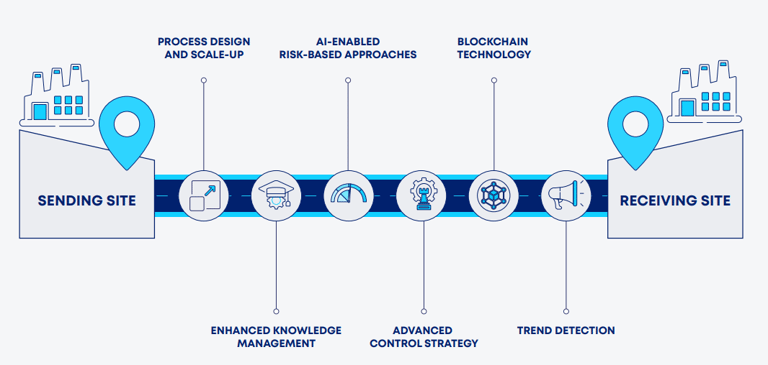
In successful Pharma 4.0 implementations, new techniques, platforms, and technologies are integrated into digital toolboxes that enhance existing mathematical algorithms through AI and ML, process monitoring, and optimization tools. These toolboxes can be leveraged within a technology transfer process roadmap to deliver multiple benefits, including the following (see Figure 2):
- Process design and scale-up
- Enhanced knowledge management
- AI-enabled risk-based approaches
- Advanced control strategy
- Trend detection
- Blockchain technology
Process design and scale-up
Digital tools, leveraging ML algorithms, developed from process development data, quickly identify optimal processing parameters for scale-up processes, thus reducing development time and minimizing waste.
Enhanced knowledge management
A critical aspect of tech transfer involves the migration of data, which can present substantial challenges. While the concept of transferring data may seem straightforward, issues such as connection failures can result in data loss and retrieval difficulties. Moreover, existing data often remains unused due to a lack of structure, connectivity, and context, creating a bottleneck in the tech transfer process. To mitigate risks, it is advisable to migrate data incrementally.
During tech transfer, several challenges arise:
-
Data collection completion: The initial stages of product development involve numerous trials and errors, generating a substantial influx of data. Stakeholders must meticulously record relevant data from these stages and employ proper methodologies and guidance to manage vast amounts of data effectively. Without adequate recording systems in place, data may go underutilized, leading to statistically unsound analyses and missed insights.
-
Data accuracy and integrity: Beyond completeness, it is critical to ensure the accuracy and integrity of recorded data. This requires implementing robust recording methods, verifying data during the recording process, and selecting appropriate recording tools-whether digital or manual.
-
Structuring and retrieving data: Organizing data into coherent, well-structured formats enables stakeholders to accurately locate and use the information they need. Conversely, poorly structured data offers limited value. In industries like pharmaceuticals and biotechnology, where data structures can be intricate, subject matter experts play a key role in planning data collection and organization strategies that ensure meaningful and logical organization.
In the era of big data, maintaining data integrity is paramount. Within a digital toolbox, AI algorithms are adept at detecting anomalies, ensuring data accuracy, and preventing tampering. Machine learning models can analyze vast datasets, identifying patterns that might elude human inspection. This strengthens data integrity throughout the pharmaceutical product lifecycle.
AI-enabled risk-based approaches
Digital tools have the potential to revolutionize quality risk management (QRM) within the ICH Q9(R1) framework. The ability of AI to process complex data quickly and accurately makes it an ideal tool for real-time risk assessment, decision-making, and mitigation by identifying potential risks in large datasets, detecting patterns, identifying correlations and relationships, and ultimately improving accuracy in risk assessments. Artificial intelligence allows manufacturers to proactively address issues that could affect product quality or safety.
Automated risk assessments simplify risk assessment procedures and foster a systematic and proactive approach to risk management. Real-time monitoring provides continuous surveillance of critical quality parameters, with AI exploring data to uncover risks that may be challenging to detect through traditional methods. Additionally, AI enables reducing biases and subjectivity in risk interpretation and probability scoring, leveraging the automation of routine compliance tasks.
Advanced control strategy
Digital tools can be employed to develop advanced process controls that predict the trajectory of manufacturing processes using real-time sensor data combined with AI methods. These controls, known as soft sensors, offer an effective alternative to traditional hardware sensors for gathering, monitoring, and regulating crucial process variables. This data-driven, AI-enabled approach presents a novel and efficient means of obtaining accurate readings throughout the entire processing chain without costly hardware installation, enhancing efficiency and reducing waste by optimizing process control.
Additionally, predictive maintenance analytics can anticipate potential equipment malfunctions and their timing by analyzing extensive datasets. Identifying correlations between obscure signals and events enables real-time decision support and pre-emptive alerts about potential failures.
Several pharmaceutical manufacturers have already implemented these methods, integrating an understanding of the underlying chemical, physical, and biological transformations occurring in the manufacturing process with AI-enabled techniques.
Blockchain technology
Blockchain is considered a key enabler of improved drug safety, reduced counterfeiting and fraud, enhanced supply chain efficiency, and ensured regulatory compliance. It relies on veracity, transparency, independence, and security to ensure certified, publicly accessible and cryptographically protected transactions.
Storing data from IoT sensors on a blockchain serves multiple purposes, such as facilitating more efficient real-time decision-making and enabling the creation of predictive models based on environmental hazards encountered throughout the cold chain cycle. These models reinforce the pharmaceutical cold chain by assessing and mitigating potential risks before they arise.
Trend detection
As part of the digital toolbox, AI plays a crucial role in identifying and analyzing clusters of problem areas, facilitating their prioritization for continuous improvement.
One of AI’s significant advantages lies in its ability to pinpoint trends associated with manufacturing deviations, fostering a comprehensive understanding of the underlying root causes. For instance, AI models and expert systems can predict optimal values for complex variables under investigation to optimize formulations or processes.
Digital tools play a key role in scrutinizing deviation reports, enabling more accurate and efficient data analysis, even when extensive textual content is involved. To reduce process downtime, maintenance actions can also be triggered whenever equipment performance deviates from the norm. Consequently, digital tools allow businesses to proactively adapt their strategies and stay ahead of the competition.
Key Considerations for Application of Digital Tools in the Technology Transfer Process
Major players in the life sciences and pharmaceutical industries have begun investing in digital tools, AI, and ML algorithms, and dedicating resources to their implementation. However, reaching the highest levels of manufacturing performance and quality requires a paradigm shift in mindset, significant investment in new technologies and infrastructure, development of in-demand skills within the organization, adoption of specialized IT frameworks integrated with legacy systems, and innovative corporate strategies.
With the potential to reduce costs, drive innovation in treatments, and enhance patient outcomes, digital tools represent the future of the pharmaceutical industry, and their implementation is already feasible.
Those who begin their digital transformation journey now will gain a competitive edge, as standards, strategies, use cases, and ecosystems continue to evolve. Nonetheless, while new technologies offer promising prospects, it’s critical to prioritize user experience during implementation.
In regulated sectors, such as drug development, manufacturing, and distribution, every digital data point is subject to regulatory scrutiny. Therefore, use cases must be meticulously defined, verified, validated, and completely transparent.
Here are 3 initial steps to embark on your journey to digital transformation:
-
Identify and empower advocates within your organization to explore potential applications and foster enthusiasm across teams.
-
Cultivate relationships with the emerging digital toolbox ecosystem by partnering with like-minded research labs, academic institutions, technology providers, application developers, and start-ups.
-
Prioritize use cases for small-scale proof of value (PoV) investments. Evaluate these based on their potential to deliver business and process insights. When prioritizing, consider your organization’s therapeutic focus areas, business strategy, customer value propositions, and future growth plans. Continuously monitor PoV performance and scale up successful initiatives.
The shift to a Pharma 4.0 operating model within your organization’s digital strategy is paramount. Moving forward, every business opportunity should be examined through an analytical driven lens. Embracing this cultural and mindset shift will cultivate a data-driven organization capable of swiftly recognizing, validating, and capitalizing on opportunities.
Conclusion
The integration of digital toolboxes in technology transfer processes within the Pharma 4.0 initiative offers numerous advantages:
Holistic Control Strategy
-
Automates digitalization and validation, ensuring compliance with ICH Q10 PQS guidelines.
-
Continuously monitors manufacturing processes using knowledge and quality risk management.
-
Reduces risk levels and time-to-market while improving quality standards.
-
Improves management of complex supply chain challenges by promoting interconnectivity and breaking down data silos.
Manufacturing Optimization
-
Streamlines digital workflows to save time, reduce costs, and eliminate redundant production cycles.
-
Ensures data integrity and high-level production quality while minimizing deviations from drug recipes, order schedules, and other contractual obligations.
-
Enables secure data capture and actionable insights to support effective troubleshooting, informed decision-making, and smarter workforce management.
-
Enhances GMP compliance through predictive analytics, bottleneck elimination, and optimized maintenance strategies.
Workforce Benefits
-
Improves working conditions and decision-making, boosting overall team performance.
-
Enhances process visibility and reduces stress and uncertainty by enabling close monitoring of manufacturing operations.
-
Eliminates manual paperwork through digital recordkeeping, increasing operational efficiency.
-
Fosters a culture of innovation and continuous improvement through higher employee engagement.
References
-
Boel, J. (2023, June 19). Pharma 4.0: The Future of Pharmaceutical Manufacturing.
-
Bridge Automation. (2023). Pharma 4.0: How AI and ML are changing the landscape of the biopharmaceutical industry.
-
Haddad, G. (2024, June 5). Revolutionizing QRM: The Impact of AI and ML.
-
Innopharma Technology. (2023). To Industry 4.0 and beyond.
-
International Society for Pharmaceutical Engineering (ISPE). (2022). ISPE GAMP® 5: A Risk-Based Approach to Compliant GxP Computerized Systems (Second Edition).
-
Jayus, A. A. (2023, June 3). The Role of Artificial Intelligence (AI) in Tech Commercialization: Powering the Future of Innovation.
-
Kidwai, A. (2024, November 19). The Nine Pillars Of Industry 4.0: Technological Advancements.
-
Körber Pharma. (n.d.). How data management and analytics ensure a successful tech transfer.
-
Lighthouse. (2023). The History Of Pharmaceutical Manufacturing: Industry 1.0 to Pharma 4.0.
-
Mack, J., & Mercer, E. (n.d.). Pharma 4.0 – A Vendor’s Perspective.
-
Misra, S. (2021, February 11). AI in Pharma: Emerging Use Cases Across the Value Chain.
-
Silvertown, A. (2023, November 25). Artifical Intelligence in Retail Pharmacy: The Impact and Potential of AI.
-
V Dashpute, S., J Pansare, J., K Deore, Y., & J Pansare, M. (2023, September). Artificial Intelligence and Machine Learning in the Pharmaceutical Industry.
-
VimaChem. (n.d.). Pharma 4.0 – A practical guide for a successful digital transition.
Table of Contents


