Smarter by the Second: How Real-Time Monitoring is Redefining Pharma and Biopharma Manufacturing


Summary
Real-time monitoring uses in-process sensors to capture and analyze manufacturing data as it happens. It gives continuous visibility into critical process parameters so teams can correct deviations quickly, supporting PAT, quality control, and lower variability.
This paper outlines why this matters in pharma and biopharma, the main monitoring technologies (including spectroscopy), and practical steps for implementation such as data integrity, interoperability, scalability, and regulatory alignment.
Key Takeaways
-
Continuous, in-process data helps detect drift early and correct deviations before they affect product quality or trigger rework or rejection.
-
Real-time monitoring supports PAT by enabling timely measurements tied to control tools that keep processes within design space.
-
Spectroscopic and dielectric tools can monitor cell culture and quality attributes, but they generate high-volume data that often needs preprocessing and multivariate analysis.
Who is this for
-
Bioprocess engineers (upstream and downstream)
-
Process Analytical Technology (PAT) specialists
-
Quality assurance and quality systems leaders
-
Validation and continued process verification (CPV) teams
-
Manufacturing science and technology (MSAT) professionals
-
Automation and controls engineers
-
Regulatory affairs and compliance professionals
-
Data integrity, IT, and OT/industrial cybersecurity teams
Download your Industry Insight
Smarter by the Second: How Real-Time Monitoring is Redefining Pharma and Biopharma Manufacturing
Real-time monitoring integrates physical sensors into pharmaceutical and biopharmaceutical manufacturing processes to capture and analyze process data as it occurs. Unlike traditional offline methods, this approach provides continuous visibility into critical process parameters, enabling rapid correction when deviations arise. As part of a Process Analytical Technology (PAT) framework, real-time monitoring strengthens quality control, improves process efficiency, and reduces variability through early drift detection. It also lays the foundation for advanced manufacturing models such as continuous processing, Pharma 4.0 connectivity, and the development of digital twins. This Industry Insight explores the role of real-time monitoring in ensuring product quality, regulatory compliance, and operational agility, outlining current technologies, implementation strategies, and future trends shaping the industry’s digital transformation.
Introduction
The pharmaceutical and biopharmaceutical industries are under increasing pressure to deliver complex products faster while maintaining consistent quality and regulatory compliance. Traditional process monitoring methods, largely dependent on offline sampling and delayed analysis, struggle to keep pace with today’s expectations for data integrity, real-time decision-making, and operational efficiency.
Real-time monitoring addresses these challenges by integrating physical sensors into the production process to enable the continuous acquisition of real-time data. This approach contrasts with conventional monitoring methods, which rely on offline sampling and typically require multiple analytical preparation steps and additional reagents.
As digital transformation accelerates, initiatives such as Process Analytical Technology (PAT) and Pharma 4.0 are reshaping how manufacturers design, monitor, and control their processes. Real-time monitoring sits at the center of this transformation, offering a proactive approach that enables continuous oversight of critical process parameters (CPPs) and rapid response to deviations.
By embedding intelligent sensors, analytics, and control tools directly into production systems, real-time monitoring empowers manufacturers to maintain processes within their defined design space. The result is improved product quality and compliance plus greater scalability and cost efficiency, which matter in a competitive, data-driven market.
Importance for Pharma and Biopharma
Biopharmaceutical production processes are inherently complex due to the variability of biological products. This variability results from the presence of cellular entities that are highly sensitive to minimal variations in the culture medium, which can influence their ability to produce the intended product.
For pharmaceutical and biopharmaceutical manufacturers, implementing real-time monitoring is essential to ensuring product quality, safety, and compliance. By using real-time monitoring probes, parameters such as the cell state, nutrient levels, and by-product concentrations can be monitored alongside product formation. These tools can initiate corrective control mechanisms when monitored variables deviate from their set points or normal operating ranges (NOR), preventing impacts to product quality that could lead to product loss, batch reprocessing, or even batch rejection.
When the right attributes are monitored, any undesired process drift can be detected early, allowing the appropriate control mechanisms to adjust process parameters. This corrective action helps steer the process into its defined design space, ensuring the desired product quality. Timing is critical: the faster the deviation is corrected, the less likely it is to impact the final product.
Ultimately, real-time monitoring drives process optimization, increases efficiency, and reduces costs. This capability is particularly important in cell and gene therapy, where large quantities of viral vectors or cells must be manufactured cost-effectively. Real-time monitoring supports the development of scalable, compliant, and standardized manufacturing processes.
Some of the key benefits of implementing real-time monitoring include:
- Reducing process variability
- Increasing process productivity
- Maintaining consistent product conditions that ensure quality throughout the different process steps and in the final product
Real-time monitoring can also be applied to downstream processing to ensure impurity removal and maintenance of product quality.
Finally, when combined with automation, real-time monitoring enables continuous manufacturing, a technology that reduces plant footprint, capital costs, and labor needs. Continuous manufacturing also provides greater flexibility, scalability, and efficiency than traditional batch processing, since setup times are shorter, and downtime between batches is reduced. Real-time monitoring tools are key enablers of this approach, enabling faster response times, control, and real-time release testing, which are essential for continuous processes.
Relationship with Process Analytical Technology
According to the FDA, PAT is “a system for designing, analyzing, and controlling manufacturing through timely measurements (i.e., during processing) of critical quality and performance attributes of raw and in-process materials and processes, with the goal of ensuring final product quality”.
Real-time monitoring is a key component of the PAT framework, as it supports the requirement for timely measurements. Ideally, to provide timely measurements, real-time monitoring tools should be either online or in-line, as these types of sensors insert the probe directly into contact with the fluid to be analyzed.
To maintain an adequate process state, the real-time monitoring tools used should be integrated with suitable control tools that receive the information provided by the real-time monitoring probe and act accordingly. By adjusting the necessary process variables within the defined design space limits, the process is maintained in the correct control state, thereby ensuring final product quality and sustaining the PAT initiative.
Technologies and Solutions for Real-Time Monitoring
In pharmaceutical and biopharmaceutical manufacturing, real-time monitoring tools can be used to expand process knowledge regarding CPPs and their impact on critical quality attributes (CQAs). Examples of these applications include:- Raw material and intermediate product identification and/or quality assurance
- Mixture homogeneity assessment
- Determination of water content
- Monitoring and control of process parameters (pH, dissolved oxygen, protein concentration, and so on)
- Detection and quantification of the protein of interest in downstream steps
- Supporting experimental design by structuring experiments to obtain the maximum knowledge possible
Ideally, and especially in biopharma contexts, real-time monitoring tools should be non-destructive, non-invasive, and provide rapid and comprehensive information from the culture in real time, with accurate and actionable measurements. They must also be robust, capable of withstanding the cellular culture environment and sterilization procedures, and reliable across several batches.
In biopharmaceutical processes, the use of spectroscopic tools offers these characteristics and has been widely employed for monitoring cell culture parameters, ranging from process parameters such as pH to product quality attributes, including titer and even the antibody glycosylation profile. Examples of these tools include infrared spectroscopy (near, mid, and Fourier-transform), dielectric spectroscopy, fluorescence spectroscopy, and Raman spectroscopy (3).
Table 1 provides an overview of the most common spectroscopic techniques used for cell culture monitoring, including measurement principles, key features, and current limitations.
Table 1. Common spectroscopic techniques used for cell culture monitoring.
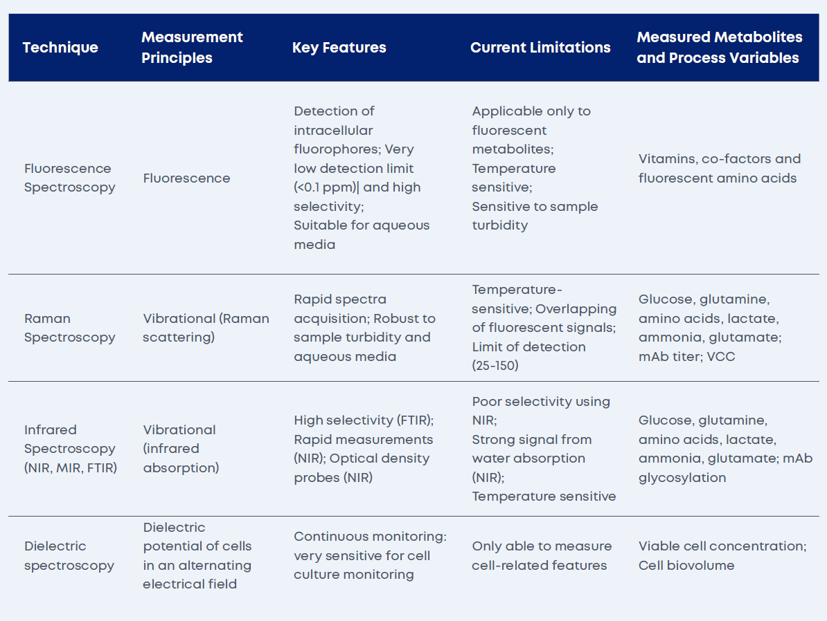
Due to the complexity of the culture medium, the ability of these tools to measure data at different wavelengths and frequencies, and the high frequency of data acquisition, these tools generate large amounts of data. Spectroscopic outputs are typically distributed across multiple peaks and bands. Therefore, analysis of this type of data requires preprocessing steps and usually multivariate data analysis tools, which can reduce the multivariate dataset obtained, eliminate noise, and correlate the processed data with the variable(s) of interest.
Beyond multivariate approaches and machine learning, artificial intelligence (AI) presents vast opportunities for the industry. Predictive analytics can provide data-driven insights into drug discovery, clinical trials, and patient outcomes, while image recognition technology aids in medical imaging analysis, accelerating diagnosis and treatment decisions.
Implementation Strategies
Implementing real-time monitoring systems in pharmaceutical and biopharmaceutical processes requires following certain best practices to ensure these systems enhance product quality and operational efficiency through the entire manufacturing product lifecycle:
Data security and integrity
Organizations should establish robust security measures and maintain data integrity throughout all phases of real-time monitoring implementation.
Scalability
In the scope of Pharma 4.0 (7), where every piece of equipment is expected to communicate in real time with every other, companies should implement real-time monitoring systems that anticipate growth in the volume of generated data. This planning should account for both the increasing volume of data and evolving business requirements over time, including solutions for data storage and maintenance, as well as the number of real-time monitoring tools required.
Interoperability
Also in the context of Pharma 4.0, this requirement refers to the need to standardize data formats, communication protocols, and equipment interfaces. Doing so ensures compatibility with existing infrastructure and software systems, enabling data sharing, analysis, and collaboration across the organization and with external stakeholders.
Interdisciplinary teams
Given the technical, data, and operational complexities involved, cross-functional collaboration is essential. Teams should include process engineers, IT specialists, operations personnel, and quality assurance and regulatory compliance experts to ensure a holistic approach to real-time monitoring implementation. It is also essential to conduct a thorough risk assessment of current processes to identify risks, opportunities for improvement, and key performance indicators (KPIs) for the real-time monitoring program.
Regulatory Considerations
The implementation of real-time monitoring tools in this industry must comply with relevant regulatory guidance, such as ICH Q8, ICH Q9, and ICH Q10 (8-10), the FDA’s PAT Guidance for Industry (5), and any applicable documentation for the specific real-time monitoring tools, including pharmacopoeia monographs.
Regulatory agencies, including the FDA, the European Medicines Agency (EMA), and the Brazilian Health Regulatory Agency (ANVISA), enforce guidelines to ensure the safety, efficacy, and quality of medical products, while promoting continuous improvement and lifecycle management. In doing so, they help ensure smooth regulatory approvals.
Real-time monitoring data can also be valuable during audits because it provides a comprehensive understanding of the process as a whole. It facilitates proactive risk management and quality assurance by supporting the implementation of in-process controls and creating the conditions for an enhanced validation approach through continuous process verification, as defined in ICH Q8.
Future Trends and Opportunities
In the future, it is expected that the ICH Q8 through ICH Q11 guidelines will evolve from industry standards to formal regulatory expectations for product approval within the pharmaceutical and biopharmaceutical industries. These will be accompanied by the implementation of science- and risk-based methodologies for development, manufacturing, and quality assurance, in line with the Quality by Design (QbD) initiative.
The routine use of real-time monitoring tools, aligned with QbD and PAT frameworks, will ensure that manufacturing processes are robust and efficient, capable of consistently delivering high-quality products in a cost-effective manner. It is also expected that PAT systems will become an integral part of both commercial and development equipment, enabling the collection, storage, and processing of vast amounts of data. This will increase process and product knowledge, even during development, thanks to advances in AI.
These developments will ultimately support the achievement of real-time release testing, defined as “the ability to evaluate and ensure the quality of in-process and/or final product based on process data, which typically include a valid combination of measured material attributes and process controls”.
As mentioned in this article, one emerging trend is the integration of Internet of Things (IoT) devices and sensors into real-time monitoring solutions, aligned with the principles of Industry 4.0. Furthermore, advancements in data analytics and AI are enhancing the capabilities of real-time monitoring systems to detect patterns, predict outcomes, and optimize processes in real time.
Ultimately, these technologies will enable the development of a process digital twin, a digital copy of the manufacturing process, that allows teams to test different process configurations and control strategies, and to predict their impact on productivity and product quality.
Conclusion
The implementation of real-time monitoring presents significant opportunities for innovation in the pharmaceutical and biopharmaceutical industries. It can lead to increased process efficiency, waste reduction, and accelerated time-to-market for new drugs and therapies.
Real-time monitoring is also a key component of the PAT framework, providing timely information that supports decision-making at every stage of the product lifecycle. As the industry continues to evolve, real-time monitoring will play an increasingly important role in shaping the future of drug development and manufacturing, driving efficiency, agility, and competitiveness in a rapidly changing market.
References
- Wasalathanthria, D. P., Ding, J., & Li, Z. J. (2020). Real Time Process Monitoring in Biologics Development. American Pharmaceutical Review. https://www.americanpharmaceuticalreview.com/Featured-Articles/564225-Real-Time-Process-Monitoring-in-Biologics-Development/
- Alimagham, F., Winterburn, J., Dolman, B., Domingues, P. M., Everest, F., Platkov, M., Basov, S., Izakson, G., Katzir, A., Elliott, S. R., & Hutter, T. (2021). Real-time bioprocess monitoring using a mid-infrared fibre-optic sensor. Biochemical Engineering Journal, 167, 107889. https://doi.org/10.1016/j.bej.2020.107889
- Pais, D. (2020). Development of advanced monitoring and control tools for rAAV production in the insect cell system. Universidade Nova de Lisboa.
- Jungbauer, A., & Hammerschmidt, N. (2017). Integrated Continuous Manufacturing of Biopharmaceuticals. In Continuous Manufacturing of Pharmaceuticals (pp. 247–281). John Wiley & Sons, Ltd. https://doi.org/10.1002/9781119001348.ch7
- United States Food and Drug Administration. (2004). Guidance for industry: PAT — a framework for innovative pharmaceutical development, manufacturing, and quality assurance. https://doi.org/https://www.fda.gov/downloads/Drugs/GuidanceComplianceRegulatoryInformation/Guidances/UCM070305.pdf
- Pais, D. A. M., Carrondo, M. J. T., Alves, P. M., & Teixeira, A. P. (2014). Towards real-time monitoring of therapeutic protein quality in mammalian cell processes. Current Opinion in Biotechnology, 30, 161–167. https://doi.org/10.1016/j.copbio.2014.06.019
- Manzano, T., & Langer, G. (2018). Getting ready for pharma 4.0. Data integrity in cloud and big data applications. Pharmaceutical Engineering, 72–70. https://www.ispe.gr.jp/ISPE/02_katsudou/pdf/201812_en.pdf
- International Council for Harmonisation of Technical Requirements for Pharmaceuticals for Human Use. (2009). ICH guideline Q8 (R2) on pharmaceutical development.
- International council for harmonisation of technical requirements for pharmaceuticals for human use. (2023). Quality Risk Management Q9(R1). https://database.ich.org/sites/default/files/ICH_Q9%28R1%29_Guideline_Step4_2023_0126_0.pdf
- International council for harmonisation of technical requirements for pharmaceuticals for human use. (2008). ICH guideline Q10 on pharmaceutical quality system. https://www.ema.europa.eu/en/documents/scientific-guideline/international-conference-harmonisation-technical-requirements-registration-pharmaceuticals-human-guideline-q10-pharmaceutical-quality-system-step-5_en.pdf
- Zhavoronkov, A., Vanhaelen, Q., & Oprea, T. I. (2020). Will Artificial Intelligence for Drug Discovery Impact Clinical Pharmacology? Clinical Pharmacology & Therapeutics, 107(4), 780–785. https://doi.org/10.1002/cpt.1795
- Zhavoronkov, A., Ivanenkov, Y. A., Aliper, A., Veselov, M. S., Aladinskiy, V. A., Aladinskaya, A. V., Terentiev, V. A., Polykovskiy, D. A., Kuznetsov, M. D., Asadulaev, A., Volkov, Y., Zholus, A., Shayakhmetov, R. R., Zhebrak, A., Minaeva, L. I., Zagribelnyy, B. A., Lee, L. H., Soll, R., Madge, D., … Aspuru-Guzik, A. (2019). Deep learning enables rapid identification of potent DDR1 kinase inhibitors. Nature Biotechnology, 37(9), 1038–1040. https://doi.org/10.1038/s41587-019-0224-x
- U.S. FDA. (2023). Using Artificial Intelligence & Machine Learning in the development of drug and biological products - Discussion paper and request for feedback. https://www.fda.gov/media/167973/download?attachment
- Bader, J., Narayanan, H., Arosio, P., & Leroux, J.-C. (2023). Improving extracellular vesicles production through a Bayesian optimization-based experimental design. European Journal of Pharmaceutics and Biopharmaceutics, 182, 103–114. https://doi.org/10.1016/j.ejpb.2022.12.004
- Bayer, B., Striedner, G., & Duerkop, M. (2020). Hybrid Modeling and Intensified DoE: An Approach to Accelerate Upstream Process Characterization. Biotechnology Journal, 15(9). https://doi.org/10.1002/biot.202000121
- Chen, Y., Yang, O., Sampat, C., Bhalode, P., Ramachandran, R., & Ierapetritou, M. (2020). Digital Twins in Pharmaceutical and Biopharmaceutical Manufacturing: A Literature Review. Processes, 8(9), 1088. https://doi.org/10.3390/pr8091088
Table of Contents


