Scaling SAP Validation Without Scaling the Workload: Risk-Based Planning and Controlled Reuse

Part of: Validation
Summary
SAP migrations and rollouts create different validation needs across sites. Teams can limit repeated work by defining scope from intended use and risk, reviewing approved content for reuse, and keeping requirements, tests, evidence, findings, and approvals connected.
The eBook shows how risk-based prioritization, connected knowledge, controlled reuse, and digital CSV workflows can help teams assess changes, justify test reuse, address site differences, and maintain validation evidence as SAP programs expand.
Key takeaways
- Validation scope should reflect an SAP function’s intended use, potential impact, site differences, and the testing needed to show that it works correctly.
- Existing requirements, test procedures, risk assessments, and results should be reviewed for applicability before they are reused at another SAP site.
- Connecting requirements, tests, evidence, findings, and approvals helps teams assess changes without repeatedly reconstructing earlier validation decisions.
Who is this for
- VP of Validation / CSV
- Director of Validation / CSV
- Director of QAV
- VP of IT / IT Quality / Digital Quality / Operations
- Director of IT
- VP of Quality/QA
- Director of Quality/QA
- VP of Digital Transformation / Innovation
- Project Manager
Download your e-Book
eBook
Scaling SAP Validation
Without Scaling the Workload
Risk-Based Planning and Controlled Reuse
01. Executive Overview
Make Validation Part of Transformation Readiness.
SAP validation helps confirm that the system works as intended and that its data can be
relied on for regulated business activities. A successful transaction alone does not
demonstrate that a quality control works. Requirements, risks, tests, and reviewed
evidence must support the conclusion.
As programs expand, workload grows for different reasons. New interfaces,
configurations, and intended uses may require additional testing. The goal is to keep validation
effort from growing with every rollout by reducing repeated preparation, testing, and
review where existing work remains applicable. A new warehouse interface may require
additional testing, while another site may be able to reuse existing tests after confirming they
remain applicable. Managing these differences consistently helps teams expand validation
without repeating work unnecessarily.
Three practices support this approach:
-
Define scope from intended use and risk.
- Review approved content for reuse in the
target environment. - Connect requirements, tests, evidence,
findings, and approvals.
A digital approach to computerized system validation (CSV) keeps requirements, tests,
evidence, and approvals connected, helping teams reduce repeated preparation and
coordination while maintaining control as SAP validation expands.
02. The Challenge
Follow the Change Beyond the Transaction.
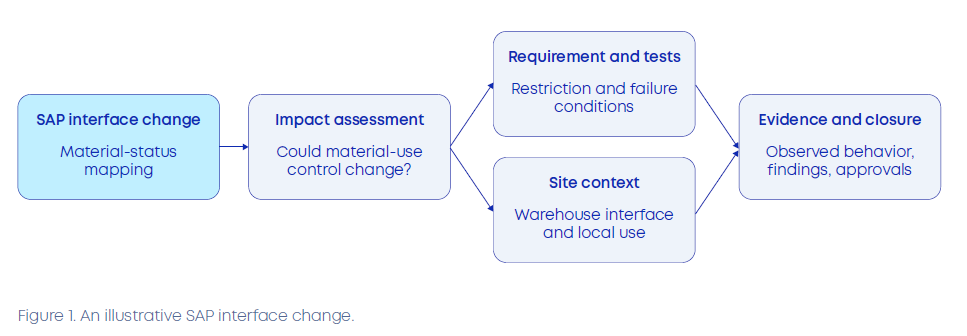
Consider a change to how SAP communicates material-status information to a
warehouse system. The validation team must confirm that the warehouse system still
prevents restricted materials from being used. Teams need to establish:
-
Which approved requirement and configuration apply?
-
Which tests remain relevant and what additional tests are needed to check how the system handles errors?
-
What test results show that the warehouse system correctly prevents restricted material from being used?
-
Which issues still need to be resolved, and which approvals are needed to complete validation?
Workload increases when teams must search through separate records and
manually compare information to answer these questions. As SAP is introduced at
more sites, identifying shared requirements and site-specific differences helps teams
decide which existing tests can be reused and document why they still apply.
03. Risks of the Status Quo
Avoid Carrying Validation Gaps Into the Next SAP Rollout.
As SAP is introduced at more sites, teams may copy validation tests from an earlier rollout.
Those tests may miss differences in SAP configuration, user permissions, or connections to
warehouse systems. Checking and correcting them late adds work.
Completed testing can also give an incomplete picture. A test may confirm that SAP sent a
restricted material status without checking whether the warehouse system prevented that
material from being used.
Before completing validation for an SAP rollout, ask:
-
Do the tests address the site’s SAP configuration and connected systems?
-
Do the results show that material restrictions work as intended?
-
Have issues found during testing been reviewed, with actions and decisions documented?
-
Have the required validation records been approved?
04. Risk-Based Prioritization
Match Effort to Intended Use.
Validation effort depends on how an SAP function is used and what could happen
if it fails. For example, a material-status rule that prevents restricted material from
being used needs testing that demonstrates the restriction works. EU GMP Annex 11
supports a documented, risk-based approach and traceable user requirements.
| ASSESS | ASK |
| Business use | Which regulated activity does this SAP function support? |
| Potential impact | Could an error affect material use, product quality, or records? |
| Site differences | Do SAP settings, connected systems, or user permissions differ at this site? |
| Testing needed | Which tests show that the function works correctly and handles relevant errors? |
Use these answers to decide which existing tests remain applicable and where
additional testing is needed. Document the reasons so reviewers can understand
the selected scope.
Keeping these decisions linked to requirements and tests in a digital CSV workflow
helps teams assess future SAP changes without rebuilding the rationale each time.
05. Connected Knowledge and Controlled Reuse.
Confirm What Can Be Reused at Each SAP Site.
Connected knowledge links requirements, tests, SAP configurations, and results.
These relationships help teams understand why a test exists and whether it
applies to another site, reducing the effort of reconstructing earlier decisions.
| ASSET | CHECK BEFORE REUSE |
| Requirements and test objectives | Do the same business rules and expected results apply? |
| Test procedures and risk assessments | Do they address the site’s SAP settings, connected systems, user permissions, and potential errors? |
| Previous test results | Do they support the current setup and use? Has their reuse been justified and approved? |
Record whether content can be reused unchanged, needs updating, or must be
created. Keep its source version and the reasons for the decision.
Digital workflows maintain these links. AI can help compare authorized content,
highlight differences, and draft updates using relevant requirements and records.
Qualified people confirm applicability and approve the resulting records.
06. Strategic Business Value
Reduce Repeated Work Across SAP Rollouts.
Digital validation can help teams reuse approved work, spend less time checking
separate records, and identify what still needs attention before an SAP release.
Measure these benefits against a completed rollout with similar scope and risk.
| BUSINESS BENEFIT | WHAT TO MEASURE |
| Less preparation effort | Hours spent creating or updating SAP validation tests |
| Smoother reviews | Review cycles and requests for missing information |
| Less avoidable retesting | Tests repeated because instructions or evidence were incomplete |
| Clearer release readiness | Requirements without supporting test results, unresolved issues, and pending approvals |
Across sites, track whether updating existing tests takes less effort than recreating
them. Check that the results still demonstrate the required SAP behavior.
These improvements support rollout planning, although SAP go-live also depends
on configuration, data migration, training, and business acceptance. Expand the
approach when comparable rollouts show less repeated work and adequate
validation evidence.
07. Practical Application
Verify the Control After the Change.
EU GMP Annex 11 addresses validation, traceability, and migration checks for GMP
computerized systems. For drug manufacturing, 21 CFR 211.68 also requires controls
over computerized records and input/output accuracy.
An approved business rule prevents restricted material from being used. An SAP
rollout changes how that status is translated and sent to the warehouse system.
| ACTION | WHAT THE TEAM CHECKS |
| Reuse | Do the existing requirement and test objective still apply? |
| Reassess | Could the changed status mapping affect how the warehouse blocks material use? |
| Test | Does the restriction work, including when a status is missing or unrecognized? |
| Complete review | Have test results been reviewed, issues addressed, and required approvals obtained? |
Confirming that SAP sent the status is only one check. Test results must also show
that the warehouse applies the required restriction.
This example is illustrative. Select tests and expected results are based on
approved business requirements and the site’s SAP setup.
08. The Smarter Way Forward
Start With Reusable Knowledge and the Right Context.
For the next SAP migration or rollout, select one process with repeated validation effort. Review
it with Validation, Quality, IT, and the process owner.
Ask:
-
Which existing requirements and tests could we reuse?
-
Which SAP configurations and changes affect their suitability?
-
Which previous results and internal standards should guide the work?
-
Can reviewers trace content to its source and confirm it applies?
Pilot the approach and compare preparation effort and evidence quality before expanding.
Reusable SAP knowledge provides a starting point. Customer requirements, configurations, and
records provide the context for applying it. AI assistance should use authorized sources, with
qualified people reviewing outputs and approving records.
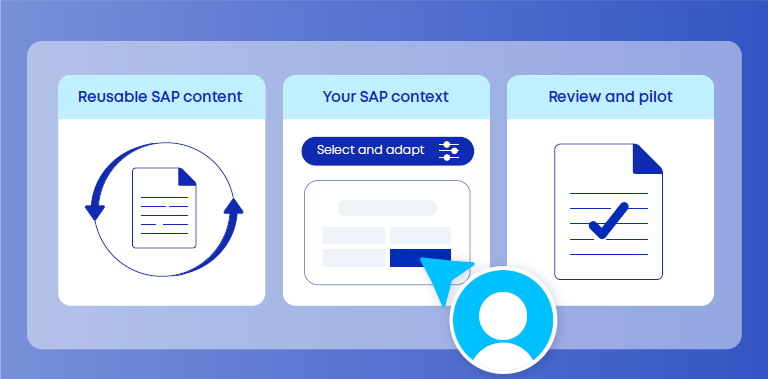
Confirm applicability. Compare effort and evidence quality.
09. Conclusion
Scale SAP Validation With Less Repeated Work.
Each SAP migration or rollout needs evidence that the system supports its intended use.
Reusing suitable content, assessing site differences, and connecting requirements, tests,
results, and approvals can reduce repeated work.
The next step is making relevant knowledge available alongside the customer’s SAP
context, so teams can build on existing work and understand what needs to change.
ValGenesis iVal™ supports digital CSV workflows, controlled test execution, and
traceability. The ValGenesis Knowledge Hub provides SAP reference and validation
content for customers to draw on. The Customer Knowledge Hub holds customer controlled
requirements, configurations, and records. VAL™ (ValGenesis AI) retrieves
authorized customer knowledge to generate context-specific outputs, with qualified
people reviewing and approving the resulting records.
Table of Contents


