Comparability for Post-Approval Changes


Summary
Post-approval manufacturing changes for biologics can shift product quality, even when normal batch-to-batch variability is expected. The paper explains how to compare pre-change and post-change lots using a full analytical package across multiple quality attributes.
It proposes multivariate methods, including multiblock analysis and PCA, to pinpoint which analytical domains and variables drive differences, then apply risk-based tiering and standard statistics to judge whether differences are clinically meaningful.
Key takeaways
-
Post-approval changes such as site transfers, scale-up, equipment replacement, or new analytical methods call for tight comparability between pre-change and post-change lots.
-
Compare the full analytical package across domains like structure, purity, post-translational changes (PTM), and bioactivity, then use multiblock analysis to see which domain drives variability.
-
Within the domain of interest, use PCA to identify the variables responsible, then apply standard statistics and FDA 3-tier classification to judge criticality and clinical meaning; summarize results in a comparability map.
Who is this for
-
CMC regulatory affairs specialists preparing post-approval change packages
-
Process development and manufacturing scientists planning scale-up or equipment changes
-
Analytical development scientists designing characterization and comparability strategies
-
Quality control (QC) and quality assurance (QA) teams reviewing attribute trends and deviations
-
Tech transfer and manufacturing site-change leads managing pre- and post-change lots
-
Biostatisticians or data scientists supporting multivariate analyses in CMC
Download your Industry Insight
Comparability for Post-Approval Changes
Currently it is known and well-accepted that, even for the same biological medicine, a small degree of variability over consecutive batches production is expected. A classic example is the glycosylation profile of a protein that can present minor differences in sugar chains without affecting its biological activity.
Nevertheless, process post-approval changes are expected during the product lifecycle. Changes in location of manufacturing, scale-up operations, equipment replacement or introduction of new analytical methods, can strongly affect product quality and safety. In these situations, the differences found in comparability assessments before and after change should be even smaller than those between products made by two different processes and manufacturers. Therefore, the business case for the usage of multivariate approaches becomes highly relevant given that, as these tools allow the analyst to find very small changes across multiple attributes which can be translated into an overall assessment of the product changes in consideration.
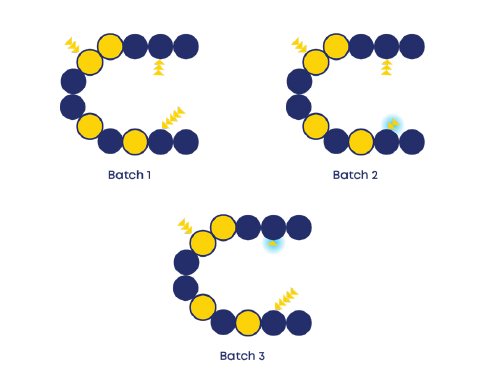
Fig. 1 - Adapted from: Inter-batch variability in protein glycosylation profile of a certain biologic product. From EMA Biosimilars in the EU: Information Guide for Healthcare Professionals (2017)
The presented approach is based on the comparison of analytical packages, a comprehensive set of analytical techniques that includes different types of data for multiple quality attributes. In a post-approval change scenario, the biosimilarity assessment will include two analytical packages: pre-change and post-change. The usage of a multivariate approach in this context ensures that the most relevant information on each analytical technique used is captured and that all techniques are consolidated into a single overall analytical package evaluation, allowing the package comparison.
This type of approach enables a product’s quality and safety comparison between the two different situations. By categorizing the quality attributes into different analytical domains, such as structure, purity, post-translational changes (PTM) and bioactivity, and using a multiblock algorithm, it is possible to find out which domain is the major source of variability to suggest more relevant differences between the two groups in comparison (pre and post-change).
This first insight on data is important, since it allows companies to streamline the exhausting process of assessing each quality attribute using traditional approaches by guiding the comparability exercise towards the ones that really need more attention. Figure 2 shows an example of how this anaylsis can be conducted. In this case, a good hint of similarity is given in the cases of blocks having the same weights in both products (bars with the same size). Consequently, these results indicate that the differences between pre-change and post-change lots may be significant in terms of purity.
After identifying which analytical domain is the strongest candidate to explain potential differences between pre-change and post-change product, the next step is to focus on the variables that are responsible for those differences. Once again, by using a multivariate approach such as Principal Component Analysis (PCA), it is possible to identify, within the analytical domain with greater variability, which variables are responsible for the differences.
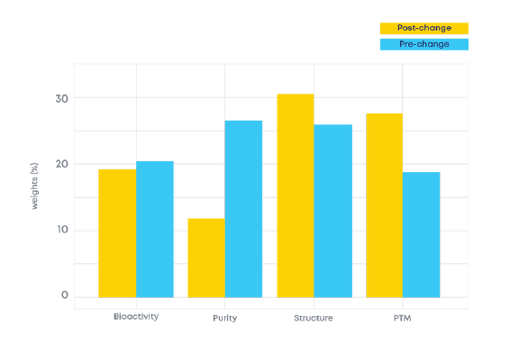
Fig. 2 - Use of multiblock approach to identify the analytical domain representing the major source of variability between the pre-change and post-change product.
Finally, at variable-level, all classical statistical approaches are applicable to analyze trends and deviations.
This stage becomes much less effort and time-consuming since, instead of analyzing an extensive list of quality attributes using a one-at-the-time and univariate approach, a robust multiparametric and multivariate methodology was applied first to filter the variables that really matter in the comparison exercise. On top of that, the use of a risk-based approach to assess effect using FDA’s 3-tiered classification allows to determine if these found variables are critical or non-critical.
The result of the comparability exercise made as described in this article, using both multivariate approaches and classical univariate statistical evaluation, is a detailed assessment of product differences to determine whether they are clinically meaningful to the comparison in place either it a post-approval change scenario (e.g. site transfer or process scale-up) or a biosimilarily assessment. Figure 3 illustrates how the results can be wrapped up into a powerful visual tool. This way of data visualization can be extremely powerful since it gathers all the relevant information retrieved from the application of multivariate tools and organizes it in a hierarchical way, summing up all the steps in the comparability exercise workflow:
-
Identification of major sources of differences between pre and post-change batches;
-
Identification of analytical domain for those variables;
-
Criticality Assessment in terms of effect and uncertainty on clinical outcomes.
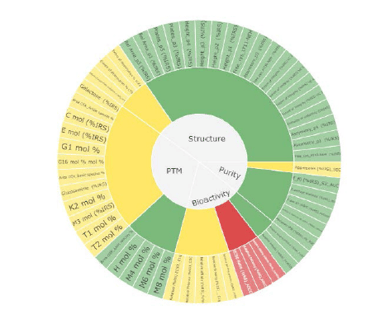
Fig. 3 - Map of Comparability Exercise results following ValGenesis stepwise and risk-based approach.
Consistent with the FDA’s tiered and totality of-evidence concepts in biologic development, a unique multiparametric approach is proposed 1,2,3. Although particularly useful to compare the complete domains of biosimilar and reference products, the use of these methods can be extended to comparability assessments performed during the lifecycle management of a given biologic product.
References
-
U.S. Food and Drug Administration, CDER, CBER. (April, 2015). Scientific Considerations in Demonstrating Biosimilarity to a Reference Product.
-
Menezes, J.C., Loia, A.C., Leitão, C.S. (2019). Biosimilarity Assessments The Totality of Evidence Framework. BioProcess International.
-
Leitão, C.S. Fast-tracking Biosimilars Approval: How to Reduce Time-to-Market; ValGenesis Industry Insights;
-
European Medicines Agency and the European Commission. (2019). Biosimilars in the EU: Information Guide for Healthcare Professionals.
Table of Contents


