Kneat's Comparison of ValGenesis Raises Questions About Its Methodology


Summary
Kneat ranked itself above ValGenesis without publishing, on the face of the page, a buyer-grade methodology. In validation circles, comparative claims should be tested against verifiable evidence.Key Takeaways
-
Comparative claims should be tied to disclosed sources, criteria, sample size, product versions, user roles, and review dates.
-
In regulated validation environments, marketing claims are not a substitute for auditable evidence.
-
Buyers should ask each vendor for proof across lifecycle coverage, data integrity, implementation support, references, and measurable customer outcomes.
Who is this for
- Validation leaders
- Quality assurance leaders
- Computer system validation specialists
- CQV managers
- Regulatory affairs professionals
- IT quality and compliance leaders
- Life sciences procurement teams evaluating validation platforms
Relevant Entities to this Post
Kneat recently published an article on its website titled "8 best ValGenesis alternatives."
Based on ValGenesis’ review of the article, it is a vendor-authored comparison that ranks Kneat as the best alternative to ValGenesis. Notably, Kneat stops short of claiming it is a “better” alternative to ValGenesis.
Vendor-authored comparisons can be useful when they are transparent, sourced, and auditable. On the face of the article, readers are asked to accept conclusions without the benefit of clearly disclosed sourcing details. ValGenesis believes such details are essential for independent evaluation.
The article does not appear to disclose a scoring methodology, source list, review sample, or timeframe. Without these inputs, readers may have limited ability to independently assess the conclusions. That matters.
Validation buyers operate in strict environments characterized by traceability, documentation control, review discipline, and inspection readiness — standards that require claims to be supported, not based on assumptions. Conclusions that cannot be traced to verifiable evidence should not be treated as decision-grade inputs.
What Buyers May Infer From The Article
The issue is not that Kneat competes. Every serious vendor does. The issue is how the comparison appears to be constructed.
The article assigns ratings, characterizes ValGenesis across key categories, and positions Kneat as the preferred alternative, but it does not appear to provide the underlying method needed for readers to independently test those conclusions.
When a comparison presents conclusions without traceable inputs, it may function more as marketing than as independent analysis. In regulated environments, marketing statements are not a substitute for evidence.
If readers are asked to accept conclusions that are not tied, on the face of the page, to disclosed sources or criteria, they may reasonably question whether the same level of substantiation is used elsewhere — for example, in a product demo, an implementation plan, an audit-readiness claim, or a data integrity assertion.
In validation, trust depends on consistent evidence standards.
This article reflects ValGenesis' assessment of the publicly available comparison article identified above, as reviewed on May 28, 2026. It is intended to comment on disclosed sourcing and substantiation, not to make claims about Kneat's overall product quality or business practices.
What Were the Claims Presented — And What Buyers Should Ask
| Kneat claim | What should be asked | ValGenesis response |
| Kneat characterizes ValGenesis as difficult to use. | Which reviews, product versions, user roles, sample size, and date range support that rating? |
In the article reviewed, no disclosed source or evaluation method was identified to support that characterization. In contrast, ValGenesis has published customer case studies describing structured signoffs, simplified review and approval, one-click deviation access, enhanced collaboration, and review cycles reduced from one week to half a day. |
| Kneat suggests that some users found ValGenesis insufficiently flexible or supported. | Which customers? Current or former? Which use cases? How many? |
In the article reviewed by ValGenesis, the statement is attributed to unspecified customer experience. In contrast, a ValGenesis published customer case study documents scalable deployment across 25+ global systems, support for 400+ users, management of 20,000 validation documents, configurable role-based access, and delivery team support during enterprise CSV transformation efforts. [link to Catalent case study] |
| Kneat rates itself highly across key categories. | Who scored the categories, and what evidence would change the score? | The article assigns Kneat high ratings across key categories, but ValGenesis did not identify a published scoring framework or criteria that would allow buyers to independently evaluate those results. |
| Kneat states that offline test execution can create data integrity risk. | Is there a cited incident, technical risk analysis, or regulatory finding? |
ValGenesis did not identify disclosed evidence in the article tying that statement to a cited incident, technical analysis, or regulatory finding. ValGenesis states that its offline execution capability is designed to maintain contemporaneous ALCOA documentation when internet access is limited, with automatic synchronization, audit trails, timestamps, electronic signatures, encryption, and Part 11 and Annex 11 alignment. |
| Kneat suggests it offers lower data storage, support, and consulting costs. | Where is the cost model, and what assumptions were used? | In the article reviewed by ValGenesis, the cost comparison is not accompanied by pricing assumptions, implementation scope, administrative effort, or services model details. Without those inputs, buyers may have limited ability to evaluate the comparison. |
| Kneat presents itself as the "safer" alternative. | Is that conclusion based on independent analysis or vendor preference? | That conclusion appears to reflect vendor opinion rather than a disclosed independent framework. Buyers may instead want to evaluate platforms based on documented validation lifecycle coverage, CSA support, configurable workflows, offline execution, automated evidence handling, audit trails, enterprise integrations, and customer outcomes across relevant use cases. |
Kneat's article seeks to position ValGenesis as the higher-risk choice. Buyers may wish to consider whether conclusions that are not tied to disclosed evidence should materially influence vendor selection.
In regulated environments, credibility is not a tone. It is a cornerstone of the credibility of the process.
Things You Can Verify About ValGenesis Right Now
-
Third-party recognition: ValGenesis was named "BioTechnology Innovator of the Year" in the Industry Leadership category of the 2025 BioTech Breakthrough Awards.
-
Validation coverage: ValGenesis supports equipment, process, cleaning, and software validation (CSV and CSA) across applications such as ValGenesis iVal™, ValGenesis iClean™, and ValGenesis iOps™. You can request a demo here.
-
Regulatory alignment: ValGenesis is designed to support FDA 21 CFR Part 11, EU GMP Annex 11, GAMP 5, ALCOA+ data integrity principles, audit trails, role-based access, and ISO 27001:2013 security controls.
-
Implementation proof: In a published case study, MilliporeSigma reports achieving go-live in 97 days and recouping 50% of its investment within 20 weeks.
-
Scale proof: As mentioned earlier, Catalent manages 20,000 validation documents and supports 400+ users in ValGenesis, with 25+ critical computer systems validated through the platform and review and approval cycles reduced from one week to half a day.
-
Equipment qualification proof: In a published case study, Transcat reports a four-day reduction in project turnaround time for qualification deliverable a four-day reduction in project turnaround time for qualification deliverables, 1,500 hours of documentation time saved, and the ability to execute qualification protocols offline in low-connectivity environments while supporting ALCOA+ data integrity requirements through contemporaneous documentation practices.
Questions You Can Ask Any Validation Vendor — Including Kneat
-
Which claims are based on customer data, analyst research, named references, or vendor opinion?
-
What review source, sample size, product version, user role, and date range support each rating?
-
Can you provide current customer references in our validation discipline?
-
How do you support CQV, CSV, CSA, process, cleaning, equipment, utilities, and operational execution?
-
How do you document implementation timelines, scope changes, testing, and change control?
-
What evidence supports your data integrity and audit–readiness claims?
-
How does your system handle validation activities across multiple systems, sites, and teams?
-
What happens when execution must occur in controlled or low-connectivity environments?
-
What services, admin resources, and partner support are required after go-live?
-
What proof demonstrates adoption, time savings, and reduced review cycles in companies like ours?
Table of Contents


Questions You May Have
Related Blog Posts
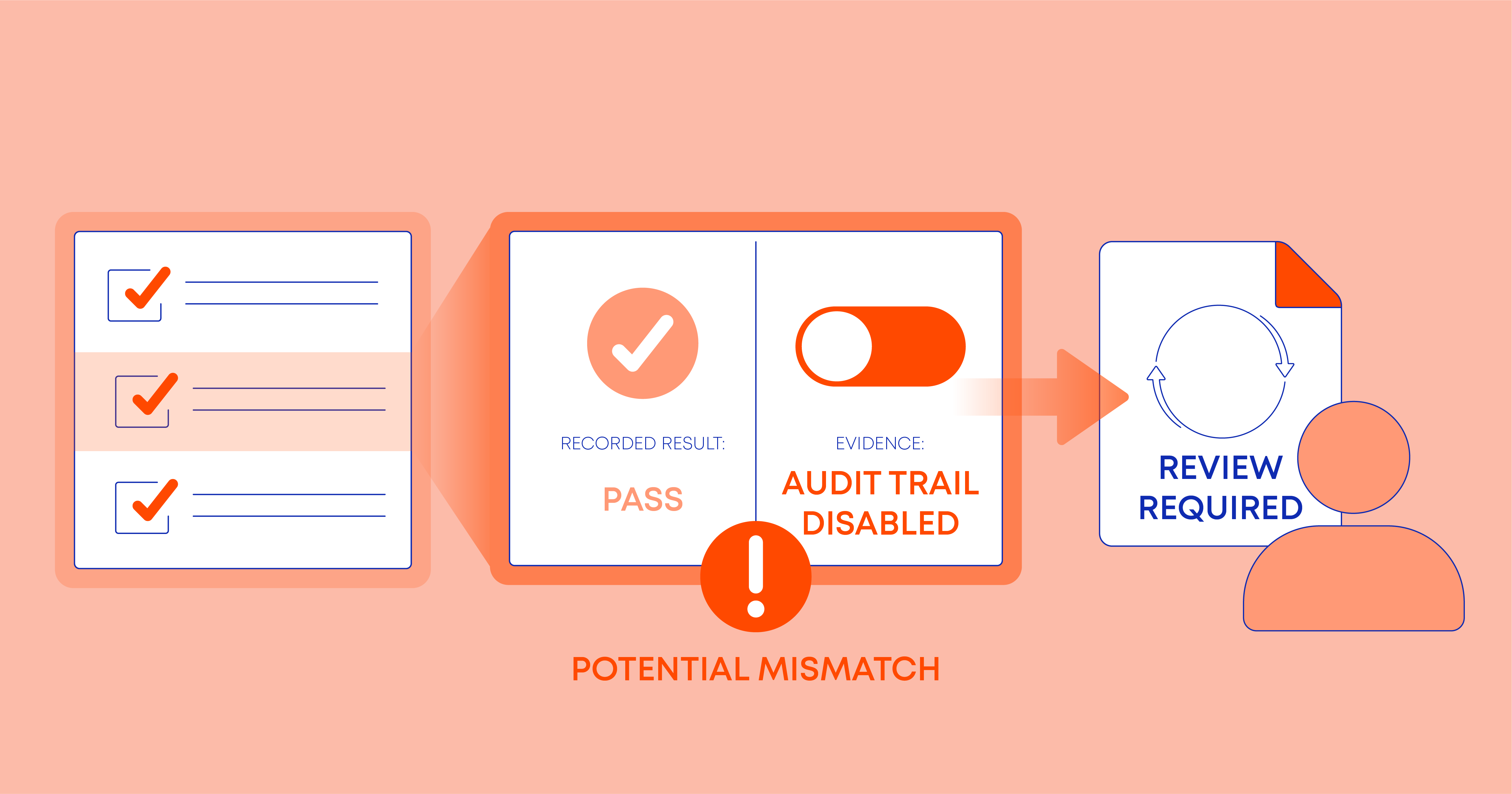
Catching Validation Anomalies with Automated Verification
Discover how automated verification enhances validation processes by catching anomalies early, improving accuracy, and enabling better decision-making.
By Sweta Shah
.webp)
Why Validation Review Needs an Exception-based Model
Scale validation review without scaling review burden. Learn how reusable validation assets and exception-based review support faster, risk-focused CQV.
By Sweta Shah
.webp)
ValGenesis VLMS 5.0: Next-Gen Validation Lifecycle Management
Explore how ValGenesis VLMS 5.0 marked a key milestone in the evolution of digital validation lifecycle management, paving the way for today's iVal solution.
By Sweta Shah