


Artificial intelligence (AI) is rapidly advancing in validation, CQV, and quality operations across life sciences, but many organizations are still trying to separate meaningful transformation from AI hype. While many AI offerings focus on drafting, summarization, review acceleration, and copilot-style assistance, the industry is increasingly expecting something more: trustworthy AI that can operate inside validated workflows, preserve human oversight, maintain traceability, and support governed execution at enterprise scale.
This FAQ brings together practical answers to the most important questions life sciences leaders are asking about AI in validation, including what makes AI trustworthy in GxP environments, why document-centric approaches create operational limitations, how governed execution intelligence differs from AI copilots, and what organizations should evaluate when selecting an AI validation platform for long-term digital transformation.
AI Strategy and Digital Transformation
What is the difference between AI-assisted validation software and digital validation transformation?
AI-assisted validation software usually improves specific tasks such as drafting, summarization, document review, issue flagging, or user support. These capabilities can reduce manual effort, but they often leave the broader operating model unchanged. People still manually coordinate workflows, connect evidence, manage context, resolve exceptions, and drive validation work across the lifecycle.
Digital validation transformation is different. It changes how validation work is governed and executed. It connects workflows, lifecycle data, evidence, approvals, risk context, and oversight into a controlled operating model where AI can support execution under human accountability. In other words, AI-assisted validation helps users work faster; digital validation transformation helps organizations operate differently.
Why is document-centric AI not enough for validation transformation?
Document-centric AI is a useful starting point because validation has historically been documentation-heavy. Protocols, reports, test scripts, deviations, approvals, and evidence packages all create significant manual burden. AI can help generate, review, and summarize these artifacts faster. These capabilities can improve document efficiency, but validation is not fundamentally a document problem. It is a lifecycle execution problem.
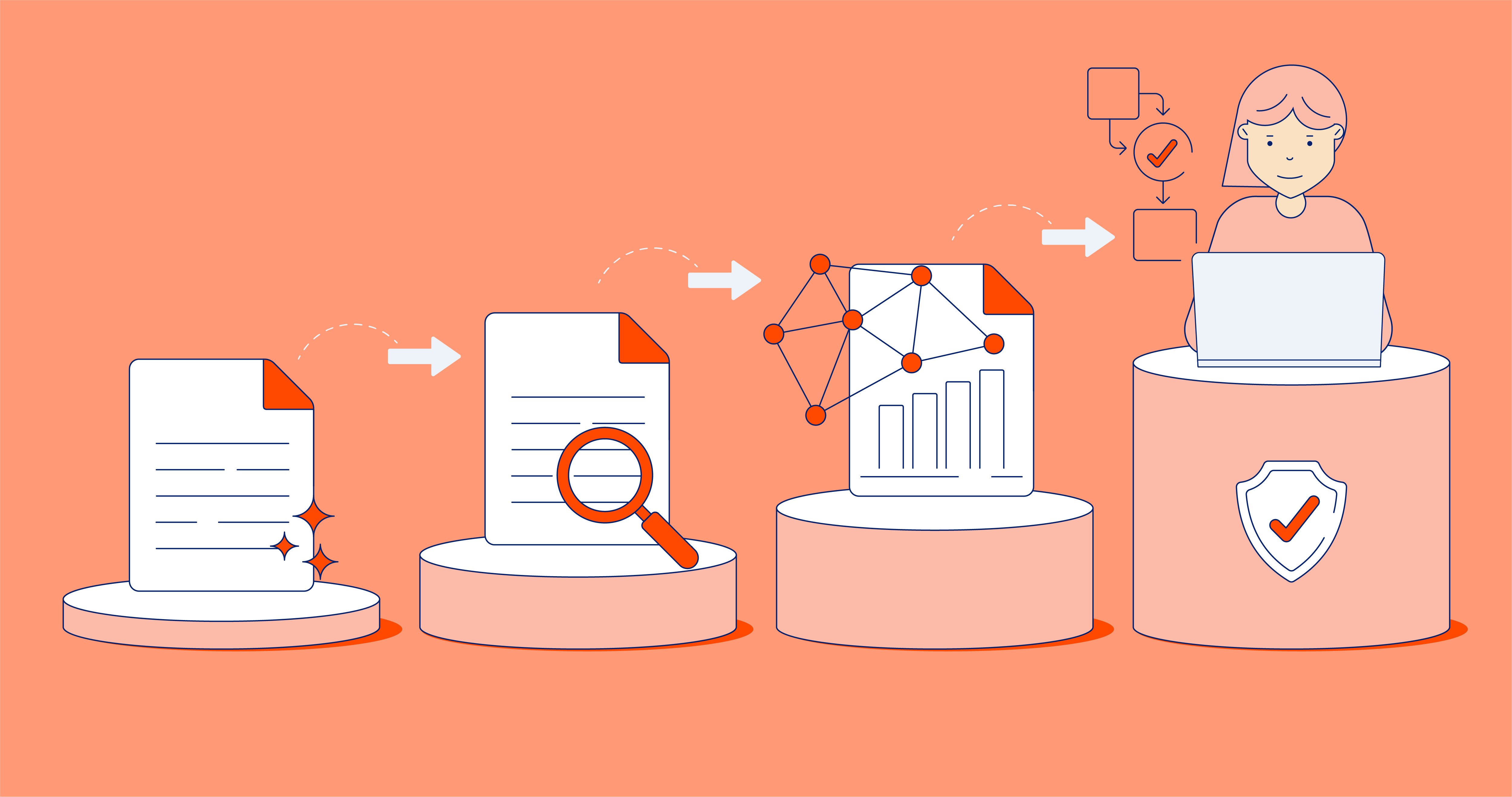
If AI only improves documents while humans still manually orchestrate the lifecycle, the organization has not transformed validation. It has accelerated one part of the old model. True transformation requires AI to support connected execution across planning, authoring, risk assessment, execution, review, reporting, release readiness, and continuous validation state management.
Can AI that generates, reviews, and interrogates validation content support true digital transformation?
AI that generates, reviews, and interrogates validation content can improve document efficiency, but those capabilities alone do not prove transformation readiness. In regulated validation, the higher standard is whether AI can operate inside validated workflows, connect to lifecycle data, preserve audit trails, enforce human oversight, and support controlled execution across the validation lifecycle. If AI remains centered on content assistance, review acceleration, or conversational access to information, it may improve document efficiency without changing how validation work is governed, executed, and scaled across the enterprise.
What does the life sciences industry actually expect from AI?
The industry is becoming more practical and more demanding. Life sciences organizations are not simply asking whether AI can generate content or improve productivity. They are asking whether AI can be trusted in regulated operations. Axendia’s research shows that organizations prioritize data quality, output reliability, explainability, validation assurance, regulatory compliance, data security, privacy, lifecycle monitoring, and governance when evaluating AI solutions (Axendia, 2025).
That means AI for life sciences must be designed around trust, control, traceability, and human oversight. It must support operational value without compromising compliance confidence. The industry is not looking for uncontrolled autonomy, but it is also moving beyond isolated document-assistance capabilities. The expectation is governed AI that can support controlled work inside regulated workflows.
Trustworthy AI and GxP Governance
What makes AI trustworthy in a GxP environment?
Trustworthy AI in GxP environments must be embedded in validated workflows, operate within controlled boundaries, produce explainable and traceable outputs, preserve data integrity, and support audit readiness. It must also enforce human oversight through workflow checkpoints rather than relying on broad claims that humans remain “in the loop.”
Trustworthy AI should be reproducible, reviewable, and governed. Teams must be able to understand what data informed an AI output, how the output was generated, who reviewed it, what changed, how it was approved, and how it was used in regulated work. Without that level of control, AI may create efficiency but also introduce defensibility risk.
Why does system-of-record architecture matter for AI validation?
The validation system of record is where regulated work is controlled. It contains workflows, approvals, audit trails, version history, evidence, role-based access, change records, and process controls. If AI operates outside this foundation, governance becomes harder to defend.
When AI is embedded in the system of record, its outputs can remain connected to lifecycle data, workflow status, evidence, review history, and approval decisions. This is essential for audit readiness and inspection confidence. AI that sits outside the system of record may assist users, but it can also create disconnected outputs that teams must manually reconcile and defend.
Why is “human-in-the-loop” not enough as a claim?
“Human-in-the-loop” has become common language in life sciences AI, but it is not meaningful unless it is operationalized. In regulated environments, human oversight must be built into the workflow through enforced review checkpoints, approval controls, role-based access, audit trails, and traceable accountability.
A system that allows humans to approve AI suggestions is not automatically a governed AI execution model. The stronger model ensures AI-supported activities are constrained by process logic, connected to evidence, visible to reviewers, and auditable from creation through approval.
Is autonomous AI appropriate for validation and quality operations?
Life sciences organizations should be cautious with autonomy in GxP environments. The industry is prioritizing governed AI that augments expert work and supports controlled execution under human oversight rather than AI that replaces human accountability. Axendia’s research also indicates that autonomous AI is developing more slowly, reflecting the industry’s cautious approach to systems operating with minimal human oversight in regulated environments (Axendia, 2025). This cautious approach is also reflected in FDA and EMA guidance emphasizing governance, risk management, lifecycle oversight, and human accountability for AI-enabled processes (European Medicines Agency, 2024; U.S. Food and Drug Administration, 2025a, 2025b).
The right goal is not uncontrolled autonomy. The goal is governed execution: AI that can support regulated work while humans retain responsibility for critical decisions, review, approval, and quality oversight.
Governed Execution Intelligence and Lifecycle Operations
Is AI-assisted review enough for enterprise validation transformation?
No. AI-assisted review can be helpful, but review is only one step in the validation lifecycle. Review usually happens after content has been created, evidence has been gathered, and execution decisions have already shaped the record. That makes review-oriented AI inherently reactive.
Enterprise transformation requires more than faster issue detection. It requires a model that improves how work is executed from the beginning. AI should help reduce gaps, inconsistencies, and rework by operating within lifecycle workflows, not only by reviewing documents after the fact. Faster review can improve document efficiency; governed execution can improve the operating model itself.
What is governed execution intelligence?
Governed execution intelligence is AI that supports controlled GxP work across regulated workflows while preserving human oversight, traceability, and compliance confidence. It is different from a chatbot, copilot, or review assistant because it is connected to the lifecycle operating model, not just individual user tasks or documents.
Governed execution intelligence helps organizations move from “AI helps people with tasks” to “AI supports controlled work inside governed processes.” This is the shift life sciences organizations should expect as AI matures from productivity assistance to enterprise-scale operational capability.
How is governed execution intelligence different from an AI copilot?
An AI copilot typically assists users. It can answer questions, summarize information, generate drafts, flag issues, or recommend next steps. These features can be valuable, but they primarily help individual users perform tasks more efficiently rather than governing how regulated work is executed across the lifecycle.
Governed execution intelligence is centered on the process. It connects AI activity to workflow state, validation data, evidence, approvals, and compliance context. It supports controlled execution across the lifecycle while preserving human accountability. For regulated operations, that distinction matters because productivity alone does not create compliance-ready transformation.
Why are AI pilots not enough?
Pilots can demonstrate potential, but they do not prove enterprise transformation. Many organizations can test AI in isolated use cases, but meaningful value comes when AI is adopted consistently across routine operations, sites, programs, workflows, and governance models.
Axendia’s research notes that innovators are beginning to scale AI beyond pilots, while many organizations remain focused on experimentation and use case evaluation (Axendia, 2025). For validation leaders, the goal should be enterprise-scale operationalization, not endless proof-of-concept activity.
How does governed AI support commissioning, qualification and validation (CQV)?
Governed AI can support CQV by improving documentation consistency, accelerating protocol and report development, supporting evidence traceability, identifying gaps or inconsistencies, and helping teams execute validation workflows more efficiently under controlled conditions. It can also support better lifecycle visibility by connecting execution activity to workflow status, evidence, exceptions, and approvals.
The key is that AI must operate within validated workflows and preserve human review, approval, and accountability. In CQV, speed only matters if the resulting work remains traceable, defensible, and inspection-ready.
What is the risk of choosing AI that is mainly document-centric?
The risk is that organizations may invest in AI that improves document efficiency but does not advance digital transformation. Document-centric AI may help teams draft, summarize, and review faster, but the broader validation lifecycle can remain manual, fragmented, and dependent on human orchestration.
This can create a strategic ceiling. The organization may see local efficiency gains without achieving enterprise-scale execution capacity, continuous validation intelligence, or lifecycle-level governance. In the long term, that may delay the transition to a truly modern validation operating model. Organizations may mistake local efficiency gains for digital transformation while continuing to operate largely the same validation model underneath.
What does “AI-native validation” mean?
AI-native validation means AI is not merely added as a feature around existing workflows. It means AI is built into the operating foundation of validation, connected to lifecycle data, workflow controls, evidence, approvals, and governance mechanisms.
In an AI-native validation model, AI supports how work is executed, not only how documents are created or reviewed. This is important because regulated transformation depends on connected processes, not isolated intelligence features.
What does the PitchBook “SaaS to SaS” shift mean for validation AI?
The strategic shift from software-as-a-service (SaaS) to service-as-software (SaS) points to a broader market movement: buyers increasingly expect AI to deliver outcomes, not just productivity tools (Torrijos & Hernandez (2026) . In validation, that means the market will value AI that can support controlled work and execution capacity rather than AI that simply assists users inside a software interface.
For life sciences, this does not mean replacing human accountability. It means using governed AI to perform controlled tasks within validated workflows while humans retain oversight, review, and approval authority. This is why many industry observers view governed execution intelligence as a potential evolution beyond AI copilots and document assistants for regulated environments.
How should leaders distinguish between AI features and AI transformation?
AI features are individual capabilities, such as drafting, summarization, review assistance, translation, chat support, or analytics. AI transformation changes the operating model by connecting AI to workflows, lifecycle data, evidence, approvals, governance, and enterprise-scale execution (Torrijos & Hernandez, 2026).
Leaders should look beyond feature lists and ask whether the AI can support regulated work across the lifecycle. If AI is limited to isolated tasks, it may be useful but not transformational. If AI is embedded into governed workflows and can scale execution across the enterprise, it becomes part of the digital transformation foundation.
Enterprise AI Readiness and Platform Evaluation
What should organizations look for in an AI validation platform?
Organizations should evaluate whether the AI is embedded in the validation system of record, operates inside validated workflows, preserves audit trails and traceability, enforces human oversight, connects to lifecycle data, and scales across sites and programs. They should also assess whether the AI supports lifecycle execution or remains concentrated around document assistance. An AI validation platform should ultimately be evaluated by its ability to support governed execution across the lifecycle, not simply by the number of AI features it offers (Torrijos & Hernandez, 2026) .
The most important evaluation question is this: does the AI help transform how validation work is governed and executed, or does it only help users complete document tasks faster?
Why are AI roadmaps not enough?
AI roadmaps can create the impression of lifecycle-wide maturity by describing future capabilities across authoring, review, analytics, risk scoring, knowledge support, reporting, and proactive compliance. But a roadmap is not the same as an enterprise operating model.
For regulated organizations, the critical question is what the platform can operationalize today and how those capabilities are governed inside validated workflows. Future-state AI claims should not be confused with current enterprise readiness. Transformation depends on whether AI can be embedded into routine operations, scaled across sites, and governed consistently across real validation processes.
What role should AI play in validation lifecycle management?
AI should help validation lifecycle management move from document-centric coordination to connected, governed execution. That means supporting authoring, diagnosis, verification, comparison, detection, summarization, evidence traceability, exception visibility, and lifecycle readiness within controlled workflows.
The goal is not simply to create faster documents. The goal is to improve right-first-time execution, reduce rework, maintain compliance confidence, and help organizations stay continuously prepared for review, release, and inspection.
What is the most important question to ask about AI validation software?
The most important question is: does this AI help transform how validation work is governed and executed, or does it only help users complete document tasks faster?
That question separates AI-assisted validation software from true digital validation transformation. It also separates AI that may improve document efficiency from AI that can become a foundation for enterprise-scale, governed validation execution.
As AI adoption accelerates across life sciences, organizations are increasingly evaluating technologies based not only on productivity gains, but also on their ability to support governed execution, compliance confidence, and lifecycle visibility. In upcoming posts in this FAQ series, we'll continue exploring the technologies, operating models, and best practices shaping the future of validation and digital transformation.


Table of Contents


Related Blog Posts
.webp)