A qualification package shouldn't come together at the end of a project. It should take shape throughout the project.
Yet many validation teams spend considerable time rebuilding documentation before qualification milestones. They search for approved protocol versions, recreate information that already exists, reconnect requirements to test results, and manually assemble evidence into new reports. In these situations, a substantial portion of the effort shifts from executing or reviewing qualification activities to reconstructing the documentary record.
Not all rework is avoidable. Changes to approved protocols, unexpected test results, or equipment modifications may require additional qualification activities. A different kind of rework occurs when teams spend time reconstructing documentation that already exists because records are disconnected or difficult to trace across qualification stages.
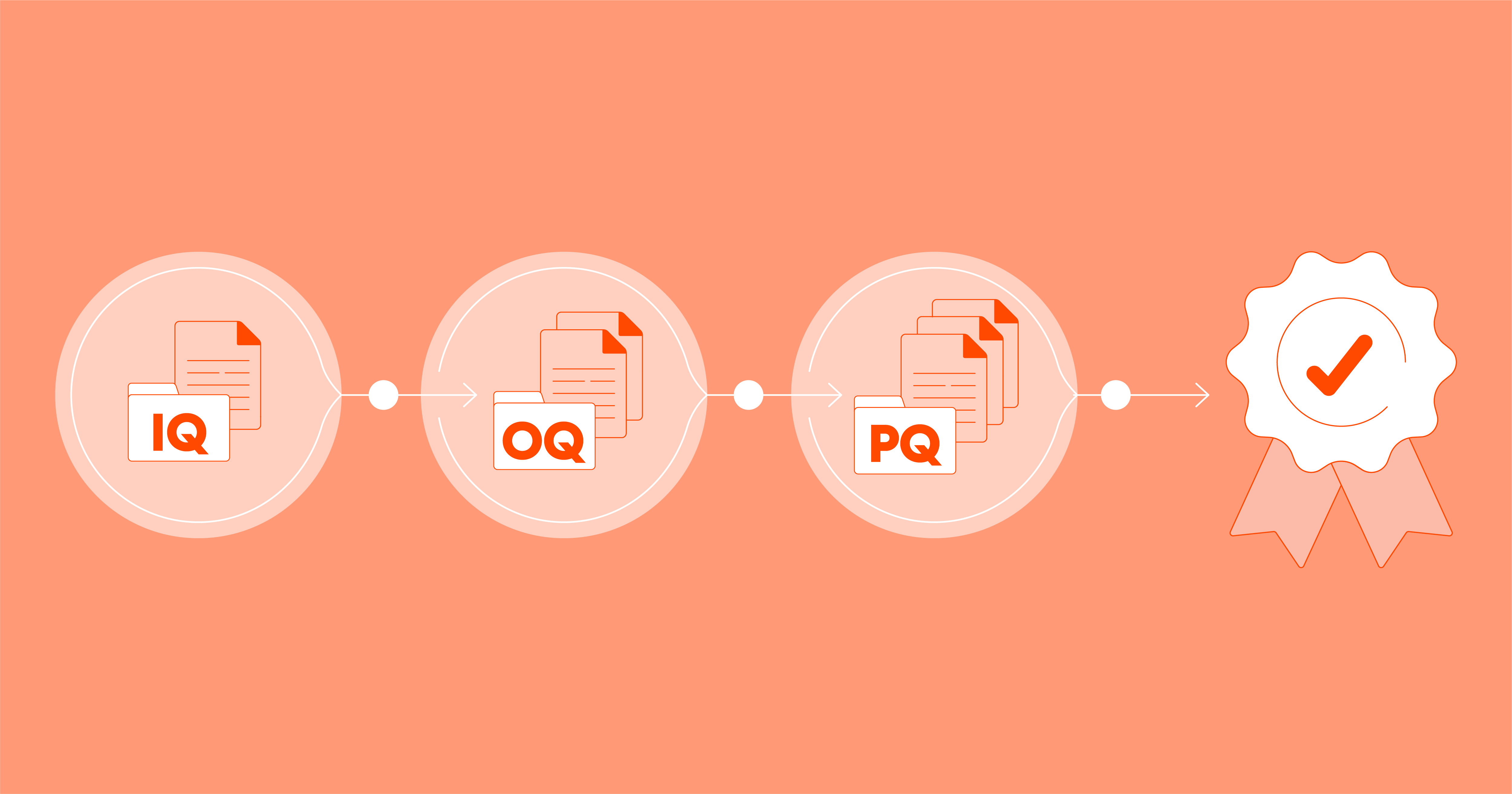
That's not how qualification is intended to work. Installation qualification (IQ), operational qualification (OQ), and performance qualification (PQ) represent successive stages in a single lifecycle. Each builds on the work completed before it, preserving approved information while adding new evidence that supports the next phase.
Each qualification stage should contribute to the existing qualification record rather than re-create it. IQ establishes the installation baseline. OQ adds evidence that the system operates within defined parameters. PQ contributes evidence that the system performs consistently under routine operating conditions. Together, these records become the qualification package presented during inspections.
That lifecycle perspective is reflected across current industry guidance. FDA's Process Validation: General Principles and Practices, EU GMP Annex 15, ICH Q9(R1), and ISPE's Baseline® Guide, Volume 5: Commissioning and Qualification all emphasize lifecycle thinking, documented evidence, traceability, and science- and risk-based decision-making (European Commission, 2015; FDA, 2011; ICH, 2023; ISPE, 2019). While these documents do not prescribe digital qualification workflows, they reinforce the importance of maintaining continuity as qualification activities progress.
What ultimately matters is not the individual qualification stages themselves, but how the information created during each stage is preserved and carried forward.
Qualification Evidence Should Accumulate, Not Restart
Installation qualification, operational qualification, and performance qualification each answer a different question. IQ verifies that equipment or systems have been installed correctly. OQ confirms they operate as intended under defined operating conditions. PQ demonstrates consistent performance in the intended operating environment. Although each stage serves a distinct purpose, the records created during one phase support the next. OQ relies on approved installation information established during IQ, while PQ builds on the operating ranges and acceptance criteria confirmed during OQ. The qualification record is therefore cumulative as well as sequential.
The evidence chain often begins before IQ. Depending on the project, approved user requirements, design records, supplier documentation, commissioning results, and factory acceptance testing (FAT) or site acceptance testing (SAT) evidence may support later qualification activities when their applicability has been reviewed and documented. This allows teams to incorporate valid existing evidence without repeating work solely because the project has moved to a new qualification stage.
That distinction matters because each stage depends on information created earlier in the process. Records generated during IQ continue to support later qualification activities. For example, calibration status established during IQ affects whether OQ results can be relied upon, while approved design requirements help determine which operating conditions OQ is expected to challenge. As qualification progresses, each stage adds evidence to what has already been established.
In practice, that continuity is often lost. Documentation may be managed across spreadsheets, shared drives, email, paper records, or disconnected applications. When information is not connected, teams spend valuable time locating approved documents, verifying that they are working from the latest version, recreating traceability, and manually transferring information into new protocols and reports. Although these activities are familiar, they add little value to the qualification itself.
The goal is not simply to produce documentation at each milestone. By the end of qualification, reviewers should be able to trace an approved requirement through the applicable risk assessment and test evidence to the result, any related deviation, and final approval. That continuity creates a qualification package that reflects the evidence generated throughout the lifecycle.
Preserving Continuity Through Digital Workflows
Documentation volume is not usually the problem. The greater challenge is maintaining clear relationships among requirements, protocols, test results, deviations, approvals, and supporting records throughout qualification.
When qualification activities are managed across multiple systems—or a mix of electronic and paper records—teams spend time searching for information instead of building on it. Approved requirements, risk assessments, test scripts, deviations, and review records may all exist, but they are not connected in a way that allows evidence to flow naturally from one qualification stage to the next.
Digital workflows support that continuity by preserving relationships among qualification records throughout the lifecycle. Rather than recreating information for each phase, teams can build on approved records as new evidence is generated. Requirements remain linked to risk assessments, while test results, approvals, revisions, and deviations remain connected to the protocols and activities that generated them.
Digital workflows do not replace established quality processes. They provide a structured way to preserve approved records, maintain traceability, and carry information forward under existing quality controls. Like any GxP process, they still depend on appropriate governance, including document control, defined review processes, and change management.
Traceability is easier to maintain when information remains connected, and reviews become more efficient when reviewers can follow the evolution of qualification records rather than reconcile documents assembled from multiple sources.
The result is a qualification package that reflects the lifecycle of the system itself. By the time performance qualification is complete, much of the supporting documentation has already been reviewed, approved, and linked to the underlying qualification activities. Preparing for an inspection may require less time reconciling documents and more time confirming that traceability is intact, deviations have been resolved, and acceptance criteria have been met.
Qualification Is a Lifecycle—Your Evidence Should Be, Too
Qualification has always been cumulative. IQ confirms that a system has been installed as intended. OQ evaluates whether it operates within approved parameters. PQ then demonstrates consistent performance under routine operating conditions. Together, these activities create the documented record supporting the system's intended use.
The methodology is well established. The practical challenge is preserving that documented record across each qualification stage so approved information remains complete, current, and readily traceable.
When organizations treat qualification as a series of disconnected documentation exercises, administrative rework becomes part of the process. Teams spend time recreating information, rebuilding traceability, and assembling records that already exist in some form. Those activities satisfy immediate documentation needs, but they add little to strengthen the qualification itself.
A lifecycle approach takes a different view. Qualification records are preserved and expanded throughout the project, creating a complete record that develops across the lifecycle. By the time IQ, OQ, and PQ are complete, the qualification package is not being assembled for the first time. It already reflects the documented evidence accumulated throughout qualification.
Current regulatory guidance consistently emphasizes lifecycle management, documented evidence, traceability, and science- and risk-based decision-making (European Commission, 2015; FDA, 2011; ICH, 2023; ISPE, 2019). Rather than viewing qualification as a series of independent documentation events, organizations should consider how approved information is preserved and carried forward throughout the lifecycle.
Organizations evaluating changes to their qualification process should look beyond simply digitizing documents. The more meaningful question is whether approved information can be carried forward without unnecessary reconstruction while preserving traceability, governance, and review.
Explore the resources below for practical strategies and real-world examples of building qualification evidence more efficiently across the validation lifecycle.

Table of Contents


Related Blog Posts