

Artificial intelligence (AI) is becoming a defining topic across validation and quality operations. Every major software provider now claims to offer AI-enabled capabilities, and most organizations are actively evaluating how AI can improve efficiency, reduce manual effort, and accelerate validation activities.
However, the market faces a growing challenge. Many AI solutions appear similar because they all demonstrate some form of content generation, review assistance, conversational search, analytics, or recommendations. While these capabilities may be valuable, they are not equal in terms of their impact on validation operations.
The result is a growing gap between AI features and AI maturity.
Organizations evaluating AI validation platforms often focus on what the AI can do. A more important question is what the AI can help the organization become (Torrijos & Hernandez, 2026). Can it simply make documentation tasks faster? Can it improve review efficiency? Can it help teams make better decisions? Or can it fundamentally change how validation work is executed?
The Validation AI Maturity Model provides a framework for answering those questions.
The Four Levels of Validation Maturity
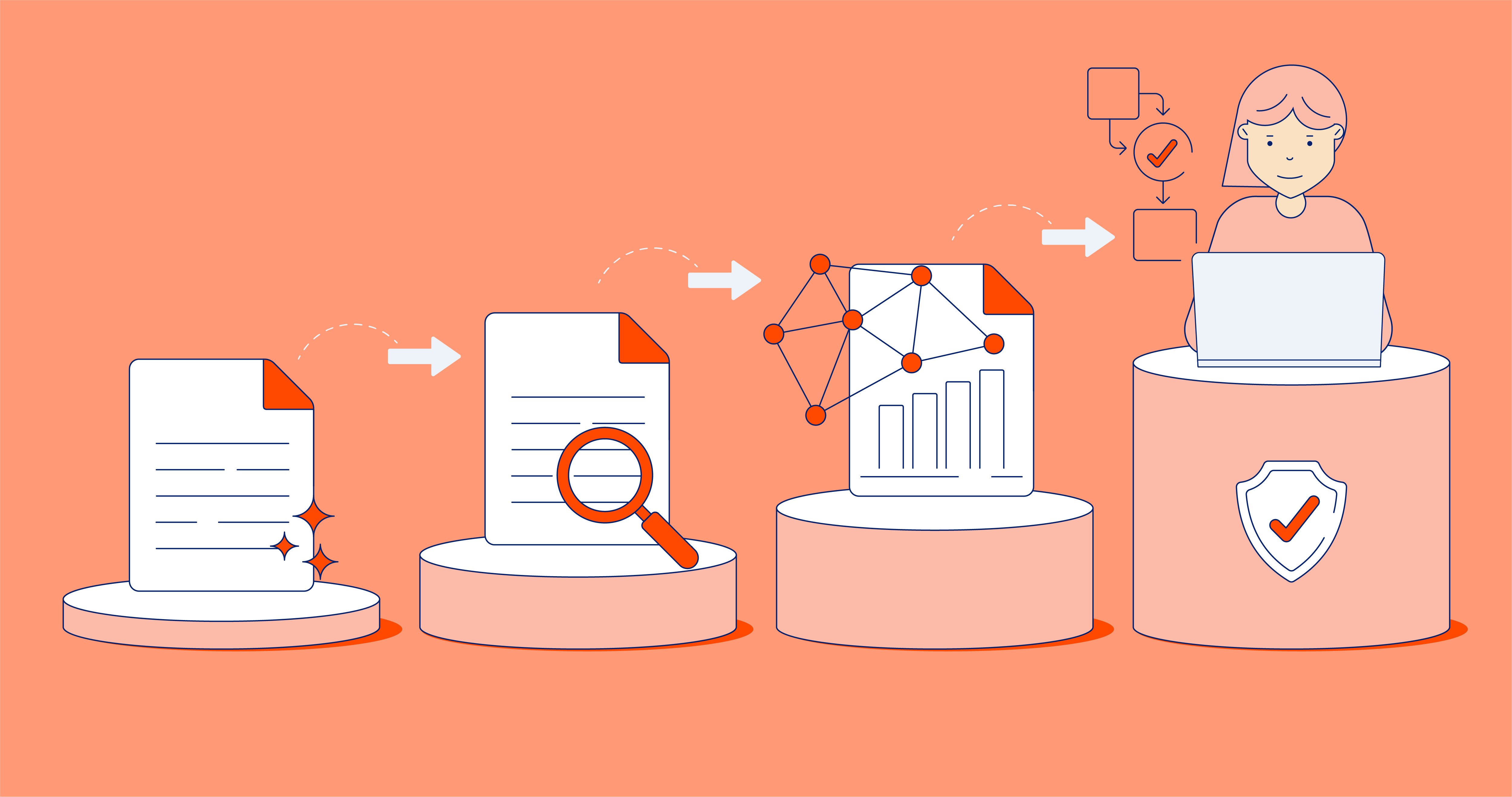
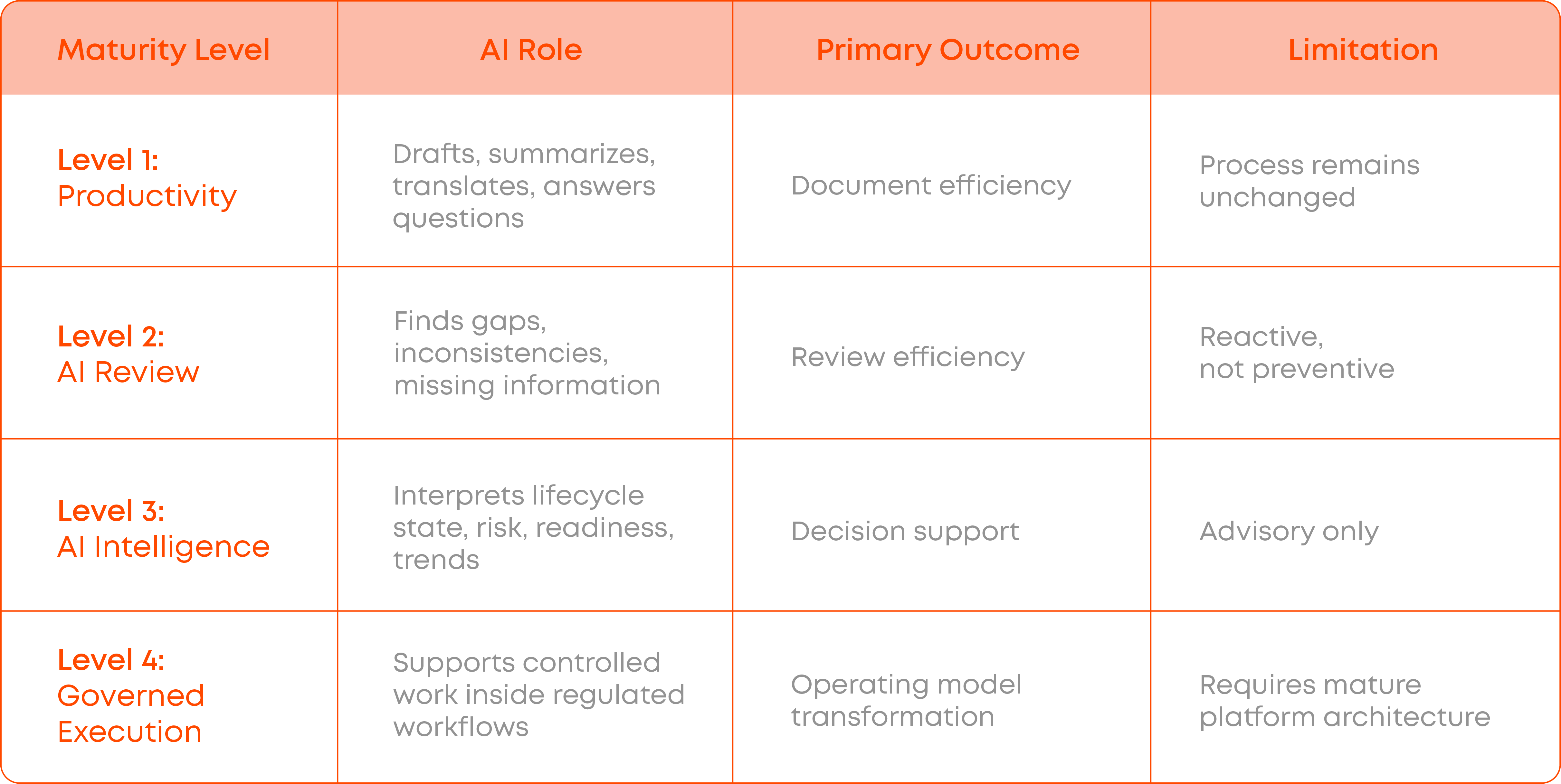
Level 1: AI Productivity — Faster Documents, Same Operating Model
The first stage of AI maturity focuses on improving individual productivity. At this level, AI assists users with activities such as drafting content, summarizing information, translating text, generating responses, or answering questions.
These capabilities can reduce manual effort and improve efficiency for documentation-intensive activities. They often provide immediate value because they help users complete familiar tasks more quickly.
However, the underlying validation process remains largely unchanged. Humans continue to coordinate workflows, manage evidence, interpret lifecycle context, and determine how work progresses through the validation lifecycle. The primary outcome at this stage is document efficiency.
Organizations often begin their AI journey here because productivity-focused capabilities are relatively easy to adopt and demonstrate. Yet while these capabilities can improve user experience, they do not fundamentally transform how validation work is governed or executed.
Level 2: AI Review — Finding Issues Faster, Not Preventing Them
The second stage introduces AI-assisted review. At this level, AI begins helping organizations identify inconsistencies, gaps, missing information, compliance concerns, deviations, or areas requiring attention.
This stage represents an important advancement because AI is no longer limited to creating content. It is now evaluating content and helping users identify potential risks more efficiently.
However, review remains fundamentally reactive. AI typically analyzes work after it has already been created, after evidence has already been gathered, and after execution decisions have already shaped the record. The primary outcome at this stage is review efficiency.
Organizations sometimes mistake this level for transformation because the AI appears more sophisticated. Yet the validation operating model remains largely unchanged. Human experts still perform most of the coordination, orchestration, and lifecycle management activities required to move validation work forward.
Review-oriented AI can help organizations find issues faster. It does not necessarily help organizations prevent those issues from occurring in the first place. As a result, organizations may improve review efficiency while leaving the underlying validation operating model largely unchanged.
Level 3: AI Intelligence — Understanding Risk, Readiness, and Context
The third stage introduces contextual intelligence. AI begins moving beyond documents and starts helping organizations understand lifecycle state, emerging risks, workflow readiness, execution trends, and operational context (ICH, 2022).
Rather than simply generating or reviewing content, AI helps answer broader questions:
-
Which validation activities may be at risk?
-
Where are execution bottlenecks emerging?
-
Which workflows require attention?
-
What trends indicate future compliance concerns?
-
What changes may affect validation readiness?
The primary outcome at this stage is decision support.
This represents a significant advancement because AI begins contributing operational awareness rather than simply assisting with document-related tasks. Organizations gain improved visibility into validation activities and can make more informed decisions.
However, AI remains largely advisory. It can provide insights and recommendations, but execution still depends heavily on human coordination and intervention.
Level 4: Controlled and Governed Execution — Supporting Regulated Work Across the Validation Lifecycle
At this level, AI is no longer limited to generating content, reviewing records, answering questions, or providing recommendations. Instead, it becomes part of the validated operating model, supporting controlled execution activities within regulated workflows while maintaining traceability, compliance controls, and human accountability (EMA, 2026; FDA, 2025, 2026). Unlike earlier maturity levels, AI is no longer focused primarily on improving document efficiency or accelerating review activities. It becomes part of how validation work is executed under governance.
Rather than functioning solely as an assistant to users, AI begins helping organizations execute regulated work under governance. Human oversight remains essential, but AI can participate in execution activities within predefined controls and workflow boundaries. The primary outcome at this stage is operating model transformation. Earlier maturity levels focus on helping individuals work faster. Controlled and governed execution focuses on helping organizations execute regulated work more consistently, more transparently, and with greater confidence across the validation lifecycle.
The Validation AI Maturity Model illustrates the progression from AI-assisted productivity to governed execution, highlighting that true AI maturity depends on both AI capability and the underlying platform architecture.
Why Many AI Strategies Improve Efficiency but Never Transform Validation
One of the most common mistakes organizations make is assuming that success at one maturity level automatically leads to the next. In reality, many AI initiatives become trapped between Levels 1 and 2. Organizations achieve meaningful gains in content creation and review efficiency without changing how validation work is executed across the lifecycle.
This creates a transformation gap. The organization experiences local improvements while the broader operating model remains largely unchanged. Workflows continue to depend on manual coordination. Lifecycle context remains fragmented. Validation activities remain difficult to scale consistently across programs, sites, and teams.
As a result, AI may improve tasks without improving outcomes. This distinction is becoming increasingly important as life sciences organizations move beyond experimentation and begin evaluating AI as a strategic capability. The greatest value does not come from accelerating individual activities. It comes from improving how validation work is governed and executed across the enterprise.
Organizations may mistake local efficiency gains for digital transformation while continuing to operate largely the same validation model underneath (Torrijos & Hernandez, 2026).
Why AI Maturity Depends on More Than AI
Many organizations evaluate AI primarily through the lens of model capability. They ask whether the AI can generate content, answer questions, identify risks, or analyze information.
While those capabilities matter, they are only part of the equation.
The ability to achieve governed execution depends just as much on platform architecture as it does on AI capability.
Levels 1 and 2 can often be achieved through standalone AI services, copilots, overlays, or document-centric tools. These approaches can provide meaningful efficiency gains because they operate primarily at the content layer.
Governed execution is different. It cannot be achieved through AI overlays alone.
To support governed execution, AI must understand workflow state, lifecycle context, evidence relationships, approvals, audit history, process controls, and role-based responsibilities (ISPE, 2022). Those capabilities require a system-of-record foundation capable of connecting AI to the operational reality of validation work.
This is why the most mature validation AI strategies are inseparable from the platforms that support them.
AI maturity ultimately depends on whether the underlying platform can provide the context, controls, and governance necessary to support regulated execution (ISPE, 2022).
In practice, this means the most mature AI strategies are built on a system-of-record foundation capable of governing workflows, evidence, approvals, and lifecycle execution.
How to Use the AI Maturity Model
Use the Validation AI Maturity Model to determine whether AI is improving isolated tasks or changing how validation work is executed across the lifecycle.
Start by mapping each AI capability to one of four levels:
Level 1: AI Productivity — drafts, summarizes, translates, or answers questions.
Level 2: AI Review — identifies gaps, inconsistencies, missing information, or compliance concerns.
Level 3: AI Intelligence — helps teams understand risk, readiness, bottlenecks, trends, and lifecycle state.
Level 4: Controlled and Governed Execution — supports controlled activities inside regulated workflows with traceability, approvals, audit history, and human accountability.
This helps separate useful AI assistance from true operating model change. The goal is not to determine whether an AI capability is useful. The goal is to determine whether it changes how validation work is governed and executed. A platform may make documentation or review faster while still leaving humans to coordinate workflows, manage evidence, and move work through the lifecycle.
When evaluating AI validation software, ask:
-
Does the AI understand workflow state and lifecycle context?
-
Can it connect evidence, approvals, audit history, and role-based responsibilities?
-
Does it operate inside controlled workflows?
-
Does it help prevent issues during execution, or only find them after the fact?
-
Can the platform govern validation work across programs, sites, and teams?
-
Can the AI support controlled and governed execution across the validation lifecycle, or does it primarily assist with content and review activities?
The strongest AI strategies move beyond content-level efficiency. They connect AI to a system-of-record foundation that can govern workflows, evidence, approvals, and lifecycle execution (ISPE, 2022).
The Future of Validation AI Will Be Defined by Execution
The next phase of AI adoption in life sciences will not be defined by which AI platforms offer the most AI features. It will be defined by which organizations successfully move from AI assistance to governed execution.
As regulatory expectations evolve and organizations seek greater scalability, AI maturity will increasingly be measured by execution capability, governance, traceability, lifecycle integration, and operational impact (EMA, 2026; Torrijos & Hernandez, 2026; FDA, 2025, 2026).
The most powerful AI platforms will not simply help users generate content, review documents, or retrieve information. They will help organizations execute validation work more consistently, more transparently, and with greater confidence under governance. They will combine AI with a validated system-of-record foundation capable of governing workflows, evidence, approvals, and lifecycle execution (EMA, 2026; Torrijos & Hernandez, 2026; FDA, 2025, 2026).
That is the progression represented by the Validation AI Maturity Model. And it is the progression life sciences organizations should use when evaluating the future of AI in validation.


Table of Contents


Related Blog Posts

.webp)