Digital & AI-Powered Validation
Explore how AI-powered workflows, digital CQV, inspection-ready traceability, and paperless validation support faster, more controlled validation across the lifecycle.
Last Updated: August 04, 2026
Digital & AI-Powered Validation in Life Sciences
Digital & AI-Powered Validation replaces fragmented, paper-driven work with governed workflows that connect validation planning, authoring, execution, review, approval, evidence, and change control. Digitalization creates the controlled system of record; AI can then assist selected activities such as document generation, guided execution, and issue detection while people remain responsible for regulated decisions. This guide explains how AI-powered validation, audit and inspection readiness, digital CQV, and paperless validation work together to improve speed, traceability, consistency, and lifecycle control.
Creating a governed digital validation lifecycle
Validation demonstrates that processes, systems, facilities, equipment, and methods perform as intended. The overview of validation types in the pharmaceutical industry shows how validation activities extend across development and manufacturing. When those activities are managed through paper, spreadsheets, PDFs, and email, the evidence becomes difficult to coordinate and maintain as requirements, assets, procedures, and projects change.
Digital validation changes the operating model. Instead of producing separate documents that must be reconciled later, teams work within controlled workflows where requirements, risks, protocols, results, deviations, approvals, and changes remain connected. The introduction to paperless validation describes the operational and compliance difficulties of manual processes, including human error, slow execution, audit preparation, and complex lifecycle change control. A digital system can standardize the flow of work while preserving role-based review and approval.
Artificial intelligence becomes useful when it operates inside that governed foundation. AI can support repetitive or information-intensive tasks, but speed alone is not enough in a regulated process. The video AI-Powered CQV That’s Still Audit-Ready identifies practical guardrails: controlled content reuse, human review, audit trails, and governed change control. AI-generated or AI-assisted outputs still require clear provenance, review, approval, and connection to the validation record.
This model applies directly to CQV. Commissioning and qualification establish that facilities, utilities, equipment, and systems are designed, installed, and operating for their intended purpose. The commissioning and qualification overview explains the relationship between these activities. In a digital workflow, project teams can use approved templates, structured data, electronic execution, real-time issue management, and automated traceability rather than relying on document handoffs.
Digitalization also changes inspection readiness. Readiness is maintained through current, accessible, and traceable records, rather than assembled shortly before an audit. The article on spreadsheet compliance risks highlights the control problems created when regulated data lives in tools that are difficult to govern. Digital audit trails, version control, electronic signatures, connected evidence, and searchable histories can make it easier to explain what happened, who reviewed it, and which approved version was used. ![[BP]-Move-Beyond-Manual-CQV-Challenges-with-Digital-Solutions](https://www.valgenesis.com/hs-fs/hubfs/%5BBP%5D-Move-Beyond-Manual-CQV-Challenges-with-Digital-Solutions.webp?width=423&height=222&name=%5BBP%5D-Move-Beyond-Manual-CQV-Challenges-with-Digital-Solutions.webp)
Intelligent automation can further reduce administrative work. Automating CQV workflows can support protocol authoring, execution, review, and reporting while keeping deviations and evidence visible. The objective is to direct validation expertise toward risk, quality, and decision-making instead of document reconciliation.
Implementation should be staged. Begin with a defined validation workflow, identify manual bottlenecks and control gaps, standardize content and data, establish governance, and then introduce automation or AI where the benefit and assurance needs are clear. The webinar on accelerating compliance through data digitalization and AI provides a broader view of this progression across CSV, CSA, and CQV.

AI-Powered Validation
AI-powered validation uses artificial intelligence to assist validation activities within a controlled lifecycle. Relevant applications in the bundled materials include generating structured validation content, guiding execution, and identifying inconsistencies or anomalies. The value comes from reducing repetitive effort and helping teams find issues earlier, while preserving human ownership of quality and compliance decisions.
Governance comes first. AI should work with approved templates, requirements, and validated content components rather than uncontrolled material. Generated outputs should remain linked to their inputs and the version used. Reviewers need to understand what the system produced, make necessary changes, and approve the final record. Audit trails should capture those changes and approvals.
The webinar AI-Powered Validation Document Generation That Cuts Authoring Time describes generating structured, traceable test cases from requirements within a secure validation environment. This use case illustrates a practical principle: AI can accelerate the first draft, but the result must enter the same governed review and approval process as other validation content.
AI can also support execution. The video on advancing CQV with AI explains how manual checks and late detection of discrepancies can create rework. Guided digital execution and issue detection can help teams identify missing information or unexpected results while work is in progress.
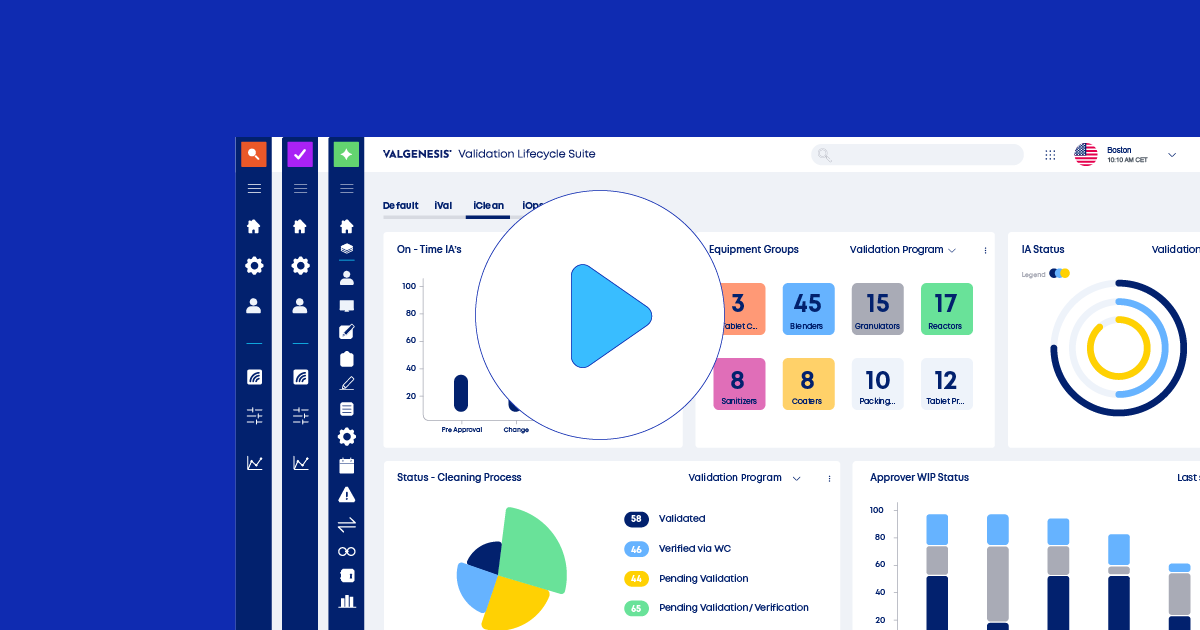
Organizations should select an initial use case with clear inputs, outputs, reviewers, and acceptance criteria. Define which tasks AI may assist, which decisions remain with SMEs and QA, how output quality is checked, and what records must be retained. The video ValGenesis iVal: Faster Validation, Smarter Execution, Always Audit-Ready provides an overview of AI-assisted workflows and traceability within a validation system.
The safest adoption path is incremental. Establish the digital validation foundation, pilot one controlled AI use case, measure quality and rework, train reviewers, and expand only when governance and evidence remain effective.
Audit & Inspection Readiness
Audit and inspection readiness means validation evidence is current, complete, traceable, and accessible during routine operations. It is not a one-time preparation project. Teams should be able to locate approved requirements, protocols, execution records, deviations, signatures, audit trails, and change histories without reconstructing them from multiple repositories.
Manual and spreadsheet-based processes make this harder. Files can be copied, renamed, emailed, or edited outside a controlled workflow. The post on leveraging vendor testing shows why evidence from multiple parties must be evaluated and integrated carefully. Vendor evidence can reduce redundant testing, but the regulated organization still needs a clear rationale, controlled review, and traceability to intended use and risk.
A digital validation record strengthens readiness by maintaining version control, access control, electronic signatures, workflow history, and linked evidence. Reviewers can see which requirement a test addresses, what result was recorded, whether an exception occurred, and how it was resolved. Automated traceability can reveal missing coverage before an inspector or auditor does.
AI-assisted processes require the same discipline. The system should show who approved the output, which source content or requirement set was used, what changed during review, and how the final record entered change control. AI-powered, audit-ready CQV emphasizes that AI must operate inside the validation system of record rather than outside controlled processes.
Teams can improve readiness by defining the evidence set for each validation activity, standardizing naming and metadata, monitoring overdue reviews and open deviations, and rehearsing retrieval of representative records. The webinar Templates, Version Control, and Reviews explores how content control and review practices affect both speed and traceability.
The practical test is simple: can the team retrieve the current approved record, explain its lifecycle, and show the evidence behind the decision without manual reconstruction? If not, the readiness process still depends too heavily on individual knowledge and file handling.
Commissioning, Qualification and Validation (CQV)
CQV provides a lifecycle for demonstrating that facilities, utilities, equipment, and systems are designed, installed, operated, and maintained for their intended use. Commissioning verifies that systems are installed and function in line with design intent, while qualification creates documented evidence for regulated use. Validation connects those qualified assets and systems to the process they support.
A risk-based CQV approach focuses effort where failure could affect product quality or the regulated process. The article Best Practices in Commissioning and Qualification – Part One outlines a framework for integrating lifecycle phases. Requirements, design reviews, commissioning tests, qualification protocols, deviations, and acceptance decisions should remain traceable rather than being managed as disconnected project packages.
Digital CQV supports reuse and consistency. Approved templates and content can be reused across similar assets or projects when the applicability and required adaptations are controlled. Electronic execution can enforce required fields, capture evidence at the point of work, and route exceptions for review. The webinar One CQV Protocol, Three Projects shows how protocol reuse can be standardized while project-specific decisions remain justified and documented.
Automation can also reduce manual transfer between authoring, execution, review, and reporting. The article From Weeks to Minutes describes the administrative burden created by paper, signatures, spreadsheets, and reconciliation. A connected workflow keeps project status, deviations, approvals, and evidence visible in real time.
Organizations should start by standardizing their CQV information model: asset requirements, risk classification, document types, test content, acceptance criteria, exception handling, and approval roles. The webinar on best practices in commissioning and qualification provides further lifecycle guidance. Once the workflow is consistent, AI can be introduced selectively to assist authoring or review without weakening controlled execution.
Paperless Validation
Paperless validation replaces physical documents and disconnected electronic files with a controlled digital process for planning, authoring, execution, review, approval, reporting, and change management. It is the operational foundation for advanced automation and AI because validation data must be structured, current, and traceable before it can support intelligent workflows.
The shift requires more than scanning paper or saving PDFs. Paper-on-glass processes preserve many of the same problems: manual entry, duplicate files, version uncertainty, delayed signatures, and separate evidence. The article Validation Is Stuck in the Past describes how fragmented systems and static files create repeated document work and slow reviews.
A true paperless workflow uses controlled templates, structured fields, electronic signatures, access controls, audit trails, automated routing, and linked records. Execution data is captured directly, exceptions are raised within the workflow, and approved reports are generated from the controlled record. This reduces the need to reconcile handwritten notes, spreadsheet trackers, and document versions.
Paperless validation also supports lifecycle management. When a requirement, procedure, asset, or system changes, teams can identify affected validation records and route the necessary review. The article on the benefits of paperless validation describes improvements in authoring, execution, approval, audit preparation, and operational efficiency.
Implementation should begin with process mapping. Identify each document handoff, duplicate entry, approval delay, and point where the current record can become unclear. Define standard workflows and governance before migrating content. Then select a manageable pilot that involves representative users and evidence types.
Paperless validation is also the bridge to AI-powered validation. Once requirements, risks, test steps, results, and deviations are structured and connected, automation can assist with content generation, traceability, and issue detection. Without that governed data foundation, AI risks adding another disconnected layer to an already fragmented process.
Frequently Asked Questions
Digital validation manages validation activities and evidence in controlled electronic workflows. It connects planning, requirements, risks, protocols, execution, deviations, approvals, reporting, and change control within a governed system.
No. Compliance depends on intended use, governance, assurance, security, traceability, human review, audit trails, and change control. AI output must be evaluated and approved within the validation process.
Start with a controlled use case that has clear inputs, expected outputs, reviewers, and acceptance criteria. Document what AI may assist, how output quality is checked, and which decisions remain with SMEs and QA.
It keeps records, versions, signatures, evidence, deviations, and change histories connected and searchable. Teams can retrieve the current approved record and explain its lifecycle without rebuilding the story from separate files.
Digitized validation may still rely on electronic versions of paper documents. Paperless validation uses structured workflows and data to manage authoring, execution, review, approval, traceability, and lifecycle changes without recreating manual document handling.
Use approved templates and controlled content, assess applicability to each asset or project, document adaptations, retain review and approval history, and maintain traceability to requirements, risks, execution evidence, and deviations.
No. Digital workflows can automate routing, checks, and record assembly, but qualified people remain responsible for reviewing evidence, resolving exceptions, and approving regulated decisions.
Conclusion
Digital & AI-Powered Validation works as a progression: paperless workflows create the controlled data foundation, digital CQV connects execution and evidence, audit-ready governance maintains traceability, and AI assists selected tasks without replacing accountable review. Start by mapping one high-friction validation process and separating problems caused by paper, disconnected data, inconsistent content, and late issue detection. Then pilot a governed digital workflow before adding AI. To see the broader model, watch ValGenesis VLS: AI-Powered Validation From Planning to Execution.