The Impact of Artificial Intelligence on CQV


Summary
Artificial intelligence (AI) is changing commissioning, qualification, and validation (CQV) in life sciences by automating validation document drafting, evidence capture, and review to reduce cycle time and variability.
It also supports real-time execution monitoring and predictive quality methods that surface deviations and anomalies earlier, while stressing governance that meets FDA, EMA, and PIC/S expectations for validation and data integrity.
Key takeaways
- AI can generate and review CQV documentation faster, with examples cited of major reductions in preparation time and document-processing cycle time, while enforcing audit trails and e-signature controls.
- Real-time monitoring during execution, paired with IoT data and analytics, can shorten execution time and catch deviations during testing instead of after completion.
- Predictive analytics and anomaly detection can flag precursor conditions and “not-normal” patterns (even in-spec), but require model validation, version control, traceability, and documented rationale when alerts are accepted or overridden.
Who is this for
- CQV engineers and commissioning leads
- Validation managers and validation program owners
- Quality assurance (QA) and quality compliance teams
- Computer system validation (CSV) and digital quality teams
- Manufacturing/operations engineering leaders
- Automation, MES/IT, and data integrity teams
- Regulatory affairs and inspection-readiness teams
Download your Industry Insight
The Impact of Artificial Intelligence on CQV
Artificial intelligence (AI) is redefining commissioning, qualification, and validation (CQV) processes in life sciences by automating documentation, enabling real-time execution monitoring, and driving predictive quality management. This Industry Insight examines how AI streamlines CQV documentation generation and review, facilitates real-time validation execution with improved monitoring, and empowers predictive quality and anomaly detection for proactive decision-making. We also discuss meeting regulatory expectations from the FDA, EMA, and PIC/S to ensure AI-driven CQV initiatives remain compliant with global standards. Each section distills a strategic takeaway for CQV professionals seeking to use AI beyond basic applications. The insights herein assume a foundation in CQV and focus on strategic, actionable perspectives backed by recent industry data and regulatory guidance.
Introduction
Commissioning, qualification, and validation are foundational to ensuring that pharmaceutical facilities, equipment, and processes operate consistently and comply with quality standards. In an era of digital transformation, AI has emerged as a catalyst to address long-standing CQV challenges, such as voluminous documentation, lengthy validation cycles, and complex data analysis. Regulators are cautiously embracing this shift. In early 2025, the FDA released draft guidance advocating a risk-based approach for validating AI models used in drug development and quality assurance, while the European Medicines Agency (EMA) similarly suggests applying ICH Q8, Q9, and Q10 principles to AI in manufacturing to ensure product quality and data integrity. PIC/S and EU regulatory updates (for example, the ongoing Annex 11 revision) emphasize that automated technical controls are preferred over manual approaches to bolster data integrity. Similarly, industry groups such as ISPE and BioPhorum have released position papers with considerations about regulatory submission and model lifecycle management, or a maturity model as the basis for a guideline for the establishment of validation requirements for applications based on AI and machine learning (ML).
In short, AI is no longer a futuristic concept for CQV. It is a practical tool to improve efficiency and insight, provided it operates within a framework of compliance and validation. The following sections explore AI’s effect on three critical facets of CQV.
AI-powered automation of CQV documentation
AI-powered documentation automation in CQV compresses preparation and review timelines while improving consistency, data integrity, and compliance from the ground up, allowing teams to reallocate effort from paperwork to higher-value activities.
Automated documentation generation and review
Documentation generation and management have historically consumed a significant share of CQV effort. AI is now streamlining this process by automating the creation, review, and management of validation documents. Modern language models can draft validation protocols, test scripts, and reports by learning from existing qualified templates and historical data. This accelerates authoring and enforces consistency in terminology and format across documents, reducing the variability introduced by human writers.
For example, an AI validation assistant has been shown to reduce validation document preparation time from weeks to minutes, enabling up to 80 percent faster document creation and resulting in a 30 percent cost reduction. These tools can automatically incorporate evidence as it is uploaded (for example, instrument printouts or screenshots), and even apply validation rules or checklists in real time, flagging omissions or errors for correction.
AI-driven document review is equally transformative. Using computer vision and natural language processing, AI systems can cross-verify executed test records against expected outcomes. Instead of a human manually cross-checking every step and attachment, AI can instantly parse an image (for instance, a photo of equipment readings or a screenshot of a software validation test) and compare it to the expected result logged in the protocol. Any anomaly or discrepancy, such as an out-of-range value or a missing signature, can be immediately identified for further investigation.
This level of automated scrutiny not only catches errors that might be overlooked but also speeds up the review cycle dramatically. In one case, implementing a digital AI-enabled platform cut CQV document processing time by 43 percent, eliminating bottlenecks in the approval process.
Furthermore, automation ensures that documentation is built with compliance in mind: every change is tracked with audit trails, and requirements such as 21 CFR Part 11 electronic signatures, EU GMP Annex 11 controls, and ALCOA+ data integrity principles are enforced by design. The result is audit-ready documentation that stands up to regulatory scrutiny with less manual effort.
Real-time execution and intelligent monitoring in validation
Integrating AI into CQV execution transforms validation from a static, retrospective exercise into a dynamic, real-time assured process, accelerating test cycles, reducing downtime, and ensuring that any deviation is caught and addressed immediately for a faster path to validation completion.
Real-time monitoring and automated response
AI’s effect extends into the execution phase of CQV, where real-time monitoring and intelligent assistance can improve efficiency and accuracy. Traditional execution of qualification or validation protocols is often a sequential, manual affair: execute tests, collect data, then analyze afterward. AI technologies, coupled with Internet of Things (IoT) sensors and advanced analytics, enable immediate analysis of data as tests are being executed.
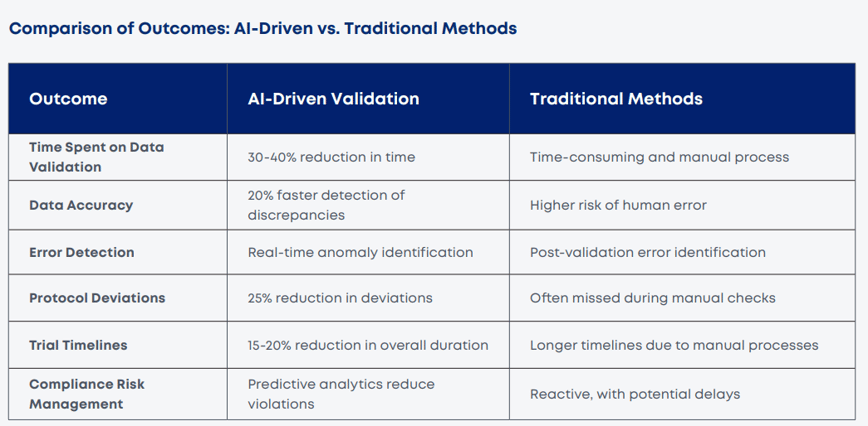
The International Research Journal of Modernization in Engineering, Technology, and Science reports the measurable effect of AI technologies when strategically integrated into CQV workflows. By quantifying outcomes such as reduced validation timelines and improved anomaly detection, the graphic provides operational benchmarks pharmaceutical companies can target when adopting AI solutions.
For instance, IoT devices streaming environmental and equipment parameters can feed AI models that analyze data for any deviations or emerging trends in real time. If a critical temperature or pressure starts drifting toward an out-of-spec limit during a qualification run, the AI can alert the team instantly, or even trigger automated corrective actions.
This real-time insight allows for prompt issue resolution on the spot, minimizing downtime and preventing costly repeats. In practical terms, companies that digitized their CQV execution with integrated AI/analytics report substantial improvements: one reported a 70 percent reduction in overall validation execution time after adopting such a system. Shorter execution times are achieved by eliminating pauses between test steps, automating data capture, and rapidly confirming whether criteria are met, or instantly recommending course correction.
Adaptive testing and guided execution
Another aspect of intelligent execution is guided or adaptive testing. AI can guide operators through complex test procedures, ensuring no steps are missed, and adapting instructions based on real-time results. For example, if a certain subtest passes with a wide margin, the system might suggest proceeding to the next section. In contrast, a borderline pass might prompt an immediate repeat or additional checks, following pre-established expert rules.
This dynamic execution approach, often informed by machine learning on historical CQV data, optimizes the testing flow without sacrificing thoroughness. It fits the industry’s shift toward continued process verification (CPV) and process analytical technology (PAT), both of which aim for ongoing assurance of quality during processes, not just after the fact.
Regulatory guidance supports these innovations: the FDA’s process validation framework (Stage 3: Continued Process Verification) emphasizes continued process monitoring during production, a principle that AI-enabled, real-time CQV execution naturally extends to the validation stage. The key is ensuring the AI tools themselves are qualified and used within a defined context. Teams must validate that an AI-powered monitoring system accurately detects the events it claims to (for example, threshold breaches) and document its integration into the quality system. When done correctly, AI-powered execution systems remain compliant and can strengthen compliance by providing complete, timestamped records of each action and system response.
Predictive quality management and anomaly detection
Leveraging AI for predictive quality management and anomaly detection turns CQV into a forward-looking, data-driven discipline, one where emerging issues are identified and resolved before they impact qualification or production. As a result, quality is safeguarded, and uptime is maximized through informed, proactive control.
Proactive issue identification through AI-powered predictive analysis
Perhaps the most game-changing contribution of AI to CQV lies in predictive quality management and advanced anomaly detection. By applying machine learning to the troves of data generated during equipment commissioning, qualification runs, and process validation batches, AI can uncover patterns and subtle signals that would escape human analysis. This empowers CQV teams to shift from a reactive stance, addressing deviations and failures after they occur, to a proactive one, anticipating and preventing issues before they manifest.
For example, AI/ML algorithms can analyze historical qualification data, sensor logs, and process outcomes to identify precursor conditions that led to past deviations or performance drifts. If certain vibration readings on a production machine have historically preceded an out-of-tolerance result in a performance qualification, the AI model can flag future occurrences of that pattern as likely anomalies. In this way, emerging problems are caught early as signals rather than after becoming full-fledged deviations.
Enhanced risk-based planning and predictive maintenance
Predictive analytics in CQV also supports better risk-based planning. Models can predict the likelihood of a process meeting its quality attributes under varying conditions, enabling engineers to fine-tune parameters or focus validation effort on high-risk scenarios. Over time, an AI system might learn, for instance, that a specific piece of equipment tends to drift out of calibration every six months given its usage patterns, allowing the team to schedule preventive maintenance at month five, thereby avoiding a qualification failure or production downtime.
Such predictive maintenance and process optimization fit the broader Quality by Design (QbD) and ICH Q10 objectives of building quality into processes and continuously improving. Notably, predictive quality management extends into ongoing facility operations (bridging into CPV), where AI can continue to monitor qualified systems and processes, assuring they remain in a state of control. This tight linkage between validation and operations data creates a virtuous cycle of learning: the longer and more data an AI system ingests, the more accurate its predictions of quality outcomes or equipment reliability become.
Advanced anomaly detection beyond traditional metrics
Hand in hand with prediction is anomaly detection. Modern AI models excel at recognizing what “normal” looks like for a system by learning from historical data, and they can identify abnormal events even when all parameters technically remain within specification. For example, during a compressed air system qualification, all pressure readings might stay within acceptable range, yet the pressure fluctuation pattern might be highly unusual. An AI anomaly detector could surface this subtle irregularity for review, signaling potential instability. Such issues might elude standard validation protocols, but AI brings them to light.
Importantly, anomaly detection is not limited to numeric data. It can also be applied to document content and execution. As noted earlier, AI can detect when evidence attachments do not match expected results, or when a user’s input in a validation log appears inconsistent with prior entries, signaling a possible data integrity concern. By acting as a continuous watchdog, AI reinforces quality oversight beyond human limitations.
Meeting regulatory expectations in AI-enabled predictive systems
Adopting predictive and anomaly-detection capabilities must be done in line with regulatory expectations. Both the FDA and EMA have stressed the need for model validation and governance when using AI to support quality decisions. This means verifying the accuracy of predictions (for instance, checking the AI’s false-alarm rate for anomaly flags), managing the model’s training data and version control, and ensuring transparency and explainability where possible.
Although regulators have not issued AI-specific guidance for CQV, existing frameworks fill the gap. GAMP 5’s risk-based approach for computerized systems validation has been extended to AI, as reflected in ISPE’s GAMP 5, Second Edition (2022), which offers preliminary guidance on AI/ML in GxP environments. Additionally, PIC/S guidance on data integrity (PI 041) states that any algorithm affecting GxP data must ensure data remains attributable, legible, contemporaneous, original, and accurate (ALCOA+).
In practice, this means an AI’s predictions or anomaly alerts in CQV should be documented, traceable, and subject to review, just like any test result. When an anomaly is detected and either overridden or accepted, the rationale should be recorded. By embedding this level of governance, companies can confidently use AI insights to preempt issues, whether adjusting a process parameter before a deviation occurs or launching an investigation into a flagged anomaly, without running afoul of compliance.
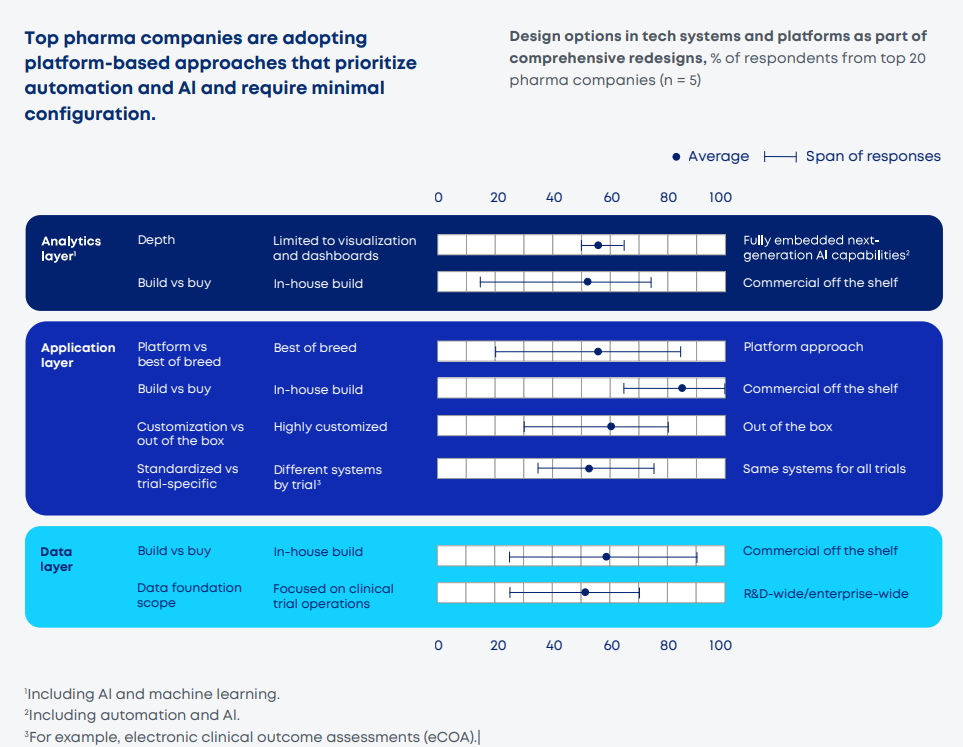
McKinsey & Company’s article “Faster, Smarter Trials: Modernizing Biopharma’s R&D IT Applications” describes the strategic shift in biopharmaceutical R&D toward integrated, platform-based technology stacks. It explains how embedding AI across analytics, application, and data layers can improve productivity, accelerate trial execution, and improve success rates. This visual supports the importance of cohesive digital infrastructures to fully use AI in CQV processes.
Conclusion
AI is increasingly integral to CQV strategy, offering a practical and professional means to reimagine validation workflows in an industry that demands precision and compliance. As detailed in this resource, AI automates labor-intensive documentation tasks, provides real-time intelligence during execution, and enables a predictive approach to quality that mitigates risks in advance.
For organizations already versed in traditional CQV, these AI-enabled practices represent a chance to reframe and elevate their validation programs, not by discarding the fundamentals, but by augmenting them. The payoff is evident in faster validation cycles, significant cost savings, and more robust assurance of quality. Early adopters have reported dramatic efficiency gains (for example, cutting execution times by more than half and paperwork by nearly as much), translating to accelerated product launch timelines and reduced compliance firefighting.
None of these advances exempt companies from regulatory obligations; meeting FDA, EMA, and PIC/S requirements enables AI in CQV. Successful case studies show that AI can be deployed in harmony with regulations by validating AI tools under a risk-based quality system and maintaining vigilant oversight of data integrity.
Regulators are signaling openness to technology that improves product quality and patient safety, as long as the principles of transparency, accountability, and validation are upheld. Therefore, the strategic imperative for CQV leaders is clear: adopt AI where it adds value, but do so within the established (and evolving) compliance frameworks.
In an industry where “quality is king,” AI is a powerful ally, not a shortcut, for those aiming to achieve right-first-time validation and continuous improvement in a competitive market. The effect of AI on CQV is broad and deep, and it is fundamentally transformative when leveraged with a clear strategy and respect for the regulatory environment that governs an industry serving the patient.
References
- Luca Mussati, Sakthi SSA, Archa Vermani. (2025, February). International Society for Pharmaceutical Engineering. Harnessing AI/ML Technology for the CQV Life Cycle. Pharmaceutical Engineering Magazine.
- Dhika Prameswari, Rida Hadirah Ramli. (2024, August 28). PharmEng Technology. Digitizing CQV: Embracing the Future of Pharmaceutical Validation.
- Lakshmanan, S. (2024, October 31). ValGenesis Blog. Move Beyond Manual CQV Challenges with Digital Solutions.
- ValGenesis Inc. (2025). ValGenesis to Unveil AI-Enabled Digital Validation at INTERPHEX 2025. ValGenesis website.
- FDA. (2025, January 06). FDA Guidance Document. Considerations for the Use of Artificial Intelligence to Support Regulatory Decision-Making for Drug and Biological Products.
- European Medicines Agency. (2024, September 09). EMA. Reflection paper on the use of Artificial Intelligence (AI) in the medicinal product lifecycle.
- PIC/S & EMA. (2022, September 19). Concept Paper on the revision of Annex 11 of the guidelines on Good Manufacturing Practice for medicinal products, Computerized Systems. PIC/S & EMA.
- International Society for Pharmaceutical Engineering. (2022, July). GAMP 5 Guide: A Risk-Based Approach to Compliant GxP Computerized Systems (2nd ed.). ISPE.
- Leslie Kux. (2011, January 25). Guidance for Industry on Process Validation: General Principles and Practices; Availability. FDA, Federal Register. [URL in original PDF]
- Peter Baker, Ulrich Köllish, Jennifer Roebber. (2023, July 20). A Framework for Artificial Intelligence and Machine Learning Validation: A 3-Step Approach. BIOPROCESS ONLINE.
- Jahnavi Vellanki. (2025, February 02). Explore how AI-driven validation tools can improve data integrity and compliance in clinical trial management. International Research Journal of Modernization in Engineering Technology and Science.
- Jeffrey Lewis, Ralf Raschke, Lieven Van der Veken, Mike Joyce, Tobias Hlavka, Moritz Wolf, Svenja Steinbach, Yevgen Kanalosh. (2025, February 13). McKinsey & Company. Faster, smarter trials: Modernizing biopharma’s R&D IT applications.
- Gregory Doddridge, Steven Doherty, Nina Cauchon, Tony Wang, Zhenqi Shi, Orna Wisniak, Clarice Hutchens, Ting-Kuo Huang, Isabelle Lequeux. (2021, January). BioPhorum. Regulatory submission and lifecycle management strategy of models used in the manufacture of pharmaceutical and biological products.
- Nico Erdmann, Rolf Blumenthal, Ingo Baumann, Markus Kaufmann. (2022, April). ISPE. AI Maturity Model for GxP Application: A Foundation for AI Validation.
- PIC/S Secretariat. (2021, July 01). Good Practices for Data Management and Integrity in Regulated GMP/GDP Environments.
Table of Contents


