Regulatory Scrutiny: Why a Paperless Approach is a Non-Negotiable in CQV


Summary
This paper explains why paper-based commissioning, qualification, and validation (CQV) no longer satisfies rising expectations for data integrity, traceability, and trustworthy records.
It ties paperless CQV to requirements in 21 CFR Part 11, EU GMP Annex 11, PIC/S ALCOA+ principles, and GAMP 5 lifecycle validation, and shows how a validated digital foundation enables AI-assisted documentation, execution monitoring, and anomaly detection.
Key takeaways
- Regulators increasingly expect validated computerized systems, secure controls, and complete, traceable records that paper workflows struggle to provide.
- Digital CQV improves lifecycle traceability, evidence quality, review speed, and inspection readiness through centralized workflows and audit trails.
- AI-enabled features can accelerate drafting, support real-time execution monitoring, and improve anomaly detection, but only on top of a compliant digital CQV foundation.
Who is this for
- CQV engineers and validation leads
- Quality assurance (QA) and compliance managers
- CSV/CSA and quality systems professionals
- Manufacturing engineering and technical operations leaders
- IT/OT and computerized systems owners in GxP environments
- Regulatory affairs and inspection readiness teams
- Automation, utilities, and facilities engineering managers
Download your Industry Insight
Industry Insights
Regulatory Scrutiny: Why a Paperless Approach Is a Non-Negotiable in CQV
Abstract
The pharmaceutical industry is experiencing unprecedented scrutiny around data integrity, electronic records, and the validated use of computerized systems. These rising expectations have direct implications for commissioning, qualification, and validation (CQV), where paper-based processes introduce avoidable risks, inefficiencies, and inconsistencies.
This Industry Insight examines why a paperless, electronic CQV lifecycle has become the most risk-resilient approach to meeting evolving regulatory expectations rather than a discretionary modernization initiative. Drawing on global guidance, including FDA 21 CFR Part 11, EU GMP Annex 11, PIC/S data integrity principles, and lifecycle concepts emphasized in GAMP® 5 (2nd ed.), this paper examines the regulatory, operational, and quality drivers that make paperless CQV essential for inspection readiness and sustained compliance (European Commission, 2011; FDA, 1997; International Society for Pharmaceutical Engineering, 2022; PIC/S Secretariat, 2021). It also explores how digital validation solutions enhance reproducibility, auditability, and decision-making, and how AI-enabled capabilities accelerate documentation, execution, and anomaly detection once a compliant digital foundation is established. While the fundamentals of CQV remain unchanged, the transition away from paper is now critical to meeting regulators’ expectations for trustworthy records, robust control, and ongoing process insight.
Introduction
Commissioning, qualification, and validation are central pillars of pharmaceutical manufacturing, ensuring that facilities, equipment, utilities, processes, and computerized systems operate consistently and reliably. Historically, much of this work has relied on paper-based documentation, manual data entry, and fragmented recordkeeping.
While these methods once met regulatory expectations, today’s environment, shaped by complex supply chains, globalized operations, and heightened scrutiny of data integrity, has rendered paper-centric CQV insufficient.
Regulators worldwide increasingly expect manufacturers to demonstrate traceability, control, and reproducibility. In practice, this is difficult to achieve at scale without electronic systems that maintain trustworthy records and enable risk-based oversight. FDA 21 CFR Part 11, EU GMP Annex 11, and PIC/S data integrity guidance collectively emphasize the importance of validated computerized systems, reliable electronic records, and technical controls that mitigate the vulnerabilities inherent in manual practices. At the same time, industry frameworks such as GAMP 5 promote lifecycle validation and electronic traceability, aligning with the shift toward digital CQV.
This paper presents a structured analysis of the regulatory, operational, and quality drivers that make a paperless approach non-negotiable for CQV. It also highlights the emerging role of AI-enabled capabilities as a natural extension of digital validation systems, accelerating documentation, improving real-time execution, and strengthening data-driven decision-making. The goal is not to replace the rigor of CQV but to reinforce it through compliant, efficient, and digital methods that withstand modern inspection expectations.
The Regulatory Drivers for Paperless CQV
Regulators are increasingly emphasizing data integrity, traceability, and the reliability of records used to demonstrate the qualification of equipment, facilities, utilities, and processes. Paper-based records, with their inherent risks of transcription errors, version confusion, delayed review, and limited metadata, no longer meet the level of oversight expected for critical GxP activities. Guidance from FDA, EMA, and PIC/S consistently highlights the principle that electronic records must be trustworthy, complete, and secured through validated technical controls.
FDA 21 CFR Part 11 defines expectations for electronic records and signatures, requiring controls such as secure user access, audit trails, and system checks to ensure the authenticity and integrity of these records. EU GMP Annex 11 similarly requires that computerized systems used in GxP environments be validated, fit for purpose, and supported by qualified IT infrastructure. These expectations apply directly when paper workflows are replaced with electronic ones and are further reinforced by EU GMP Annex 22 (Artificial Intelligence), which provides additional guidance for the use of artificial intelligence and machine learning in GxP manufacturing, requiring systems to offer equal or greater assurance of data quality (European Commission, 2023).
PIC/S data integrity guidance reinforces ALCOA+ principles, attributable, legible, contemporaneous, original, accurate, complete, consistent, enduring, and available. Inspectors frequently cite issues stemming from manual transcription, incomplete records, and poor traceability. Paper-based “patches” are increasingly viewed as high-risk because they impede transparency and complicate investigations.
Lifecycle Validation and the Limits of Manual Control
GMP regulations require manufacturers to follow a lifecycle and risk-based validation approach. A robust CQV program must demonstrate that equipment, facilities, utilities, processes, and computerized systems are fit for intended use and operate consistently. In this context, digital CQV strengthens lifecycle traceability and reduces the risk of incomplete or inconsistent records.
Under GAMP 5, lifecycle validation relies on maintaining clear linkages among requirements, risk assessments, test scripts, evidence, and approvals. These linkages are challenging to maintain across paper-based systems, particularly in organizations with extensive equipment inventories or complex global operations. Electronic systems ensure that relationships between validation artifacts remain intact throughout the lifecycle.
Regulators Expect Insight, Not Just Documentation
Inspection trends indicate that regulators expect manufacturers to demonstrate process knowledge, state of control, and the ability to detect and address issues proactively. Paper systems obscure real-time insight and slow down investigations. Digital CQV, by contrast, provides centralized access to data, structured workflows, and consistent evidence capture.
Operational Drivers: Paper Slows What CQV Must Accelerate
Even when paper-based validation practices meet minimum compliance requirements, they often impede the operational speed and coordination that modern CQV demands. Manual workflows introduce delays, increase the burden on project teams, and make it difficult to maintain consistency across systems, sites, and suppliers. In contrast, digital CQV environments centralize information, automate routine tasks, and enable faster, more reliable decision-making, capabilities that become essential as organizations scale and validation workloads intensify. The subsections that follow examine how digital execution unblocks operational bottlenecks, improves lifecycle traceability, and frees teams to focus on higher-value engineering and quality activities.
The Need for a Single Source of Truth and Reproducibility
Digital validation solutions consolidate protocols, execution data, evidence, and approvals into a centralized repository. This reduces versioning issues, eliminates manual transcription, and strengthens reproducibility across validation activities. Paper workflows are inherently prone to inconsistencies, particularly in large-scale CQV programs involving numerous assets, teams, and change cycles.
A digital system ensures that all stakeholders work from the same controlled documentation, with updates reflected automatically and changes tracked through secure audit trails.
Lifecycle Efficiency Through Electronic Traceability
Modern CQV frameworks, such as GAMP 5, emphasize a risk-based lifecycle approach. Digital validation platforms link requirements to testing activities, execution results, and evidence packaging. These linkages enable faster decision-making by presenting the full traceability chain at the point of review.
Electronic workflows also reduce delays caused by misplaced documents, incomplete signatures, or manual collation of evidence. Dashboards display execution progress and highlight deviations or open items in real time, improving both project visibility and resource planning.
Integration With Supplier and Cloud Ecosystems
Equipment vendors and automation suppliers increasingly provide digital interfaces and electronic data outputs. Integrating these systems with a paper-based CQV process creates friction and risk. Digital CQV platforms support more secure and auditable integration pathways, maintaining a chain of custody for data originating from equipment, sensors, or cloud systems.
Faster Decisions and Better Resource Utilization
Electronic data capture accelerates issue detection and resolution by surfacing anomalies and deviations immediately. Automated workflows reduce the time teams spend following up on missing evidence or correcting transcription errors, activities that consume a disproportionate share of CQV project hours in paper-based environments.
A digital approach reduces these inefficiencies, allowing teams to focus on risk assessment, engineering judgment, and quality oversight.
Quality and Compliance Advantages of Digital CQV
Ensuring the integrity, completeness, and long-term reliability of validation data is central to every CQV program; however, paper-based processes often fall short of the rigor regulators now expect. As documentation volumes grow and inspections focus more intensely on data governance, organizations increasingly rely on digital systems to provide the consistency, transparency, and control that manual practices cannot guarantee. Digital CQV platforms enhance quality oversight by integrating compliance into the validation process itself, facilitating automated audit trails, reliable metadata capture, and structured evidence management. The following subsections examine how these capabilities improve data integrity, streamline quality review, and enable a more resilient validation lifecycle.
Complete, Tamper-Evident Evidence
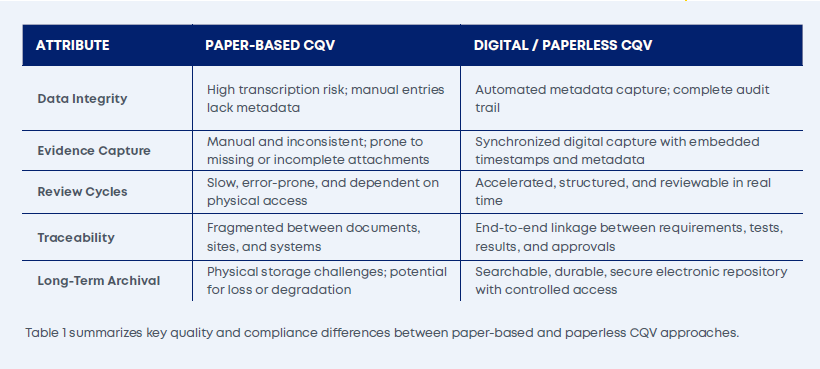
Electronic systems preserve critical metadata such as timestamps, authorship, version history, and audit trails. These features make retrospective QA review more reliable and transparent. Paper-based evidence, by contrast, often lacks sufficient metadata to support investigations or defend decisions during inspections.
Table 1. Key quality and compliance differences
Reduced Human Error and Improved Data Quality
Automation reduces transcription errors and enforces required fields, structured data formats, and workflow sequencing. Digital CQV ensures that validation activities are carried out consistently across projects and sites, strengthening data quality and reducing rework.
Long-Term Availability and Enterprise Scalability
Electronic repositories support secure storage, indexed search, and rapid retrieval. This is particularly valuable for organizations with large geographic footprints, where paper-based documentation creates silos, inconsistent practices, and fragmented oversight.
Digital systems promote standardization and allow validated processes to be replicated across sites with minimal overhead.
AI-Enabled Capabilities: The Next Layer of Assurance
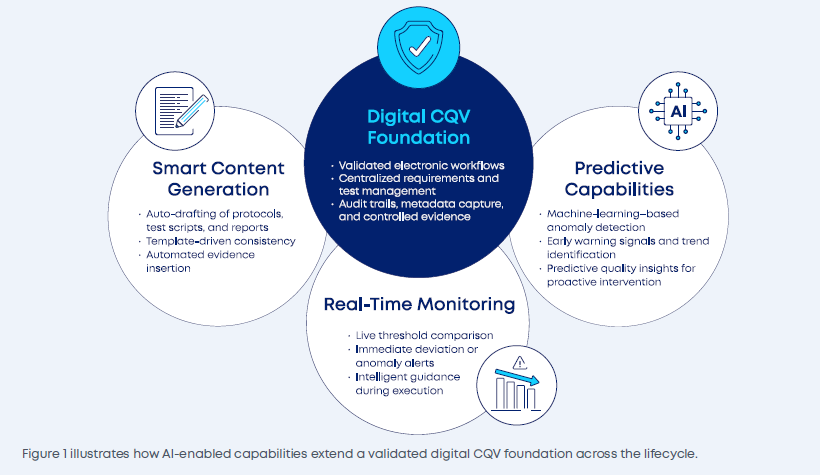
While the primary focus of modernization is achieving a paperless digital foundation, AI-enabled CQV capabilities provide an additional layer of speed, insight, and risk reduction once secure electronic systems are established.
Accelerated Documentation Through Smart Content Generation
AI features in digital validation systems can draft protocols, reports, and test scripts using predefined templates and historical data. This reduces preparation time dramatically and improves document consistency. The automated incorporation of evidence, application of validation rules, and real-time error detection further streamline the review and approval processes.
Intelligent, Real-Time Execution Monitoring
AI-enabled execution tools detect anomalies in real time, flagging deviations or out-of-specification conditions during test execution. These capabilities reduce execution cycle times by minimizing delays between test steps, eliminating manual data capture, and providing immediate feedback to operators.
Predictive Quality and Anomaly Detection
Advanced algorithms can identify patterns in process or equipment behavior based on historical data. These methods help teams detect emerging issues before they manifest as deviations, improving audit readiness and reducing downtime. Continuous learning models strengthen long-term reliability in qualification and process verification environments.
The AI-enabled capabilities described above must themselves be governed within a validated, risk-based framework. In line with GAMP 5, established guidance including Annex 11, and emerging guidance including Annex 22, organizations should treat AI functions as GxP-relevant features: clearly defining intended use, testing performance in proportion to risk, maintaining transparent input and output records, and ensuring that qualified personnel retain final decision-making authority.
The Risks of Remaining Paper-Centric
Organizations that persist with paper-based CQV, especially in complex, multisite, or highly automated environments, face increasingly serious regulatory, operational, and quality risks. Manual entries create ambiguity, inconsistent evidence, and vulnerabilities during inspections. Without real-time insight, teams cannot detect issues promptly, increasing the likelihood of deviations and costly rework.
Paper-based CQV also prolongs cycle times and inflates project costs due to inefficiencies in execution, review, and approval. In distributed organizations, information becomes siloed, and transparency suffers. As industry standards evolve and inspector expectations increase, these limitations pose significant compliance threats.
Readiness Checklist: Laying the Foundation for Paperless CQV
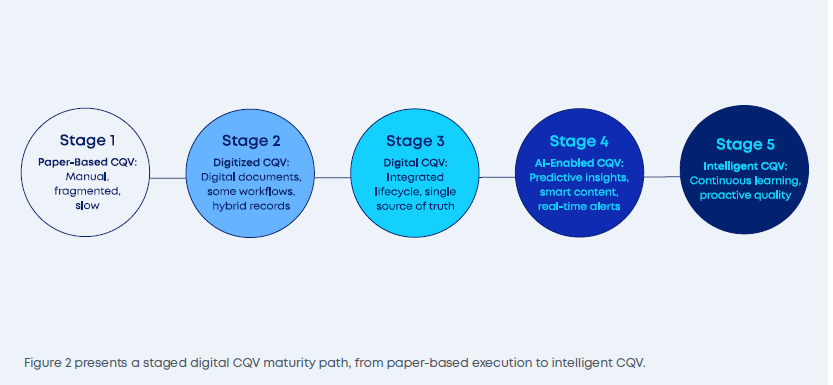
Transitioning to paperless CQV requires more than replacing binders with electronic forms. Organizations must establish the right technical, procedural, and cultural foundations to ensure digital systems strengthen, not simply digitize, validation practices. The following checklist highlights essential readiness elements to support a reliable, compliant, and sustainable move toward digital and AI-enabled CQV.
- Adopt a risk-based validation lifecycle: Ensure alignment with established frameworks such as GAMP 5 and relevant ASTM and ICH guidance. A structured, risk-based lifecycle makes digital CQV more defensible and scalable.
- Design for data integrity from the start: Embed audit trails, access controls, user authentication, and metadata preservation into system configurations and validation plans. These controls must be inherent to the workflow, not retrofitted.
- Incorporate vendor and SaaS/cloud qualification into the lifecycle: Assess supplier quality systems, service-level agreements, and cloud security controls as part of computerized system validation. External system dependencies must be validated with the same rigor as internal systems.
- Automate evidence capture and packaging for inspection readiness: Digital tools should streamline how test results, screenshots, instrument outputs, and approvals are collected and presented. Automated evidence assembly reduces review time and minimizes the risk of missing or inconsistent documentation.
- Prepare and train multidisciplinary teams: Digital CQV requires collaboration across QA, IT, engineering, and operations. Ensure teams understand digital workflows, system dependencies, and their roles in maintaining data integrity and system governance.
Conclusion
For CQV teams, moving beyond paper is no longer a matter of efficiency, it is the most defensible way to meet regulators’ expectations for validated equipment, facilities, utilities, and computerized systems while demonstrating strong data integrity throughout the lifecycle. A paperless, risk-based approach allows organizations to apply the controls expected under EU GMP Annex 11, FDA 21 CFR Part 11, PIC/S data integrity guidance, and lifecycle principles outlined in GAMP 5. These digital foundations reduce audit risk, accelerate project timelines, and significantly strengthen the completeness, traceability, and reproducibility of validation evidence.
More importantly, digital CQV provides the transparency and insight required to maintain a continuously validated state, an expectation that is increasingly emphasized in global inspections. Teams can make faster, better-informed decisions, ensure consistent execution across sites, and maintain confidence that evidence remains accurate and reviewable long after validation events are completed.
Adopting a paperless validation framework is therefore not simply an operational upgrade; it is a strategic imperative. Organizations that modernize their CQV programs position themselves to be more inspection-ready, more resilient, and better aligned with the evolving regulatory environment shaping pharmaceutical quality today.
References
European Commission. (2011). EudraLex volume 4: EU guidelines for good manufacturing practice for medicinal products for human and veterinary use. Annex 11: Computerised systems.
https://health.ec.europa.eu/medicinal-products/eudralex/eudralex-volume-4_en
European Commission. (2023). EudraLex volume 4: EU guidelines for good manufacturing practice for medicinal products for human and veterinary use, Annex 22: Artificial intelligence.
https://health.ec.europa.eu/medicinal-products/eudralex/eudralex-volume-4_en
U.S. Food and Drug Administration. (1997). Electronic records; electronic signatures (21 CFR Part 11). Code of Federal Regulations, Title 21.
https://www.ecfr.gov/current/title-21/chapter-I/subchapter-A/part-11?utm_
International Society for Pharmaceutical Engineering. (2022). GAMP® 5: A risk-based approach to compliant GxP computerized systems (2nd ed.). ISPE.
https://ispe.org/publications/guidance-documents/gamp-5-guide-2nd-edition?gad_source=1&gad_campaignid=23422749729&gbraid=0AAAAA-B17X3ru2iYiYUnZiv7JTyGr1Txy&gclid=Cj0KCQiA4eHLBhCzARIsAJ2NZoL8G81VRuUJ_5fQXTD1r1b96AY8IXAJXaY8KvIKgb50AWCdJmRpO58aAiGcEALw_wcB
PIC/S Secretariat. (2021). Good practices for data management and integrity in regulated GMP/GDP environments (PI 041).
https://picscheme.org/en/news/draft-pic-s-good-practices-for-data-management-and-integrity
Table of Contents


