Modern Cleaning Validation Program Guide: Risk-Based Prioritization, Hold Times, and Change Assessments

Summary
Modern cleaning validation keeps decision logic visible and current as products, equipment, processes, and site practices change. Risk-based prioritization helps focus effort where deeper assessment or monitoring is justified.
Hold-time control and connected change assessments help teams trace impacts, avoid unnecessary work, and maintain a defensible state of control throughout the cleaning validation lifecycle.
Key takeaways
- Risk-based prioritization should consider product characteristics, equipment design, cleaning complexity, past performance, and change impact.
- Dirty and clean hold times require defined limits, supporting evidence, storage conditions, monitoring points, and actions when limits are exceeded.
-
Changes to products, equipment, processes, or manufacturing sequences should be assessed for their effects on limits, sampling, grouping, methods, procedures, and validation records.
Who is this for
-
Director of QA Validation — cleaning validation governance and inspection readiness
-
Head of Validation — risk-based validation strategy and lifecycle control
-
VP of Quality/QA — quality oversight and consistent validation practices
-
Director of Manufacturing — equipment readiness, changeovers, and production continuity
-
Director of Engineering — equipment design, surfaces, and qualification considerations
-
Project Manager / Validation Project Manager — coordination of validation activities and change impacts
-
Director of Operations — operational efficiency and equipment availability
Download your e-Book
eBook
Modern Cleaning Validation
Program Guide
Risk-Based Prioritization, Hold Times,
and Change Assessments
01. Executive Overview
Make Every Cleaning Decision Defensible.
Every cleaning validation program eventually faces the same question:
How do you know yesterday’s decisions are still the right ones today?
Modern cleaning validation isn’t getting harder because the science
has changed—it’s getting harder because manufacturing is constantly
changing. New products, shared equipment, process updates, and
evolving site practices can quickly make old assumptions difficult
to rely on. When the supporting logic is buried in paper records,
spreadsheets, or undocumented site knowledge, teams lose time
rebuilding the rationale behind each decision.
A modern cleaning validation program gives teams a structured way
to answer everyday questions with science, risk, and data: Which
product-equipment combination should be assessed first? Does a new
product require a new cleaning study? Can equipment still be used
after the clean hold time expires? Does a formulation change affect
limits, sampling, or worst-case logic?
That is where modern cleaning validation becomes different. Together,
risk-based prioritization, hold-time control, and change assessment
help ensure decisions are not rebuilt from memory, spreadsheets, or
disconnected records.
02. The Challenge
Keeping Pace with Change.
Cleaning validation programs are under greater pressure as manufacturing
keeps changing. Sites are managing broader product portfolios, shared
equipment, complex processes, and more frequent transfers between
facilities. A program that once relied on established patterns now has to
respond to new products, process steps, equipment trains, and cleaning
requirements without losing control of the underlying rationale.
One small change can ripple across the cleaning program. It may affect
residue limits, product grouping, equipment surfaces, hold times, sampling
locations, cleaning procedures, testing methods, and validation records.
When those links are managed in separate files or through email, teams lose
time piecing the story back together. As complexity grows, cleaning validation
depends less on repeating a fixed process and more on making consistent
decisions that can be traced, explained, and defended.
03. Risks of the Status Quo
When Everything Is Priority One, Nothing Truly Gets Prioritized.
Manual cleaning validation can feel safe because it is familiar, but familiarity does not
always mean control. When decisions rely on manual tracking, teams may apply different
logic across products, equipment, sites, and changes. Over time, this makes the program
harder to defend and harder to improve.
Three risks are especially common:
• Risk ranking becomes inconsistent when teams use different criteria to decide what
matters most.
• Hold times become assumptions when they are carried forward without confirming
they remain appropriate for the current process, residue behavior, storage conditions,
or microbial risk.
• Change assessments become slow and stressful when teams have to trace the impact
across limits, equipment, sampling, procedures, and records.
This often leads to “just-in-case” work: over-cleaning, over-testing, over-documenting, or
revalidating more than needed.
04. Risk-Based Prioritization
Let Risk Guide the Work.
Risk-based prioritization gives cleaning validation teams a clear way
to separate high-impact scenarios from routine ones. Instead of
applying the same level of effort to every product, equipment train,
process, or change, teams can use defined criteria to determine
where deeper assessment or closer monitoring is justified.
A practical risk model should combine product characteristics,
equipment design, cleaning complexity, past performance, and
change impact. The approach can remain simple, but the logic must
be scientifically justified, consistently applied, and easy to explain
during inspection.
Risk-Based Prioritization Framework for Cleaning Validation
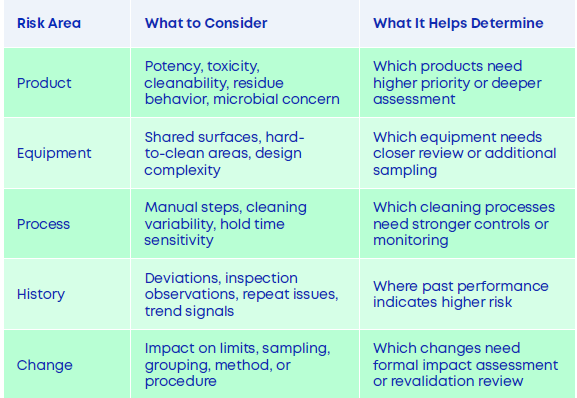
A strong risk-based approach helps teams avoid
two common problems: under-controlling a real
risk or over-controlling a low-risk scenario.
05. Hold Times That Hold Up
Because Time Is Part of the Control Strategy.
Hold times are not just schedule markers. They are part of the cleaning
control strategy because time can change risk. Residues may dry, harden,
degrade, or become harder to remove, while microbial risk can increase
depending on moisture, storage conditions, equipment design, and how
cleaned equipment is protected before reuse.
A strong hold-time approach defines the full window—from manufacturing
completion to cleaning, and from cleaning to next use. It also defines
the evidence behind those limits and the actions required when they
are exceeded. Modern programs do not set hold times once and forget
them. They reassess them when products, equipment, processes, storage
conditions, or manufacturing sequences change.
Key Hold-Time Controls
• Dirty Hold Time: Maximum time before cleaning begins
• Clean Hold Time: Maximum time before reuse
• Storage State: Whether equipment is covered, closed, dry, wet,
assembled, or disassembled
• Monitoring Point: Inspection results and environmental monitoring
• Expiry Action: Reclean, resample, inspect, investigate, or quality review
06. Strategic Business Value
Cleaner Decisions. Faster Changeovers. Fewer Surprises.
A stronger cleaning validation program helps teams make decisions with less backtracking.
Instead of rebuilding rationale from scattered records or debating the next step, teams can
see the logic behind a decision and move forward with more confidence. That matters for
quality, validation, operations, and technical teams because each group depends on the
same underlying question: is the cleaning program still controlled?
The result is not less validation. It is better validation with less wasted effort.
• Compliance Confidence: Clearer rationale, traceability, and inspection readiness
• Operational Efficiency: Faster decisions, fewer delays, and reduced rework
• Resource Optimization: Less manual checking and fewer repeated assessments
• Scalability: A consistent approach across sites while allowing justified local flexibility
07. Regulatory Case Insight
When "We'll Validation It Later" Is Not Enough.
In a public FDA enforcement example*, a manufacturer using
shared equipment was cited because it could not demonstrate
that its cleaning practices adequately removed potential
contaminants and prevented product carryover. Beyond
missing studies, the agency identified gaps in the control
strategy, including acceptance criteria, cleaning frequency,
dirty hold-time limits, and evidence that the process could
address worst-case cleaning conditions.
The inspection highlighted a broader lesson for modern cleaning validation:
firms must evaluate difficult-to-clean products, challenging sampling locations,
hold-time limits, and the impact of introducing new products or equipment.
Cleaning validation is not a one-time exercise; it is a lifecycle program that must
connect risk, hold times, and change assessments to maintain a defensible
state of control.
* FDA Warning Letter 320-26-25
08. The Smarter Way Forward
Build the Program Like a Living System.
Modernizing cleaning validation does not require doing everything at once.
The best approach is practical, phased, and risk-based. Start by mapping
the current program, defining the risk logic, standardizing hold-time logic,
connecting change assessments, and digitizing the highest-friction areas.
Common starting points include residue limit calculations, worst-case
assessments, equipment surface mapping, change impact assessments,
protocol tracking, and hold-time monitoring. Once connected, continued
monitoring and periodic review help teams identify trends, prevent drift,
and strengthen the control strategy.
A phased approach keeps modernization practical, risk-based, and easier to scale:
-
Map current program
-
Define risk logic
-
Control hold times
-
Connect change impact
-
Monitor and improve
09. Conclusion
Making Cleaning Validation Work Smarter.
Cleaning validation will always be a critical part of pharmaceutical quality.
But it does not have to be slow, scattered, or stressful. Modern programs keep
the rationale visible, current, and ready when products, equipment, processes,
or expectations change. They bring structure to the areas that create the most
day-to-day pressure: risk-based prioritization, hold-time control, and change
assessment. The future of cleaning validation is not more paperwork. It is
better science, better data, and better decisions.
Table of Contents


