From AI Assistance to Governed Execution: Rethinking Control in CQV


Summary
AI can move CQV beyond task assistance by executing suitable, repeatable activities within defined boundaries. The goal is to reduce avoidable execution variability while keeping human expertise responsible for judgment, risk, exceptions, and approval.
Greater system responsibility should follow demonstrated performance, risk assessment, and governance. Ongoing performance evidence can also extend assurance between formal CQV activities without replacing qualification.
Key takeaways
- Governed AI can move suitable controls closer to execution, reducing variability before it reaches review, correction, or rework.
- Responsibility should expand only when performance evidence, risk assessment, and governance justify a broader execution scope.
- Ongoing monitoring can provide continuity of assurance between validation events, while formal qualification remains necessary.
Who is this for
- VP of Validation / CQV
- Director of Validation / CQV
- VP of Quality / QA
- Director of Quality / QA
- VP of Engineering / Facilities
- VP of Digital Transformation / Innovation
Download your Industry Insight
From AI Assistance to Governed Execution: Rethinking Control in CQV
Abstract
Early applications of artificial intelligence (AI) in commissioning, qualification, and validation (CQV) have largely focused on efficiency: accelerating documentation, review, and execution. While these capabilities can reduce manual effort, they address only part of the opportunity. A more fundamental challenge is variability in how repeatable validation work is executed across teams and sites.
Governed AI introduces a different model. Rather than simply assisting users, AI can perform suitable activities within defined boundaries while human expertise remains responsible for judgment, risk, and accountability. As evidence demonstrates reliable performance, organizations can determine where greater system responsibility is justified and where human oversight remains necessary.
This Industry Insight examines how that shift could reduce avoidable execution variability, support right-first-time performance, and change how control is exercised during CQV. It also considers the governance and regulatory expectations required when AI assumes greater responsibility for validation execution and explores how ongoing performance evidence could provide greater continuity of assurance between formal validation activities without replacing qualification.
Introduction
Commissioning, qualification, and validation (CQV) have long provided documented evidence that facilities, systems, equipment, and processes are fit for their intended use. Yet despite advances in digital validation, execution still depends heavily on people to interpret requirements, perform activities, assess evidence, and document results. That dependence can introduce variability in repeatable validation work across teams and sites.
Several developments are making AI increasingly relevant to validation: processes have become more digital and data-rich, AI can increasingly interpret unstructured information rather than only execute predefined rules, and regulators are beginning to establish expectations for AI use in GxP environments. Together, these factors make it possible—and necessary—to reconsider where human execution is essential and where greater system responsibility may be appropriate.
One measurable benefit of AI in validation is greater efficiency. ARC Advisory Group reports that AI-powered validation can reduce validation timelines by up to 50% beyond improvements achieved through standard digital validation (Abel, 2025). But efficiency addresses only part of the opportunity. Accelerating a variable process does not necessarily make it more controlled.
The more consequential opportunity is to reconsider where control occurs during validation execution. Rather than relying primarily on people to perform repeatable activities and then using review to identify inconsistencies, organizations can increasingly build controls into execution itself. AI can extend this model beyond conventional workflow automation by working with context and unstructured information in activities that cannot always be reduced to fixed rules.
This does not mean replacing deterministic automation with AI. Where requirements and outcomes can be reliably predefined, fixed rules may provide the appropriate control. AI becomes relevant where execution also requires interpretation, such as evaluating content, identifying patterns or exceptions, or applying context within defined boundaries. Combining these capabilities within governed workflows can expand the range of validation activities that systems can support or execute while preserving human responsibility for judgment, risk, and approval.
In CQV, greater system responsibility cannot be assumed simply because the technology makes it possible. It must be supported by evidence that the system performs reliably for its intended use and by governance that defines where AI can act, when human intervention is required, and how performance is monitored.
The opportunity, then, is not simply to automate more tasks or remove people from the process, but to determine which activities can be executed more consistently within a governed system, which still require human judgment, and how evidence can justify changes in that boundary over time.
What’s Broken: CQV as a Variable, Human-Dependent Process
Standardization has long been central to CQV, yet standardized procedures do not always produce standardized execution. Across large programs, multiple sites, and repeated validation activities, differences in how approved procedures are interpreted and carried out can introduce variability into a process designed to demonstrate consistency.
Human judgment itself is not the problem. CQV depends on subject matter expertise, particularly when decisions require context, investigation, or risk assessment. The limitation arises when repeatable execution depends unnecessarily on individual interpretation. In those situations, adding reviews and approvals may help detect inconsistencies, but it does not remove their source.
The more consequential question, therefore, is how much avoidable variability can be removed from repeatable execution without diminishing the role of human expertise. This reframes the opportunity: human judgment remains essential where context, risk, and investigation matter, while suitable repeatable activities may increasingly be executed within governed systems.
AI as a Governed Execution Layer
Governed execution begins when AI moves beyond supporting individual tasks and assumes responsibility for suitable, bounded activities within the validation workflow. The relevant question then becomes not simply what AI can do, but what work an organization can responsibly allow it to perform.
From task support to execution
In a governed execution model, AI operates within defined boundaries rather than independently determining how validation should be performed. Approved requirements, workflow rules, acceptance criteria, permissions, and escalation paths establish what the system can do and when human intervention is required.
For repeatable activities, this allows the system to execute defined tasks, apply established rules, and capture evidence as the work occurs. Activities requiring contextual judgment, risk assessment confirmation, or approval remain with qualified personnel. The distinction is not simply between human and machine execution; it is between work that can be bounded sufficiently for system execution and work that still requires human judgment.
That changes the user’s role as well. Subject matter experts remain responsible for defining requirements, establishing acceptable boundaries, reviewing exceptions, and determining whether outputs can be relied upon. Execution can move into the system without transferring accountability to the system.
Expanding responsibility through evidence
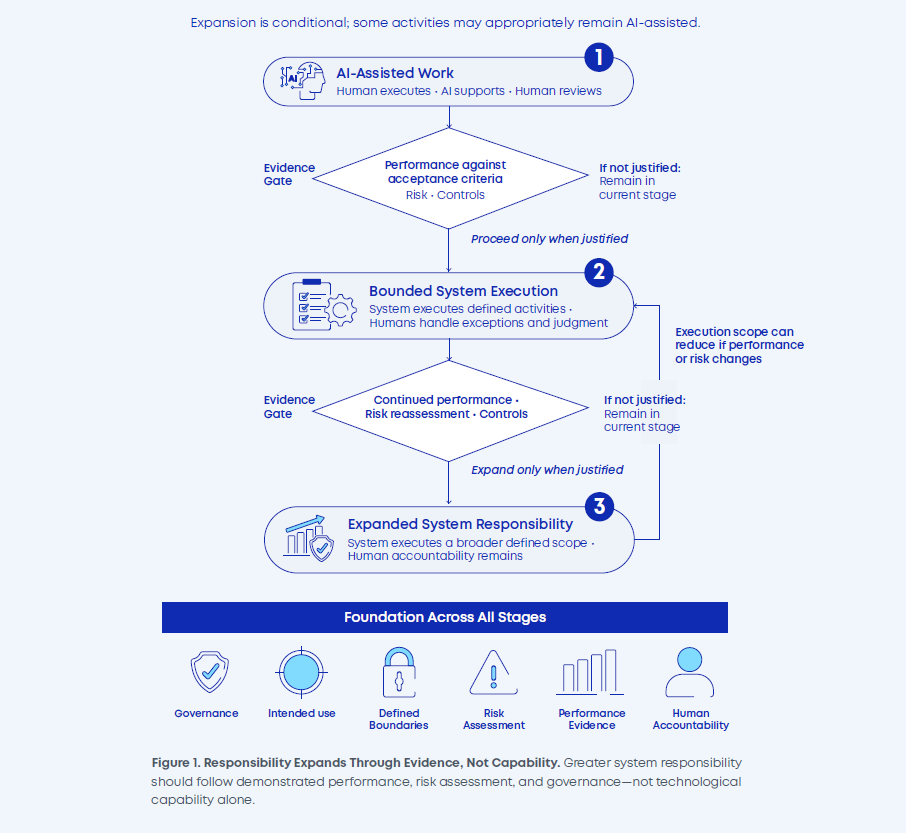
The transition from AI assistance to system execution should not be treated as an inevitable progression toward autonomy. Greater system responsibility must be earned.
Organizations can begin with bounded activities where outputs remain subject to human review, then evaluate performance against predefined criteria and the existing process. Evidence from those activities can show where AI performs reliably, where human intervention remains necessary, and where additional controls are required.
As confidence grows, the boundary of system execution may expand, but only when performance evidence, risk assessment, and governance support that change. Maturity, then, is less about how sophisticated the AI becomes and more about how much responsibility the organization can justify assigning to it.
Governance as the foundation
Governance is what makes this model different from autonomous AI operating without sufficient control. System-executed validation requires defined intended use, clear boundaries, traceability, appropriate human oversight, and mechanisms for identifying and escalating exceptions.
These controls also make execution reviewable. Organizations need to be able to determine what the system did, what information informed the activity, where human intervention occurred, and how exceptions were handled. As the system assumes greater responsibility, the evidence supporting that responsibility becomes increasingly important.
That changes the user’s role as well. Subject matter experts remain responsible for defining requirements, establishing acceptable boundaries, reviewing exceptions, and determining whether outputs can be relied upon. Execution can move into the system without transferring accountability to the system.
Reducing Variability to Support Right-First-Time Outcomes
Right-first-time performance depends on more than completing validation activities without deviations or rework. It depends on whether requirements are clear, the underlying process is sound, execution follows the approved approach, and evidence is captured correctly. AI cannot control all of these factors. It can, however, reduce variability in repeatable activities where differences in interpretation or execution add risk without adding meaningful judgment.
That distinction is important. Standardizing execution does not make an ineffective process effective. A poorly designed protocol executed consistently is still a poorly designed protocol. The value of governed execution is that it removes one source of uncertainty: whether a defined activity was carried out as intended.
Reducing variability at the point of execution
In conventional CQV workflows, controls often identify inconsistencies after an activity has occurred. A reviewer may discover missing evidence, an incorrectly completed step, or a deviation from the approved procedure. The issue can then be investigated and corrected, but the variability has already entered the process.
Moving suitable activities into a governed execution environment changes where that control occurs. Rather than relying entirely on each user to interpret and perform a repeatable step, the system can apply defined requirements, workflow rules, and acceptance criteria during execution. Human review remains necessary where judgment or risk warrants it, but it is no longer the primary mechanism for creating consistency in work that can be standardized.
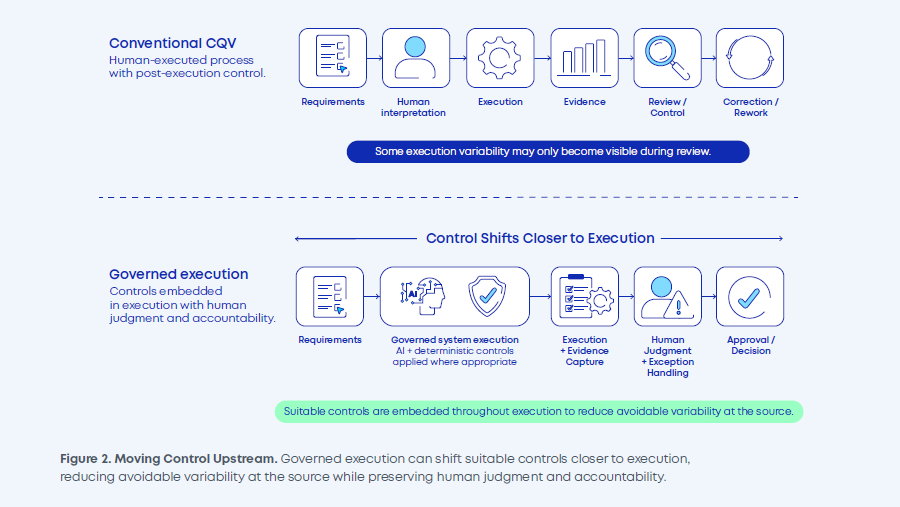
This is where AI can contribute to right-first-time performance without making the stronger claim that AI produces right-first-time validation. By reducing avoidable variation in how repeatable work is performed, governed execution can reduce opportunities for errors that lead to review cycles, corrections, and rework.
From checking work to governing execution
The distinction also changes the role of quality oversight. Traditional review frequently asks whether completed work followed the approved process. A governed execution model can enforce some of those requirements as the work occurs, while preserving evidence of the actions taken, exceptions encountered, and decisions requiring human intervention.
That creates a different relationship between execution and assurance. Quality oversight can increasingly focus human attention on exceptions, risk, and decisions requiring expertise, while appropriate system controls support consistency in routine, repeatable activities.
Governance, Trust, and Regulatory Alignment
As AI assumes greater responsibility within CQV workflows, organizations need evidence that the system performs reliably within its defined boundaries. Trust cannot rest on the technology’s capabilities alone. It depends on whether performance can be measured, reviewed, and defended.
This changes how organizations establish confidence in AI-supported validation. Documentation remains essential, but the evidence base expands to include how the system performs across defined use cases, how exceptions are handled, and whether controls continue to operate as intended.
Demonstrating trust through performance
Trust in system-executed validation must be earned through demonstrated performance. Organizations need to understand how the system performs under its intended conditions, where its limitations emerge, and whether those limitations remain within acceptable boundaries.
That requires more than measuring successful outputs. Performance evidence should also reveal how the system responds to exceptions and changing conditions and when human intervention becomes necessary. A system that performs reliably in one context cannot automatically be assumed to perform equally well in another.
Performance evidence therefore becomes part of the basis for defining intended use, appropriate oversight, and the boundaries within which AI can be relied upon. Those boundaries should be reassessed as systems, processes, risks, or operating conditions change.
Regulatory considerations and emerging guidance
Regulatory expectations for AI in GxP environments are still developing. Draft EU GMP Annex 22 provides one of the clearest indications of how regulators are approaching AI in pharmaceutical manufacturing. Its current scope focuses on static AI and machine-learning models with deterministic outputs when used in critical GMP applications that directly affect patient safety, product quality, or data integrity (European Commission, 2025).
The draft takes a more restrictive position on other forms of AI. Dynamic models that continuously learn during use, models that produce probabilistic outputs, generative AI, and large language models are outside its defined scope and should not be used in critical GMP applications. For noncritical applications, however, the draft allows greater flexibility, provided qualified and trained personnel remain responsible for determining whether outputs are suitable for their intended use (European Commission, 2025).
These distinctions make intended use and criticality central to decisions about AI in validation. The question is not simply whether an organization uses AI, but what the AI is being asked to do, the consequences if it performs incorrectly, and what controls and human oversight are appropriate for that use. Draft Annex 22 reinforces this risk-based approach through expectations for defined intended use, performance metrics, and acceptance criteria, representative testing, change control, and ongoing performance monitoring (European Commission, 2025).
The regulatory position is also still developing. At a two-day multistakeholder workshop on June 30 and July 1, 2026, the European Medicines Agency (EMA) sought expert input on how adaptive and probabilistic models could be accommodated within Annex 22 and what validation approaches and guardrails might support generative AI and large language models in GMP environments (EMA, 2026). This should not be interpreted as a change in the current draft position. It does, however, indicate that EMA is actively examining whether risk-based controls and mitigation measures could support technologies that fall outside the draft’s current scope.
For organizations exploring more advanced AI applications in CQV, this uncertainty strengthens the case for evidence-based adoption. Draft Annex 22 calls for predefined performance metrics and acceptance criteria and states that model acceptance criteria should be at least as high as the performance of the process being replaced (European Commission, 2025). That provides a practical benchmark: organizations should be able to demonstrate how an AI-supported process performs against the existing process and whether the controls surrounding its use are appropriate to the risk.
The Future of CQV: Connecting CQV to Continuous Assurance
CQV has traditionally established documented evidence that facilities, systems, equipment, and processes are fit for their intended use at defined points in the lifecycle. That foundation remains essential. What AI may change is the degree of visibility and control organizations can maintain after those formal activities are complete.
When execution occurs within governed systems, the resulting data can provide a more continuous view of performance. Instead of relying only on evidence generated during formal qualification or requalification activities, organizations can use ongoing performance information to identify changes, exceptions, and emerging risks between those events.
This does not make initial qualification or subsequent validation activities unnecessary. Rather, it creates an opportunity to connect formal CQV activities more closely with the evidence generated during ongoing operations.
Extending assurance beyond validation events
Formal qualification establishes that a system or process performs as intended under defined conditions. Over time, however, operating conditions change. Equipment ages, processes evolve, systems are updated, and new data becomes available.
Continuous monitoring can provide additional evidence about whether validated systems and processes continue to perform within established parameters. AI can extend that capability by identifying patterns, changes, or exceptions in larger volumes of operational data and directing attention to conditions that warrant investigation or review.
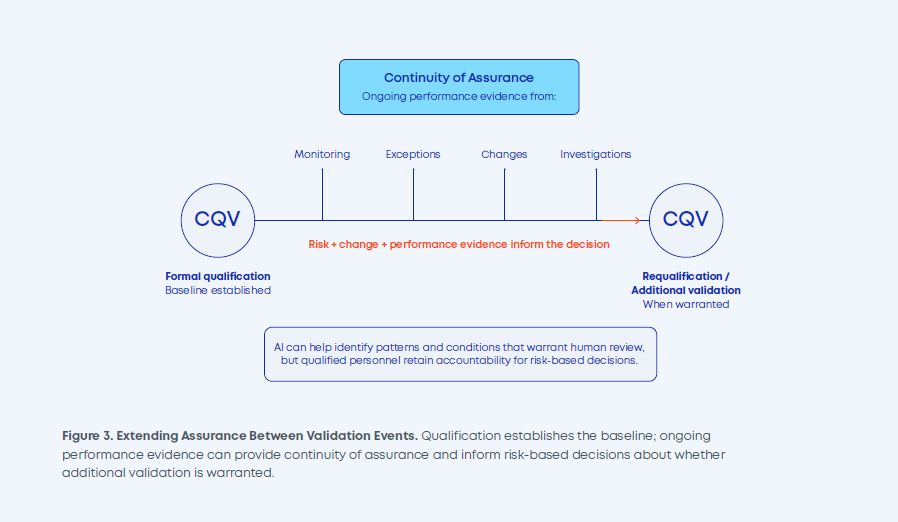
The result is not continuous validation in place of formal CQV; it is greater continuity of assurance between validation activities. Qualification establishes the baseline; ongoing evidence helps organizations understand whether performance continues to support that validated state.
Connecting CQV to lifecycle assurance
This model also creates a stronger connection between CQV and the broader process lifecycle. FDA’s lifecycle approach to process validation already establishes continued process verification (CPV) as a means of providing ongoing assurance that a process remains in a state of control during commercial manufacturing (U.S. Food and Drug Administration [FDA], 2011). AI does not change that principle, but it may expand the organization’s ability to collect, interpret, and act on the evidence that supports it.
For CQV, the opportunity is to make qualification evidence less isolated from what happens afterward. Data generated during execution, monitoring, investigations, changes, and ongoing operations can provide context for future validation decisions. In turn, formal CQV activities establish requirements and baselines against which subsequent performance can be evaluated. This creates a feedback relationship rather than a series of disconnected validation events.
A more adaptive model of assurance
Over time, stronger connections between qualification and ongoing performance data could also affect how organizations determine when additional validation activity is necessary. Rather than relying solely on predetermined intervals, organizations may increasingly be able to use risk, change, and performance evidence to inform the scope and timing of subsequent activities.
That future state depends on trustworthy data, appropriate monitoring, defined thresholds, and governance over how evidence informs decisions. AI can help organizations detect conditions that merit attention, but the decision to investigate, reassess, or perform additional validation remains a regulated responsibility.
The direction, therefore, is not away from CQV. It is toward a model in which formal qualification and ongoing assurance become more connected, allowing organizations to understand the validated state through both defined validation activities and the evidence generated between them.
Conclusion
AI has the potential to change CQV in a more fundamental way than simply accelerating existing validation activities. The larger opportunity is to reduce avoidable variability by moving suitable, repeatable work into governed systems where execution can occur within defined boundaries and established controls.
That shift does not diminish the role of human expertise. It changes where that expertise is most valuable. Qualified personnel remain responsible for requirements, risks, exceptions, approvals, and ultimately whether AI-supported outputs can be relied upon. As systems assume greater responsibility for execution, organizations need evidence that the technology performs reliably for its intended use. Greater responsibility should follow demonstrated performance, not technological capability alone.
The same principle applies as organizations look beyond individual validation events. Ongoing performance data and AI-enabled monitoring can provide greater continuity of assurance between formal CQV activities, but they do not eliminate the need for qualification. Instead, they create an opportunity to connect qualification evidence more closely with what happens during ongoing operation.
The future of CQV is not defined by how much work organizations can automate, but by how deliberately they govern the boundary between human and system execution. The evolution from AI assistance to governed execution should be measured not simply by how much responsibility AI can assume, but by whether the evidence justifies that responsibility and whether the result is stronger, more demonstrable control.
Table of Contents


