Digital CMC Maturity Starts with Structure: Rethinking QTTP and Control Strategy


Summary
Digital CMC maturity starts with structured, connected product and process knowledge, not the digitization of static documents. QTPP, CQAs, CPPs, CMAs, analytical strategy, validation, and control strategy need to remain traceable across development, submissions, and commercial manufacturing.
By treating QTPP and control strategy as lifecycle assets, companies can reduce rework, improve Module 3 readiness, support technology transfer, and manage post-approval changes with stronger scientific and risk-based justification.
Key takeaways
- Digital CMC maturity depends on how knowledge is structured, governed, and connected from the point of creation.
- Fragmented documents, spreadsheets, and siloed systems make CMC decisions harder to trace across development, validation, technology transfer, and commercial operations.
- A connected, science- and risk-based CMC knowledge model can support faster Module 3 preparation, stronger regulatory justification, and better lifecycle management.
Who this is for
- CMC leaders and strategy teams
- Pharmaceutical development teams
- Quality by Design (QbD) and quality risk management professionals
- Regulatory affairs and regulatory CMC professionals
- Process validation and PPQ teams
- Technology transfer teams
- Manufacturing, quality, and lifecycle management leaders
Download your Industry Insight
Digital CMC Maturity Starts with Structure: Rethinking QTTP and Control Strategy
The transition to digital CMC strategies requires a fundamental shift in how product and process understanding is created, structured, and managed across the product lifecycle—from early development through commercial operations. As products move through increasingly accelerated clinical timelines, CMC teams must complete process characterization, analytical validation, scale-up, facility readiness, comparability and stability assessments, and process validation strategies while also addressing regional regulatory expectations in Module 3 submissions.
In this environment, time to market is critical, but regulatory readiness cannot rely
on fragmented documents, disconnected systems, or late-stage consolidation of CMC knowledge. An effective knowledge management system, grounded in scientific evidence and risk-based decision-making, is essential to manage product and process complexity while enabling global cross-functional teams to operate with both global alignment and local regulatory specificity.
Building on previous Industry Insights on digital QbD, this paper explores why digital CMC maturity starts with how knowledge is structured—not merely digitized.
It examines the technical, logistical, and regulatory challenges that prevent organizations from fully realizing the value of their CMC knowledge and proposes
a more integrated approach to connecting QTPP, CQAs, CPPs, CMAs, analytical strategy, control strategy, validation, technology transfer, and lifecycle management.
Ultimately, digital CMC maturity is not achieved by digitizing existing documents; it requires a shift toward structured, science- and risk-based knowledge management. Organizations that make this transition will be better positioned to accelerate development, improve Module 3 readiness, manage post-approval changes, and sustain product quality across global manufacturing networks.
Introduction
This Industry Insight builds on previous publications, Integrating Digital Transformation and Quality by Design for Enhanced Pharmaceutical Development and Transforming Pharmaceutical Development: Combining Digital Platforms and QbD Principles, which explored QbD and analytical quality by design (aQbD) development using digitally enabled methodologies. These papers highlighted the challenges of paper-based processes and the value of a digital ecosystem to streamline risk assessments, accelerate regulatory submissions, and improve knowledge management. Real-world case studies demonstrated how embedding digitalization throughout the development lifecycle can strengthen compliance, increase agility, accelerate innovation, and foster a culture of continuous improvement.
This paper extends the discussion further by exploring how CMC strategies can be revolutionized—not just digitized—through approaches that address the technical,
logistical, and regulatory challenges preventing organizations from fully realizing the value of their CMC knowledge.
Even when organizations adopt structured QbD development processes, limited digital maturity can still create significant challenges, including gaps in traceability
between development decisions and downstream activities; inconsistencies during technology transfer and scale-up; and misalignment across development, validation, and commercial operations. Perhaps most importantly, many organizations still fail to treat the QTTP and control strategy as evolving lifecycle assets. Without an integrated and interconnected approach from the outset, organizations risk losing the relationships, criticality assessments, and risk logic needed to maintain continuity across development, PPQ, and commercial manufacturing.
Organizations that structure and connect CMC knowledge at the point of creation are better positioned to improve consistency, scalability, user adoption, and lifecycle management readiness. Consistency is key to reducing reliance on manual interpretation, knowledge reconciliation, and rework. Establishing a systematic approach to align clinical outcomes with CMC strategy is particularly important in accelerated programs. Clinical teams may push for rapid pivotal studies or accelerated filings while CMC teams still need to complete process characterization, analytical validation, scale-up, facility readiness, comparability, stability, and process validation strategy (FDA, 2024; Fontanillo et al., 2022).
Digital CMC maturity enables organizations to address these challenges more proactively while reducing the time and effort required across the product lifecycle—from development scientists to MS&T technicians and CMC specialists. Organizations can also mitigate the risk of delays and incomplete CMC information in Module 3 submissions, which, as stated above, are likely to require an understanding of the nuances of regions-specific regulatory commitments.
Driving the Next Level of CMC Submissions
Where We Stand: Digital Maturity
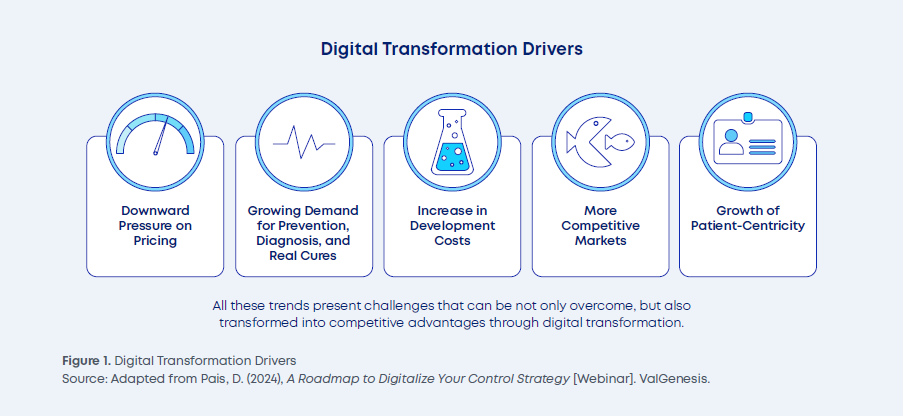
The pharmaceutical industry is experiencing a significant digital transformation driven by the need for faster, more efficient, and compliant product development. Regulatory expectations, particularly those outlined in ICH Q8–Q14 guidelines, are pushing organizations toward systematic, science- and risk-based approaches, while business drivers are pushing companies to become more digitized (Figure 1).
However, many companies still rely on manual, paper-based processes that create inefficiencies, increase data integrity risks, and limit opportunities for innovation.
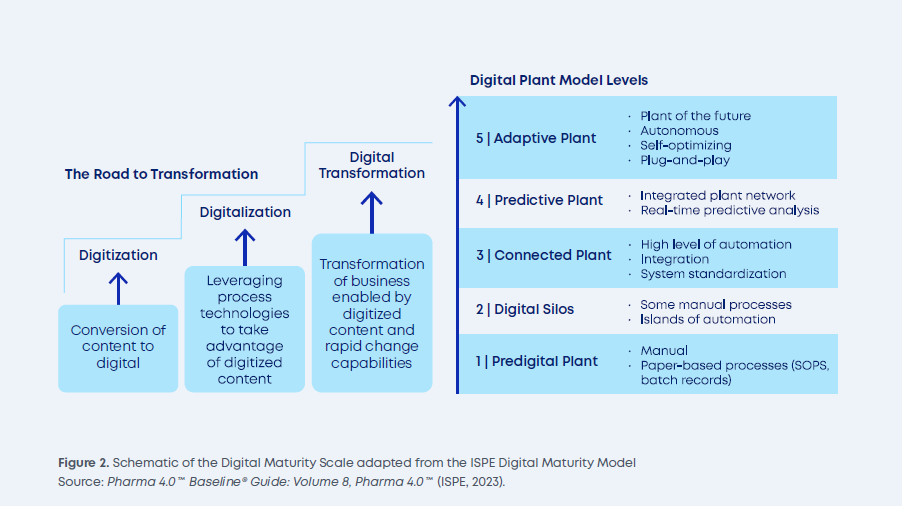
Others have begun taking the first steps toward a more systematic digital transformation in how CMC strategies are developed. One widely recognized framework
for assessing the digital maturity of pharmaceutical companies is the ISPE Digital Maturity Model, developed as part of the Pharma 4.0™ initiative. The framework
provides a structured approach for pharmaceutical organizations to assess their current level of digital capabilities and define a roadmap toward a fully integrated, data-driven operating model (ISPE, 2023).
The model reflects a shift from traditional, document-based, siloed operations toward end-to-end digital integration across the product lifecycle, encompassing
development, manufacturing, quality, and regulatory functions. It defines five levels of digital maturity, ranging from pre-digital, paper-based operations to adaptive, autonomous organizations operating in real time with seamless data flows across the enterprise and across lifecycle stages (Figure 2).
The assessment framework considers dimensions that align closely with the “triple constraint” triangle of processes (“organizational processes”), data and
technology (“data integrity by design” and “information systems”), and people (“culture” and “resources”).
Empirical data suggests that most pharmaceutical companies are still in the early to intermediate stages of digital maturity, indicating that the industry is not lacking awareness but still running proof-of-concept (PoC) and pilot programs as scattered initiatives rather than systematic, scaled enterprise wide execution. Previous Industry Insights explored how companies in these earlier stages of digital transformation are using structured digital frameworks to build science- and risk-based control strategies (ValGenesis, 2025a; ValGenesis, 2025b).
While many companies have invested in digital tools to operationalize QbD adoption, digital CMC maturity is still constrained by how QTTP and control strategies are
structured at the source or at discrete points as product knowledge evolves. Figure 3 illustrates how control strategies evolve across the product lifecycle, from
pharmaceutical development through post-commercial manufacturing.
Building a control strategy is an essential part of the CMC regulatory dossier and the foundation of commercial manufacturing to ensure ongoing product quality
assurance. During the product lifecycle, the control strategy may evolve based on feedback from process monitoring and the change management process.
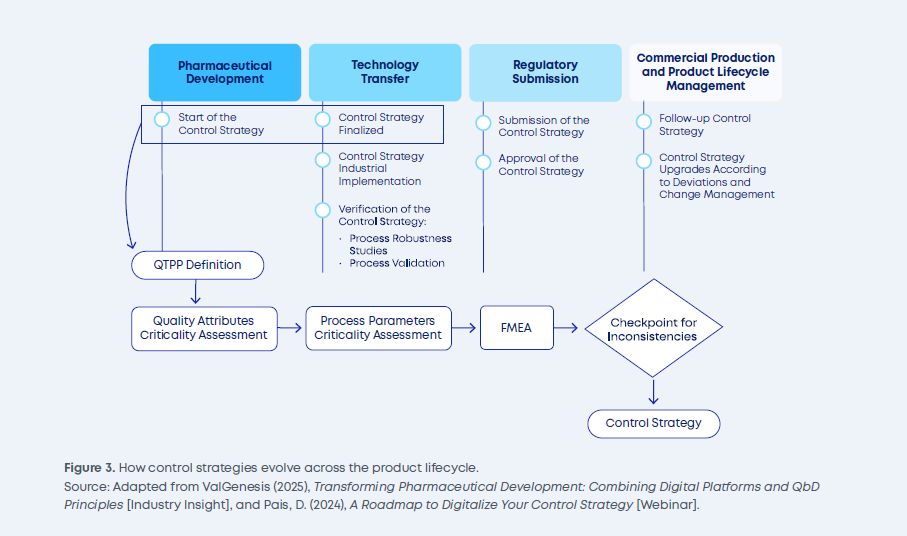
Control strategies are typically solidified during the final stages of pharmaceutical development. However, even organizations with digital platforms supporting
integrated QbD workflows often still rely heavily on manual data entry as more process and product knowledge becomes available. Clinical data generated
during accelerated development programs frequently must be manually assessed and consolidated with the desired QTPP. Likewise, development data from DoE and other exploratory studies are often stored across disconnected systems, such as ELN and LIMS, requiring manual consolidation that introduces both data integrity risks and efficiency bottlenecks.
As a result, many current digital approaches can support the technical aspects of designing a CMC strategy but still fall short of achieving the broader “north star” goal of having a single product with one process recipe built on fully traceable and connected product knowledge.
Another important dimension of digital CMC maturity involves post-approval CMC changes to existing regulatory submissions. These changes are essential
for capacity expansion, site additions, process improvements, analytical updates, and supply continuity. However, industry studies report that divergent national
requirements and review timelines can delay approvals by three to five years in some cases (Deavin et al., 2024; Mangia et al., 2024).
Global post-approval CMC change timelines indicate a 90% probability of country approval made over 24 months in 63% of countries studied and over 36 months in 15% of countries studied (Harris et al., 2023). These delays mean companies may need to operate multiple parallel supply chains, inventory strategies, and registered process versions for the same product while waiting for approvals across markets (Harris et al., 2023; Deavin et al., 2024).
Together, these challenges highlight why organizations must move beyond simple CMC digitization toward more integrated and structured digital CMC maturity models.
Moving Beyond Digitization of CMC: Challenges
Legacy processes, unstructured data, lack of standardization, and siloed data/system architectures continue to prevent companies from realizing the full value of digital tools and advanced analytics (Fontanillo et al., 2022). The path to true digital CMC maturity, where knowledge is embedded into a harmonized CMC submission, can be hindered by several technical, regulatory, and logistical hurdles.
Technical challenges
In digitally mature companies, process performance assessment requires advanced data and computing infrastructures capable of rapidly acquiring data and
transforming it into meaningful process and product information. One of the key challenges associated with large-scale data environments is determining how best
to use the knowledge and insights generated, whether for internal auditing purposes, product release decisions, or the development of regulatory CMC strategies.
For CMC purposes, data volumes continue to increase due to automation, equipment-generated data, real-time process monitoring, and data modeling, making data integrity and compliance with FAIR principles—findability, accessibility, interoperability, and reusability—more difficult to attain (Fontanillo et al., 2022). By applying FAIR principles within a centralized tool, companies can achieve more structured and traceable knowledge management, reducing compliance risk, streamlining analytics, and strengthening regulatory submission readiness. This means that when development laboratories, pilot plants, commercial manufacturing
sites, CDMOs, and global regulatory groups operate using integrated systems and common data standards, CMC decisions and submissions become faster and easier to defend (Fontanillo et al., 2022; Algorri et al., 2026).
There are additional technical challenges beyond data governance that continue to limit progress toward digital maturity. These include inconsistent communication
protocols and limited interconnectivity across digital ecosystems, particularly in hybrid system landscapes where legacy equipment and facilities may not support
modern communication standards (ISPE, 2025).
As organizations become increasingly digitized, cybersecurity risks also become more significant and may ultimately create vulnerabilities that affect product, process, and operational security. Companies will need to develop robust risk mitigation strategies to reduce or eliminate network vulnerabilities and strengthen
system resilience.
Regulatory challenges
Limited regulatory precedent can discourage organizations from adopting new approaches, even when those approaches may reduce regulatory burden and improve product quality over the long term. Another major challenge is the complexity of filing regulatory submissions across multiple global jurisdictions
with differing regulatory expectations, particularly for emerging manufacturing technologies. Greater international regulatory convergence on advanced manufacturing technologies could potentially lessen this uncertainty for manufacturers.
As mentioned previously, the pharmaceutical industry remains in a transitional phase in which novel and legacy systems must co-exist. This reality requires regulatory frameworks that are flexible enough to accommodate different technology paradigms.
A major industry-reported challenge is that the same CMC data and control strategy may be interpreted differently by different health authorities, even across
established ICH regions. An ISPE/IQ study covering 112 marketing applications submitted by 11 companies found an overall core-document acceptance rate of 54% across the United States, Europe, Canada, and Japan. This translated to only an 8.7% probability that core control strategy documents would be accepted by all four
regions without modification.
This creates a practical challenge for global companies. While manufacturing operations are generally run as “one product, one process” globally, registered CMC
commitments can evolve into region-specific variants. Companies may therefore be required to manage different specifications, process descriptions, material
controls, or testing expectations by market. Global CMC, regulatory, manufacturing, and quality teams must then spend significant effort reconciling local regulatory
commitments with global process realities. Ultimately, CMC strategy fails when it is treated as a late-stage regulatory writing exercise rather than an
integrated product, process, control, facility, supply, and lifecycle strategy (Fontanillo et al., 2022; FDA, 2024).
Logistical challenges
Logistical challenges are closely tied to organizational culture, workforce readiness, and cross-functional collaboration. Global organizations routinely
transfer processes from development to commercial manufacturing sites, between commercial sites, or from internal sites to CDMOs. Any gap during these transfers
can trigger CMC comparability concerns, validation delays, deviation trends, or region-specific regulatory commitments (Kaczanowski, 2024; Harris et al., 2023).
Change management and workforce capabilities: Companies must embrace change management programs to upskill existing employees, recruit new talent, and support the transition away from static, paper-based, or basic digitization. At the same time, organizations must create conditions that empower employees to adapt to new ways of working and address concerns related to increasing automation and potential job loss (ISPE, 2025).
Cross-functional collaboration: Technological advancement must be accompanied by a shift away from siloed functions toward greater transparency
and cross-functional collaboration. This is particularly important when building CMC strategies that rely on multiple functions and areas of expertise. Cross-functional
collaboration becomes especially important during technology transfer activities, which require more than the transfer of documents alone. Successful technology transfer depends on the effective transfer of product knowledge, process understanding, analytical capabilities, control strategy, equipment fit, and tacit operational know-how (Kaczanowski, 2024; Fontanillo et al., 2022).
Shaping the Future of Digital CMC
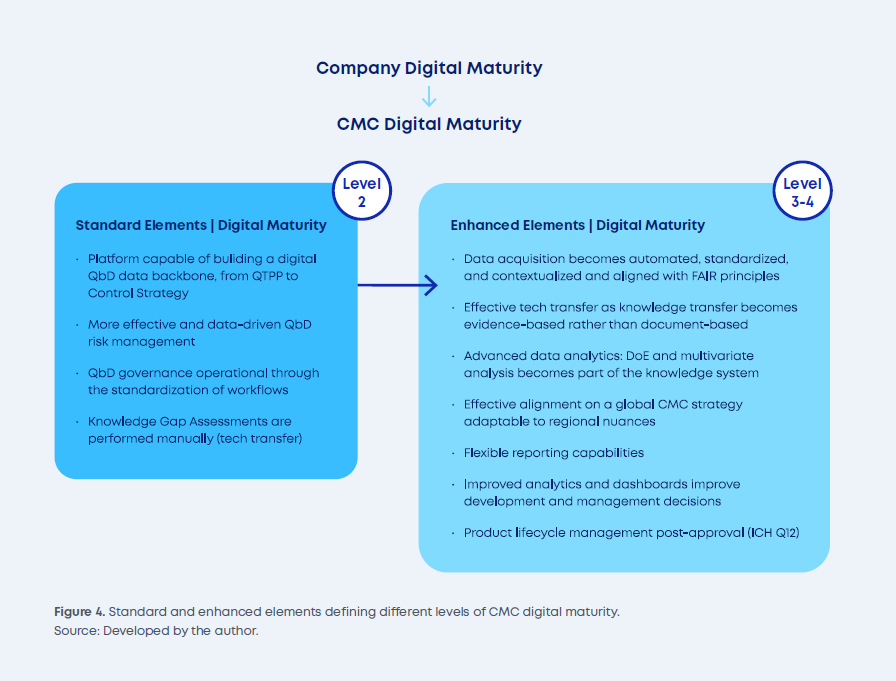
Figure 4 presents a high-level view of the digital elements that characterize increasing levels of CMC digital maturity. The figure distinguishes between a set
of foundational capabilities, referred to as standard elements, and a set of more advanced capabilities, referred to as enhanced elements, that support the next generation of digital CMC maturity.
In this context, the standard elements represent capabilities typically found in organizations that have already begun their digital transformation journey. Using
the ISPE Digital Maturity Model as a reference, these organizations generally operate around Level 2 maturity (“Digital Silos”), as illustrated in Figure 2, and demonstrate intermediate maturity across data- and technology-related dimensions.
The enhanced elements shown in Figure 4 are intended to address some of the technical challenges discussed in the previous section by establishing clearer frameworks for data acquisition, system integration, and workflow automation. These capabilities can improve how crossfunctional teams share information, manage knowledge, and collaborate across the product lifecycle.
The following section presents a proposed approach for achieving greater digital CMC maturity.
Global Implementation of an Integrated Digital CMC Strategy: An Approach
Typical Problem Statement
-
Geographical dispersion: Global organizations with geographically dispersed development and commercial manufacturing sites require a unified approach to QbD-based process development, tech transfer, and commercial operations.
-
Inefficient data analysis: Manually managing large datasets through spreadsheets makes risk management activities time-consuming and error-prone.
-
Poor knowledge sharing: Disparate systems hinder effective communication across teams and limit access to historical product and process data.
Proposed Solution
-
Implementation of a digital platform that streamlines and standardizes activities from Stage 1 through Stage 3 of the product lifecycle.
-
Development of an interoperable digital ecosystem in which QbD knowledge flows across systems and functions, supporting structured CMC data and a unified global control strategy while avoiding fragmented standards and platforms.
-
Development of integrated QbD workflows supporting process development through PPQ.
-
Development of workflows that support effective knowledge management during tech transfer activities.
-
Program management supported by a consistent delivery model that uses agile methodologies to enable adaptability and speed through a collaborative, consultative, and outcome-driven approach.
In the schematic below, the proposed approach is illustrated in a layered framework, beginning with the identification and mapping of data sources and the
establishment of data governance at its core. The expected gains and outcomes associated with this approach are also outlined.
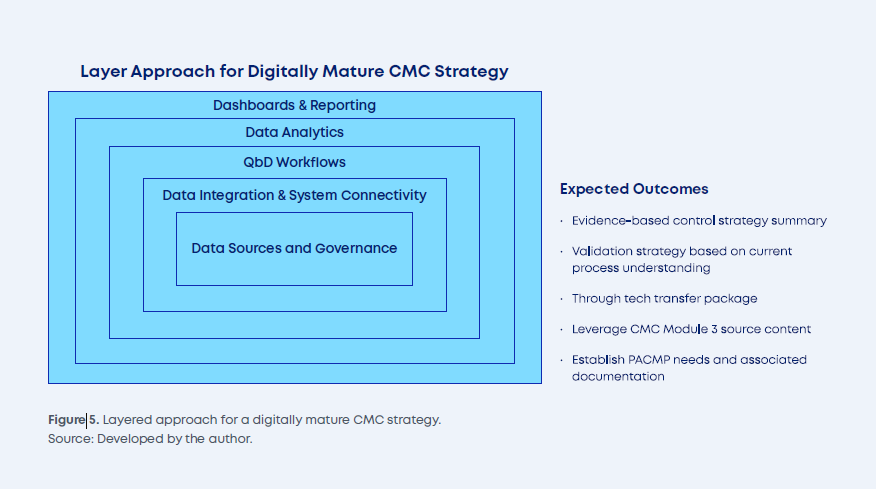
Data sources and governance
The identification of data sources (for example, ELN, LIMS, and MES) is followed by data mapping activities and engineering assessments focused on system connectivity and integration between external data sources and a unified digital platform. Within this framework, QbD workflows are supported by the required process and quality data points. Clinical outcomes may still be entered manually into the workflow to support assessment against the QTPP.
A common problem in QbD development faced by organizations is not the absence of data, but rather the lack of usable, contextualized data. Information is often
distributed across ELNs, LIMS, chromatography systems, historians, spreadsheets, MES platforms, and statistical software without consistent metadata or traceability. Data contextualization is particularly important in QbD because process understanding depends not only on the underlying data, but also on being able to explain why the data were generated, under what conditions they were generated, and how they support process understanding.
Data integration and system connectivity
Instead of keeping QTPPs, CQAs, CPPs, CMAs, DoE outputs, analytical data, batch records, and risk assessments in disconnected files, the platform can establish a connected data model where each item is linked and traceable.
This approach is particularly important because many CMC organizations continue to operate with legacy processes, unstructured data, inconsistent standards,
and siloed systems that limit the effective use of digital tools and advanced analytics. This helps create a structured “digital thread” linking development decisions
to regulatory commitments, aligning with the broader industry push toward a single global digital CMC dossier and structured CMC data exchange (Algorri et al., 2026).
Within this framework, QbD risk assessment can evolve into a more dynamic process. As new DoE, scale-up, engineering, clinical, stability, or PPQ data become
available, the platform can prompt reassessment of risk scores and control assumptions.
QbD workflows
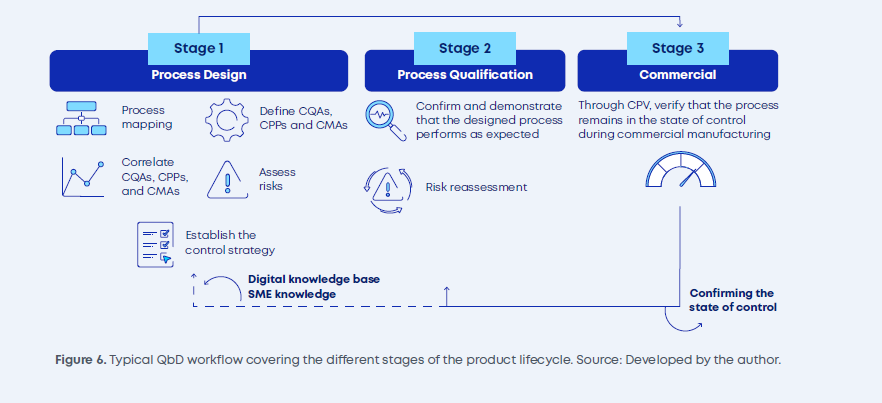
As discussed in the previous Industry Insights, QbD workflows can provide a structured approach to process development beginning with QTPP and extending
through the establishment of the control strategy. Figure 6 provides a high-level schematic illustrating a typical QbD workflow across the different stages of the product lifecycle (Figure 6).
Data analytics
Digital platforms can help incorporate DoE and modeling outputs into a structured product knowledge base by capturing key model conditions, assumptions, and
known limitations. Process observations can then be contextualized to strengthen process knowledge and scientifically justify process ranges.
This becomes increasingly important as future CMC development continues to rely more heavily on in silico tools, advanced analytics, digital twins, high-throughput
experimentation, and automated reporting (Fontanillo et al., 2022).
Instead of searching through multiple reports, teams can trace a registered process parameter back to the supporting DoE model, associated batches, analytical
data, risk assessments, and the decision record.
Dashboards and reporting
Once data are structured and connected, digital platforms can generate dashboards that support both scientific and portfolio-level decision-making, including:
-
QbD dashboards: Product and process understanding metrics to gauge the level of knowledge/uncertainty of each quality attribute, CPP/CMA–CQA relationship strength, open knowledge gaps, model confidence, and process capability.
-
Control strategy dashboards: CQA coverage through release testing or IPC/PAT controls, specification justification status, analytical method readiness, and validation readiness.
-
Technology transfer reporting: Transfer package completeness, site gap assessments, open deviations and investigations, engineering batch status, and PPQ readiness.
-
Regulatory readiness reporting: Module 3 sourcedata completeness, established conditions, regional requirement mapping, stability package readiness, process validation maturity, and facility readiness.
This aligns with broader industry trends toward real-time data visibility, advanced analytics, automated reporting, and interactive visualization supporting project- and portfolio-level decision-making.
Expected outcomes
Global alignment on control strategy
One of the major challenges for global organizations is maintaining a unified control strategy while managing regional regulatory differences. This approach can
support the development of a master control strategy linked to regional variants, allowing organizations to better respond to questions such as which process
parameters are globally registered, which ranges differ by market, which tests are release tests versus internal controls, and which commitments are site-specific.
Change management can also become more integrated and traceable across sites and regions by helping organizations assess which markets are
affected by a proposed change and whether a change can be implemented globally or requires a phased regional approach.
Knowledge transfer becomes evidence-based rather than document-based
Technology transfer is not simply the transfer of documents or assets; it requires the transfer of process understanding, product knowledge, operational expectations, and control strategy. Traditional technology transfer activities often depend heavily on reports, meetings, checklists, and tacit knowledge held
by experienced scientists. A more structured digital approach can help to transform technology transfer into a structured knowledge package in which product- and
process-specific information is more easily accessible.
Better lifecycle management after approval
QbD should not end at regulatory filing. The same digital backbone should support continued process verification (CPV) based on commercial batch data, product quality review, process monitoring, change control, deviation investigations, and post-approval improvements. Through CPV activities, organizations can reassess CQA/CPP relationships, confirm or update process models, and reevaluate control strategies through ongoing risk assessment activities. This aligns closely with the lifecycle management principles outlined in ICH Q12, which aim to support more predictable and efficient postapproval CMC changes through stronger product and
process knowledge, risk management, and an effective pharmaceutical quality system (ICH, 2019).
Conclusion
Digital CMC maturity is not achieved by simply converting documents into digital files; it begins when product and process knowledge are structured, connected, and governed from the point of creation. For organizations developing complex products, operating across global sites, and navigating accelerated clinical and regulatory timelines, the ability to trace decisions from QTPP through CQAs, CPPs, CMAs, analytical strategy, process validation, and control strategy is becoming a defining capability.
A mature digital CMC strategy enables companies to move beyond static submissions and fragmented knowledge repositories toward a connected, evidence-based product knowledge ecosystem. This supports faster and more consistent Module 3 preparation, more robust technology transfer, stronger regulatory justification, and improved lifecycle management after approval.
The future of CMC will depend less on isolated digital tools and more on an organization’s ability to create a connected digital thread across development, validation, manufacturing, quality, and regulatory functions. By treating QTPP and control strategy as evolving lifecycle assets rather than late-stage documentation outputs, companies can reduce rework, improve global alignment, and respond more effectively to post-approval changes.
Ultimately, digital CMC maturity represents a shift in operating model—from document-centric compliance toward structured, science- and risk-based knowledge management. Organizations that make this transition early will be better positioned to accelerate development, defend regulatory decisions, and sustain product quality across the full product lifecycle.
References
-
Algorri, M., Cauchon, N., Ahluwalia, K., & Abernathy, M. (2026, January/February). A cohesive vision for a single global CMC dossier. International Society for Pharmaceutical Engineering. https://ispe.org/pharmaceutical-engineering/january-february-2026/cohesive-vision-single-global-cmc-dossier
-
Almeida, R. (2026, April 15). Operationalizing QbD + QRM: Structured workflows that still fit your SOPs [Webinar]. ValGenesis. https://www.valgenesis.com/webinar/operationalizing-qbd-qrm-structured-workflows-that-still-fit-your-sops
-
Deavin, A., Hossain, A., Colmagne-Poulard, I., Wong, K. C., Perea-Vélez, M., Cappellini, S., Ausborn, S., Meillerais, S., & Bourguignon, C. (2024). A global industry survey on post-approval change management and use of reliance. Therapeutic Innovation & Regulatory Science, 58, 1094–1107. https://doi.org/10.1007/s43441-024-00681-y
-
Food and Drug Administration. (2024, September 23). Chemistry, manufacturing, and controls development and readiness pilot program; Program announcement. Federal Register. https://www.federalregister.gov/documents/2024/09/23/2024-21674/chemistry-manufacturing-and-controls-developmentand-
readiness-pilot-program-program-announcement -
Harris, R., Vanhooren, M., Vollmann, K., Kendzersky, B., Watson, T., Imperati, M., Dennis, S. C., & Nosal, R. (2023, September/October). An evaluation of postapproval CMC change timelines. International Society for Pharmaceutical Engineering. https://ispe.org/pharmaceutical-engineering/september-october-2023/evaluation-postapproval-cmc-change-timelines
-
International Council for Harmonisation of Technical Requirements for Pharmaceuticals for Human Use. (2019). ICH Q12: Technical and regulatory considerations for pharmaceutical product lifecycle management. https://database.ich.org/sites/default/files/Q12_Guideline_Step4_2019_1119.pdf
-
International Society for Pharmaceutical Engineering. (2023). Pharma 4.0™ Baseline® guide: Volume 8, Pharma 4.0™ (1st ed.). ISPE.
-
International Society for Pharmaceutical Engineering. (2025). ISPE good practice guide: Validation 4.0. ISPE.
https://ispe.org/publications/guidance-documents/good-practice-guide-validation-40
-
Kaczanowski, R. (2024, November 4). Strategies for overcoming common challenges in tech transfer. Pharmaceutical Technology, 48(11), 31–33. https://www.pharmtech.com/view/strategies-for-overcoming-common-challenges-in-tech-transfer
-
Mangia, F., Lin, Y. M., Armando, J., Dominguez, K., Rozhnova, V., & Ausborn, S. (2024). Unleashing the power of reliance for postapproval changes: A journey with 48 national regulatory authorities. Therapeutic Innovation & Regulatory Science, 58(6), 997–1005.
-
Pais, D. (2024, July 25). A roadmap to digitalize your control strategy [Webinar]. ValGenesis. https://www.valgenesis.com/webinar/a-roadmap-to-digitalize-your-control-strategy
-
ValGenesis. (2025a). Integrating digital transformation and quality by design for enhanced pharmaceutical development.
[Industry Insight].
-
ValGenesis. (2025b). Transforming pharmaceutical development: Combining digital platforms and QbD principles. [Industry Insight]. https://www.valgenesis.com/editorial/transforming-pharmaceutical-development-combining-digital-platforms-and-qbdprinciples
Table of Contents


