10 Questions Every Life Sciences Executive Should Be Asking About AI and the Future of Validation

Summary
AI is changing what life sciences organizations should expect from validation technology. Digital workflows remain the foundation, but future-ready validation also depends on governed AI, reusable knowledge, connected lifecycle data, scalable governance, and qualified human oversight.
Executive teams should reassess whether their validation environment can reduce repetitive effort, support product and manufacturing readiness, scale across sites, and produce measurable business and operational value.
Key takeaways
- AI-enabled validation should extend digital workflows by supporting defined tasks such as content generation, coverage analysis, evidence verification, anomaly detection, comparison, and summarization while qualified personnel retain review and decision authority.
- Validation knowledge becomes more useful when requirements, risks, tests, evidence, and decisions are structured, connected, and reusable across products, systems, sites, and lifecycle stages.
- Technology decisions should consider future operating needs, including enterprise scale, lifecycle connectivity, governance, AI readiness, operational outcomes, and the provider’s long-term validation strategy.
Who is this for
- Chief Operating Officer
- VP of Quality/QA
- VP of Validation / CSV
- VP of Validation / CQV
- VP of Digital Transformation / Innovation
- VP of IT / IT Quality / Digital Quality / Operations
- VP of Manufacturing / Operations
Download your Industry Insight
10 Questions Every Life
Sciences Executive Should Be
Asking About AI and the
Future of Validation
Executive Summary
The criteria executive teams use to evaluate validation technology are changing.
As AI reshapes what organizations can expect from validation platforms, life
sciences organizations face a broader set of considerations than those that
guided the transition from paper to digital.
Validation technology represents a significant, long-term investment. The
capabilities that supported the original business case for digital validation
remain important, but the business context has evolved. Validation is increasingly
connected to broader priorities such as operational readiness, enterprise scale,
effective use of technical expertise, and the organization’s approach to AI.
This Industry Insight presents 10 questions designed to help executive teams
look beyond current functionality and reassess what they should expect from
their validation environment. Together, the questions provide a practical way to
examine the capabilities, governance, knowledge foundation, scalability, and
technology-partner strategy that may shape an organization’s readiness for the
future of validation.
Validation Is Becoming a
Strategic Business Capability
Life sciences organizations have invested significantly
in digital validation, replacing many paper-based
processes with electronic workflows that support greater
standardization, traceability, document control, and
inspection readiness.
That was an essential step. The challenge facing
executive teams today, however, has become broader.
AI, advanced automation, and connected lifecycle data
have the potential to change not only how validation
records are managed, but also how validation work is
planned, performed, reviewed, and reused. The strategic
shift is from digitizing validation processes to applying
governed intelligence within those processes—without
removing qualified human oversight.
Leading organizations are therefore asking a more
strategic question: Can validation help accelerate
product readiness, technology transfer, manufacturing
readiness, facility startup, and global scale while
maintaining appropriate quality oversight?
As the validation technology market evolves, executive
teams should reassess whether their current environment
is positioned for the next decade or remains focused
primarily on managing today’s processes. This
reassessment should include not only what the platform
can do today, but also whether its architecture,
knowledge model, governance, and product roadmap
can support the next generation of validation.
The distinction is not between digital validation and
intelligent validation as competing approaches. Intelligent
validation extends digital validation by applying
automation and governed AI to the work performed within
those workflows.
10 Questions to Evaluate Your
Validation Strategy
The following 10 questions are designed to help executive
teams evaluate whether their current validation
strategy is ready for the next decade of life sciences
manufacturing.
1. Would We Choose the Same Validation Platform Today in the AI Era?
Many organizations selected their validation platforms before generative AI became a strategic enterprise
capability. At the time, evaluation criteria often focused on replacing paper, standardizing workflows, managing
documents, and improving traceability.
Those capabilities remain important. But if the investment decision were being made today, would the criteria
also include:
• Governed AI capabilities
• Governed use of approved enterprise knowledge
• Structured and reusable validation knowledge
• Enterprise-system connectivity
• Support for multiple validation domains
• Global scalability
• Measurable operational and readiness outcomes
The relevant question is not whether the existing platform has delivered value. It is whether it is equipped to
support the organization’s future operating model.
2. Is Our Solution Advancing How Validation Is Performed—or Just Digitizing the Process?
Digital workflows can reduce reliance on paper, standardize execution, strengthen traceability, and accelerate
review and approval. Intelligent validation should build on that foundation. Executive teams should evaluate
transformation based on business outcomes—not the number of electronic workflows. A useful test is whether the
platform reduces the work required from validation experts, improves the quality and consistency of execution,
and helps teams identify issues earlier.
Executives should ask: “Are we simply completing validation digitally? Or are we fundamentally reducing the effort
required to perform validation?”
AI-enabled capabilities can assist experts with defined tasks such as:
• Drafting validation content
• Analyzing requirements
• Identifying coverage gaps
• Supporting traceability
• Reviewing repetitive content
• Detecting anomalies and inconsistencies
• Evaluating supporting evidence
• Reusing approved knowledge
• Comparing approved content, requirements, and evidence
• Summarizing validation information for review and decision-making
3. Is Validation Supporting Product and Manufacturing Readiness?
Validation is often viewed primarily as a compliance activity. In practice, it can also affect the timing and
predictability of major business initiatives.
Delayed validation activities, repeated testing, unresolved exceptions, extensive rework, and slow approval cycles
can affect:
• Product launches
• Technology transfer
• Facility and equipment startup
• Manufacturing readiness
• Capacity expansion
• Deployment of new computerized systems
Executives should ask whether their validation environment helps teams identify and resolve readiness risks earlier
or primarily documents work after it has been completed. They should also ask whether validation data can be
connected to upstream process knowledge and downstream operational performance so readiness decisions are
based on a broader lifecycle view.
4. Is AI Integrated into the Validation Operating Model?
AI should be evaluated as more than an isolated feature. Its value depends on how effectively it is integrated into
validation workflows, knowledge, controls, and governance. For regulated use, integration alone is not sufficient.
AI should also be grounded in approved knowledge, constrained to defined use cases, traceable to source
information, and subject to proportionate human review.
Executives should ask:
• Is AI embedded in the platform and its workflows?
• Is the AI grounded in approved, controlled, and contextually relevant knowledge?
• Which validation tasks can it support?
• Is its use governed for regulated environments?
• Are outputs traceable to source information, reviewable by qualified personnel, and retained appropriately
for their intended use?
• Can the organization control where and how AI is applied?
• Do qualified personnel retain review, approval, and decision authority?
AI can assist with defined activities such as content generation, coverage analysis, evidence verification, anomaly
detection, comparison, summarization, and other repetitive validation tasks.
Governed AI requires more than human oversight. Human review is essential, but it is only one layer of control.
Trusted AI in validation also depends on approved knowledge sources, bounded intended use, role-based access,
traceability, auditability, output review, and validated controls appropriate to each use case.
5. Are We Building Reusable Knowledge—or Primarily Managing Documents?
Documents remain essential validation records. However, a document-centric environment may make it difficult to
reuse the requirements, risks, tests, evidence, decisions, and lessons contained within those records.
The objective is not to replace controlled documents, but to make the knowledge within them more accessible,
contextualized, traceable, and reusable. Modern platforms should help organizations structure and connect
validation information so it can be reused across:
• Products
• Assets
• Computerized systems
• Facilities
• Sites
• Validation programs
• Lifecycle stages
Structured, governed, and contextualized knowledge will be an important foundation for applying enterprise AI
effectively, consistently, and with a lower risk of unsupported outputs.
Executive teams should therefore assess whether their platform merely stores validation records or can also
manage the relationships among requirements, risks, tests, evidence, decisions, and lifecycle context.
6. Can Our Platform Connect the Product Readiness Lifecycle?
Validation does not operate in isolation. Product and manufacturing readiness depend on connected activities
across development, technology transfer, qualification, validation, operational execution, and continued
monitoring.
Executive teams should consider whether their technology environment and platform strategy can support and
connect areas such as:
• Computer Software Validation (CSV) and Computer Software Assurance (CSA)
• Chemistry, Manufacturing, and Controls (CMC), Quality by Design (QbD), and process knowledge management
• Process and analytical procedure development
• Process Validation
• Commissioning, Qualification, and Validation (CQV)
• Technology Transfer
• Cleaning Validation
• Continued Process Verification (CPV)
• Regulated operational execution
A connected platform can help reduce fragmented knowledge, improve lifecycle visibility, and support more
consistent decisions across functions and sites. The value comes not simply from placing multiple activities on one
platform, but from preserving traceability and context as information moves across lifecycle stages.
7. Are We Reducing Low-Value Validation Effort?
One of the most significant opportunities for AI and automation is to improve how validation experts spend their time.
Validation leaders should assess how much expert effort is still consumed by:
• Drafting repetitive content
• Reviewing standard language
• Searching for prior work
• Maintaining traceability
• Comparing requirements and tests
• Supporting routine impact assessments
• Checking execution evidence against approved expectations
• Preparing status reports
• Reformatting and reconciling documents
They should then determine which of these activities can be assisted or automated while retaining appropriate
human review and approval. The level of automation and review should vary by task, intended use, and potential
GxP impact.
The objective is not to remove experts from validation. It is to allow them to focus more of their time on scientific,
engineering, quality, and risk-based decisions.
8. Is Our Validation Environment Supporting Enterprise Scale?
As organizations expand across products, sites, systems, and geographies, validation can become a critical
dependency for commercialization, capacity, and operational readiness.
A scalable validation environment should support:
• Global process and template standardization
• Configurable governance
• Site-to-site knowledge reuse
• Reuse of approved validation content across programs and geographies
• Consistent onboarding and startup practices
• Rapid integration of newly acquired products, facilities, and sites
• Multisite visibility
• Controlled local flexibility
• Enterprisewide reporting
• Standardized review and approval processes
Executives should assess whether the platform scales through reusable knowledge and governance or
requires each site and project to recreate similar work. They should also assess whether enterprise standards
can be maintained without eliminating the local flexibility needed for site-specific risks, processes,
and regulatory requirements.
9. Is Our Technology Partner Investing in the Future of Validation?
Validation platforms are long-term strategic investments. Organizations should evaluate not only current
functionality, but also the provider’s domain commitment, product direction, and capacity to innovate responsibly.
Executives should ask:
• Where is product innovation being invested?
• What is the provider’s long-term strategy for governed AI in regulated validation?
• What controls govern AI use within regulated validation workflows?
• How is the AI grounded in approved enterprise and validation knowledge?
• Does the provider maintain deep validation and life sciences expertise?
• How are customers involved in shaping the roadmap?
• How will the platform connect validation with process knowledge, technology transfer, manufacturing
readiness, and continued verification?
• Which capabilities will define the next generation of validation?
• Which AI capabilities are available today, which are planned, and how will customers validate and adopt them?
A strategic technology partner should help customers prepare for future requirements—not merely digitize
established practices.
10. What Business Value Could AI-Enabled Validation Support?
The most important question is not simply, “Can AI improve validation?” It is: “Which business and operational
outcomes could governed AI-enabled validation help support?”
Potential areas of value include:
• Reduced validation cycle delays
• Earlier product and manufacturing readiness
• More efficient technology transfer
• More predictable facility and system startup
• Higher validation team productivity
• Better use of technical expertise
• Greater consistency across global operations
• Stronger compliance controls and traceability
• Faster identification of coverage gaps, anomalies, inconsistencies, and execution issues
• More scalable validation governance
• Reduced rework caused by incomplete, inconsistent, or poorly connected validation information
These outcomes depend on more than technology. They also require appropriate processes, data, governance,
implementation, validation, training, and user adoption.
For that reason, executive teams should evaluate not only whether AI capabilities exist, but also whether the
technology provider offers the governance, knowledge foundation, implementation approach, and domain
expertise required to help organizations realize these outcomes responsibly.
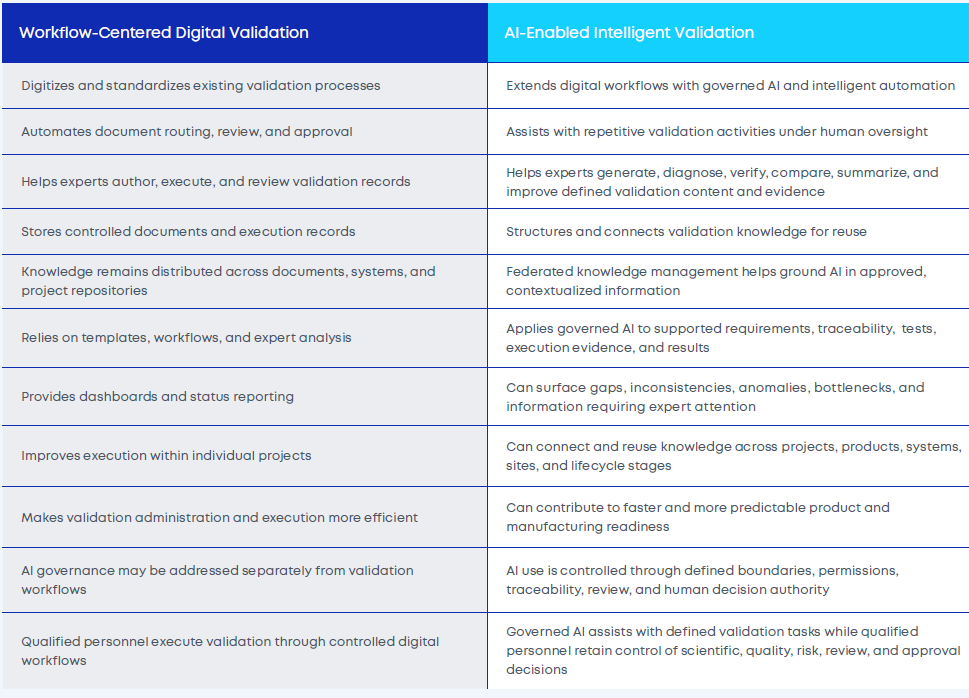
Digitizing Validation Is Not the
Same as Transforming It
Digital validation established the foundation by improving
how organizations manage workflows, records, execution,
approvals, and traceability.
AI-enabled intelligent validation can extend that
foundation by reducing repetitive effort, making
knowledge more reusable, and helping experts analyze
validation information more efficiently.
The comparison table below illustrates how AI-enabled
intelligent validation can build on the capabilities
established through workflow-centered digital validation.
Conclusion
The future of validation is not autonomous validation. It is a more connected and intelligent
model in which governed AI and automation support experts, institutional knowledge becomes
reusable, and validation contributes more directly to product and manufacturing readiness.
For executive teams, preparing for what comes next starts with reassessing what they expect
from their validation strategy—and whether their current technology environment is equipped
to meet those expectations.
The organizations best positioned for that future are those that combine digital validation
maturity with governed AI, connected lifecycle knowledge, and a technology partner
committed to continued validation innovation.
Table of Contents


