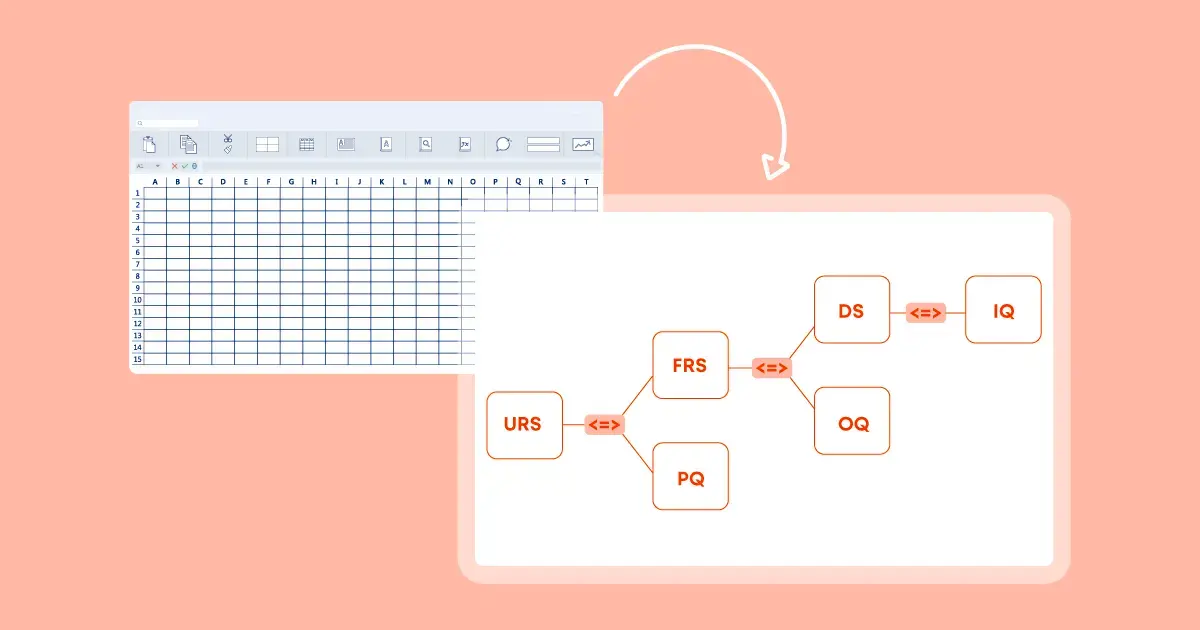
The requirements traceability matrix (RTM) plays a critical role in validation within the life sciences. It links requirements to their corresponding test protocols, ensuring your team effectively verifies all system requirements.
The RTM is usually developed in conjunction with the initial list of requirements. As your design specifications and test protocols evolve, you need to update the matrix to include the latest documents. Ideally, each requirement should be traced to the specific test step where it is verified.
The Hidden Costs of Manual RTMs
Despite its importance, keeping your RTM up to date and aligned with evolving system requirements can be challenging. Manual methods introduce inefficiencies, increase compliance risks, and require significant resources to maintain.
If you’re still using spreadsheets or paper to track requirements, you're likely dealing with a process that’s time-consuming and prone to errors. Maintaining an RTM manually isn’t just inefficient—it’s expensive. Here's why:
- Excessive resource commitment—Your validation team spends too much time updating and maintaining traceability instead of focusing on strategic initiatives.
- Audit preparation headaches—Compiling traceability data manually for audits leads to inconsistencies and last-minute corrections.
- Lost or mismanaged data—Paper-based or spreadsheet-driven processes increase the risk of misplaced or outdated records, which can result in citations, fines, or even product recalls.
The Challenges of Manual Requirements Traceability Methods
If your organization relies on manual RTM methods, you may struggle to maintain accurate requirement traceability throughout the system lifecycle. Many companies create a requirements traceability matrix during initial validation but fail to update it over time, increasing compliance risks and complicating audits.
Here are some of the most common challenges you might face:
- Human error—Copying and pasting data between spreadsheets often leads to inconsistencies, omissions, or duplication.
- Inefficient change management—Every time you update your system, manually adjusting the RTM to reflect new requirements and test protocols becomes a complex, error-prone task.
- Lack of real-time visibility—Without automation, it’s difficult to identify gaps in test coverage or track relationships between requirements and verification steps.
- Compliance risks—An outdated or incomplete RTM raises red flags during audits and increases your regulatory exposure.
Digital Requirements Management with ValGenesis iVal™
Instead of managing an RTM manually, you can use ValGenesis iVal™ to automate the process, dynamically generate traceability matrices, and update them in real time as your requirements and test cases change.
The application also allows you to view the traceability between documents for completeness before routing them for review and approval, significantly reducing authoring time.
Together, these capabilities modernize and simplify how teams manage traceability:
- Generate traceability matrices dynamically—Eliminate the need for manual tracking.
- Perform coverage analysis instantly—Quickly view relationships between related items.
- Link requirements at the test step level—Ensure precise traceability and validation coverage.
- Map complex relationships—Support one-to-many, many-to-one, and many-to-many relationships to meet your validation needs.
- Maintain forward and backward traceability—Track requirements across all stages.
- Streamline approval workflows—Speed up review cycles.
- Reflect changes in real time—Ensure your RTM is always up to date.
- Improve compliance and audit readiness—Minimize risk and eliminate last-minute corrections.
Ready to Move Beyond Spreadsheets?
Automating your RTM isn’t just about saving time and effort—it’s a crucial step toward modernizing your validation processes. With the ability to generate a complete, real-time trace matrix at the push of a button, you can assure stakeholders and regulators that your validation practices are audit ready.
If you’re still relying on spreadsheets or paper-based RTMs, now is the time to digitalize your validation activities.