
A reviewer opens an executed protocol. Most test steps look familiar. Values fall within expected ranges. Attachments are present, and the required execution signatures have been applied. After several pages, the work becomes a steady sequence of checking, comparing, and confirming.
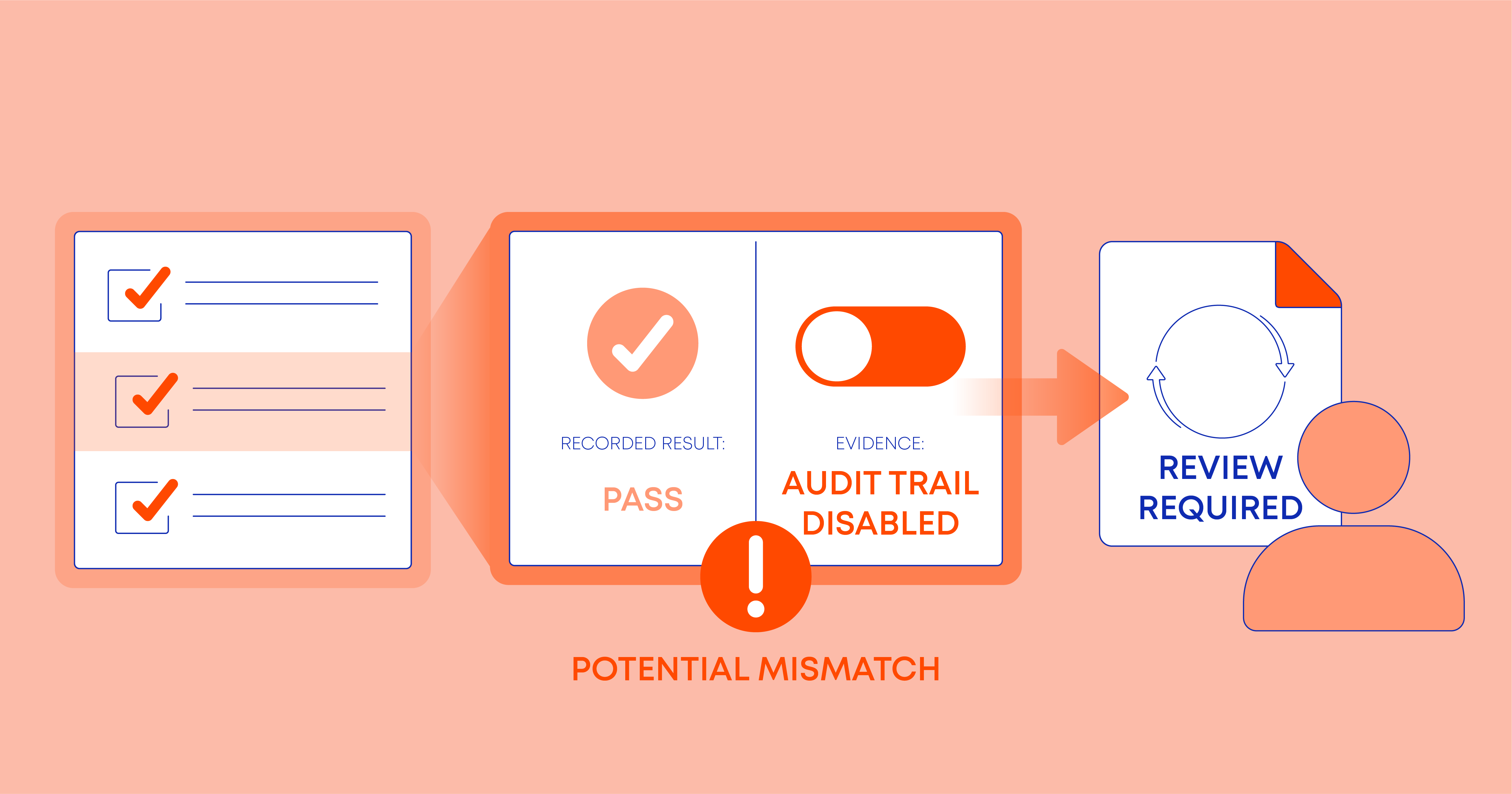
Then comes a step marked passing. The entered result looks reasonable, but the attached screenshot shows a different value. The discrepancy is small, the surrounding steps are correct, and the evidence is one of many similar files. It is exactly the kind of anomaly that manual review can miss.
Why Manual Review Misses Validation Anomalies
Manual review combines two different activities. The first is verification: Does the recorded result meet the acceptance criterion? Does the evidence support the entry? Are the value, unit, and outcome consistent? The second is evaluation: Does an unexpected result matter? What is its potential quality or patient impact? Is further testing, investigation, or deviation handling required?
Evaluation depends on the context and judgment of qualified validation professionals. Repetitive comparisons across hundreds of similar results and attachments, however, can make it difficult to maintain the same level of attention throughout the review.
Several conditions increase the likelihood of an anomaly being missed:
-
Repetition hides small differences. When most entries are correct, reviewers may read what they expect to see rather than what is actually recorded.
-
Evidence is separated from the result. Reviewers may have to open an attachment, locate the relevant information, return to the test step, and repeat the process many times.
-
Review is interrupted. Handoffs, competing priorities, and multiple open protocols make it difficult to preserve context between review sessions.
-
Review occurs after execution. By the time a question is raised, the executor may no longer remember the system state, sequence of actions, or reason a particular file was attached.
-
Review emphasis varies. One reviewer may focus on acceptance criteria, another on good documentation practices, and another on evidence completeness.
These conditions reflect the limitations of a review model that requires validation professionals to spend significant time on repetitive comparisons. Anomalies are not always obvious test failures. A step may be marked as passing even though part of the record does not agree. Examples include:
-
An executed result that differs from the value shown in the supporting evidence
-
A pass designation that does not agree with the acceptance criterion
-
A value recorded with the wrong unit or an unexpected decimal position
-
Evidence attached to the wrong step or taken from the wrong record or system state
-
A missing, duplicated, unreadable, or incomplete attachment
-
A timestamp, sequence, or related entry that does not align with the execution record
None of these automatically proves that the validated system, equipment, or process failed. Each is a signal that the record requires closer review. Verification should identify the potential inconsistency; qualified validation professionals determine its significance and the appropriate response.
Moving Verification Closer to Execution
In many validation workflows, detailed review begins after execution is complete. By then, the protocol may have changed hands, the test environment may have been reset, and the executor may already be working on another activity. When a discrepancy is identified, the team must reconstruct the original context before determining what happened and whether additional action is required.
Automated verification can move this first level of checking closer to execution. It can compare recorded results with defined expectations, examine whether the evidence supports the entry, and identify conflicts between the evidence and the selected outcome. If a potential mismatch is detected while the execution context is still available, it can be reviewed before the record advances.
Instead of having to discover every anomaly through line-by-line comparison, the reviewer is directed to the affected step, the potential inconsistency, and the supporting evidence. Identifying potential mismatches earlier allows them to be reviewed before final review, when reconstructing the execution context may be more difficult.
Where Automation Helps and Where Human Judgment Remains
Automated verification is not one technique applied to every validation record. The appropriate method depends on what needs to be checked and the form in which the information is available.
Structured conditions can often be verified through deterministic rules. A required field is either complete or incomplete. A numeric result either falls within a defined range or it does not. A selected outcome either agrees with the configured acceptance criterion or it does not. These checks can be stated precisely and performed consistently.
Other checks require more context. A screenshot may contain the expected value but refer to the wrong record or system state. An attachment may be present but may not demonstrate the action described in the test step. A free-text response may appear acceptable while failing to address what the protocol required. AI-assisted comparison can help examine these less structured relationships and flag possible inconsistencies for review.
The approach should follow the verification need:
-
Use deterministic rules for conditions that can be defined and evaluated precisely from structured data.
-
Use AI-assisted checks when the comparison depends on unstructured text, images, or relationships that cannot be reduced to a simple rule.
-
Use workflow controls when the requirement concerns sequence, role, completion, or approval.
-
Use qualified validation professionals when significance, risk, rationale, corrective action, or disposition must be determined.
Automated verification can identify that information does not appear to agree, but it should not determine product or patient impact, decide whether a deviation is required, close a deviation, or approve the validation record. Qualified personnel remain responsible for assessing the flag, determining the appropriate response, and making approval decisions.
This approach uses automation for repeatable comparisons while preserving human control over decisions that require professional judgment. It also allows validation professionals to spend less time searching for discrepancies and more time evaluating their implications.
What Makes Automated Verification Defensible
Automation does not remove the need for control. The verification function must have a defined intended use, understood limitations, risk-based assurance, and evidence that it performs as intended.
FDA’s computer software assurance guidance describes a risk-based approach for establishing confidence in automation used in medical device production and quality management systems. It also recognizes continuous performance and data monitoring as methods that can help maintain a validated state and detect issues or anomalies after implementation (U.S. Food and Drug Administration, 2026). EU GMP Annex 11 states that critical data entered manually should receive an additional accuracy check, which may be performed by a second operator or validated electronic means, with the approach based on criticality and potential consequences (European Commission, 2011).
A defensible automated verification approach should address:
-
Defined intended use: Specify what the function checks, where it is used, which records and evidence types it supports, and which decisions remain outside its scope.
-
Risk-based coverage: Prioritize checks where a missed anomaly could affect data integrity, validation conclusions, product quality, or patient safety.
-
Traceable context: Preserve the relationship among the acceptance criterion, executed result, supporting evidence, applicable version, and generated flag. The Medicines and Healthcare products Regulatory Agency (MHRA, 2018) emphasizes that metadata provide the context and meaning needed to understand a record throughout its lifecycle.
-
Reviewable outputs: Show what was flagged and provide access to the underlying result and evidence. Reviewers should be able to understand why an item requires attention.
-
Controlled handling: Define how potential anomalies are reviewed, documented, corrected, escalated, or routed into deviation and investigation processes.
-
Ongoing performance monitoring: Track confirmed anomalies, dismissed flags, missed issues, configuration changes, and changes in the formats or evidence the function evaluates.
Initial testing alone does not establish that the verification function will continue to perform reliably over time. Changes to acceptance criteria, protocol templates, interfaces, evidence formats, prompts, or models can affect its performance. Representative testing and periodic evaluation help confirm that the function continues to perform as intended.
The rollout should also avoid creating alert fatigue. Teams should begin with clearly defined verification activities focused on repetitive or time-consuming comparisons, or on steps where a missed anomaly could affect data integrity or the validation conclusion. For each check, they should identify the controlled source, define the required human review process, and monitor whether the resulting flags are accurate and useful.
From Line-by-Line Review to Exception-Focused Review
ValGenesis iVal™ provides a controlled digital environment for validation execution, evidence capture, review, and approval. By keeping acceptance criteria, executed results, evidence, metadata, and workflow status within the same governed process, iVal provides the context needed to evaluate a potential anomaly, reducing the need to manually reconcile across separate files and systems.
VAL™, the ValGenesis AI validation assistant, is designed to work within iVal’s governed validation workflows. It uses the controlled execution context to cross-check executed results, verify supporting evidence, and flag potential inconsistencies for review during execution before the protocol reaches final review. Qualified validation professionals remain in control. They assess whether the flag represents a valid issue, determine its significance, initiate the appropriate controlled process, and make the final approval decision. Automated verification supports the review; it does not replace the reviewer.
This creates a more focused review model. Routine comparisons can be performed consistently, while validation professionals concentrate on exceptions, risk, and decisions requiring scientific and procedural judgment.
Earlier Signals, Better Decisions
Validation anomalies can be missed because manual review has practical limits, not because reviewers lack diligence. Large records, repetitive comparisons, separated evidence, and late-stage review make subtle inconsistencies difficult to identify consistently.
A controlled digital validation environment can bring acceptance criteria, executed results, evidence, metadata, and workflow status into the same process. Automated and AI-assisted verification can use that context to identify potential mismatches earlier and direct reviewers to the affected step and supporting evidence.
Automated verification creates a more focused review process, directing validation professionals to potential discrepancies so they can assess their significance, manage exceptions, and make informed validation decisions.
Explore more on AI-powered validation
Learn how governed AI can support validation and qualification while maintaining human oversight, traceability, and compliance.


Table of Contents


Related Blog Posts

.webp)
.webp)